
Let’s know from Dr. Jignesh Gala Senior Eye Surgeon at Crystal Clear Eye Hospital.
Are you planning to have cataract surgery? If so, you may have two surgical options:
Traditional cataract surgery is one of the most common surgeries in the world. It is recognized as being safe and effective. Laser cataract surgery is not covered by most insurance plans. It costs more than traditional cataract surgery as well. In specific situations, it may provide some advantages. So how do you decide which type of cataract surgery to have?
Here are some things you should understand about both kinds of cataract surgery. Talk with Dr.Jignesh Gala at Crystal Clear Eye Hospital at Andheri west about which is best for you. Feel free to get another eye surgeon’s opinion as well.
How Is Traditional Cataract Surgery Done?
Phacoemulsification is the name for traditional cataract surgery. Dr.Jignesh Gala creates a small incision in your cornea by hand with a scalpel. He insert a small instrument through this opening. It goes behind your pupil where the eye’s lens sits in a capsule. Dr.Jignesh Gala Eye surgeon creates a round opening in the capsule. Then Dr.Jignesh Gala Eye surgeon inserts a pen-shaped probe through that opening. The probe applies sound waves (ultrasound) to break up the cloudy lens. Then Dr.Jignesh Gala Eye surgeon suctions out the broken-up pieces. He replaces your lens with an artificial intraocular lens (IOL). The incision is self-sealing and usually does not need stitches.
What are the main differences between traditional and laser-assisted cataract surgery?
Traditional cataract surgery involves creating a small incision in the cornea with a scalpel and using ultrasound to break up the cloudy lens, whereas laser-assisted cataract surgery utilizes a computer-programmed laser to make precise incisions and soften the lens, which can improve accuracy and outcomes, especially with premium intraocular lenses.
Who is a suitable candidate for laser-assisted cataract surgery?
Candidates suitable for laser-assisted cataract surgery are those in whom astigmatism is detected during consultation and who desire correction of it during cataract removal, and also those opting for premium lenses like toric or multifocal IOLs, provided they meet specific eligibility criteria set by Medicare guidelines.
Can patients have laser cataract surgery if their condition doesn’t meet the eligibility criteria?
No, patients who do not meet the specific eligibility conditions set by Medicare guidelines are not eligible for or cannot be charged for laser cataract surgery.
Does laser cataract surgery have a shorter recovery time compared to traditional surgery?
No, both types of cataract surgery have similar recovery times, with many patients experiencing clear vision within a week or two, and a full recovery typically taking about three months.
What are the benefits of choosing laser cataract surgery?
Laser cataract surgery offers benefits such as more precise and quicker incisions, improved accuracy in placing the intraocular lens, and the ability to correct astigmatism and softening the lens with laser energy, although it does not necessarily reduce the risk of complications or improve outcomes compared to traditional surgery.
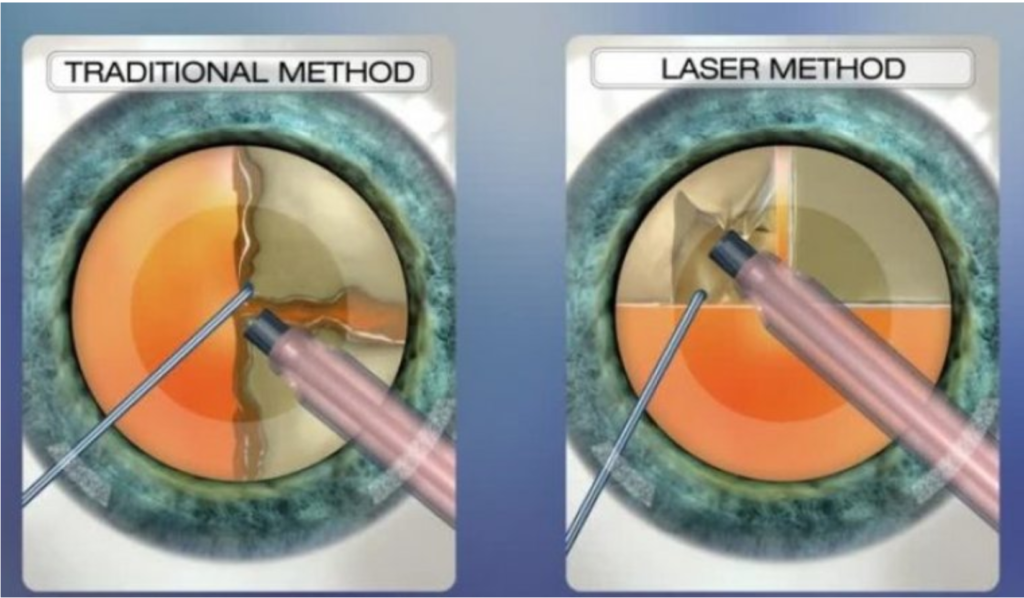
How Is Laser-Assisted Cataract Surgery Done?
A camera/ultrasound device is placed over your eye to map its surface. It also gathers information about your lens. The device sends the results to a computer that programs the laser. This tells the laser the exact location, size, and depth for incisions. Dr.Jignesh Gala Eye Surgeon may use the laser to make the corneal incision and the opening in the capsule. He may also use energy from the laser to soften the cataract. An ultrasound probe breaks the lens into pieces and suctions them out. Dr.Jignesh Gala Eye Surgeon then puts the IOL in the eye. Again, the incision usually does not need stitches.
To Whom Can Ophthalmologists Offer Laser-Assisted Cataract Surgery?

Medicare guidelines determine who can get this laser surgery. Only certain patients qualify for it.
Dr.Jignesh Gala Eye Surgeon can offer laser-assisted cataract surgery if:
- they find astigmatism during your consultation, and
- you want it corrected during cataract surgery.
In this situation, the laser creates specific incisions in the cornea to reshape it. This corrects your astigmatism.
Dr.Jignesh Gala Eye Surgeon (https://www.youtube.com/watch?v=F9D4X4bhoKk) can also offer laser surgery if you choose a premium lens. For example, this may be a toric or multifocal IOL that corrects astigmatism. Laser cataract removal allows surgeons to see and map the lens capsule better. It also helps him to place the opening in the capsule more precisely. This allows for better centering of the IOL, which is important when a premium lens is used.
Can You Have Laser Cataract Surgery if You Don’t Meet the Conditions?
If you don’t meet at least one condition, a surgeon cannot offer or charge for the laser surgery.
Which Type of Cataract Surgery Has a Shorter Recovery Time?
The recovery time for both types of surgery is the same. Some people can see clearly almost immediately. Others may find their vision clears within a week or two. It takes about 3 months to fully recover from cataract surgery.
What Benefits Does Laser Cataract Surgery Offer?
Using a laser allows the surgeon to make precise incisions in less time. It can improve accuracy and consistency. In some cases, the laser can provide more correction than traditional surgery. The laser can reduce the amount of ultrasound energy needed to soften the lens prior to removal.
However, studies do not show that laser surgery results in fewer complications. Also, studies haven’t found that laser surgery provides better outcomes. Your outcome depends in large part on the skill and experience of your surgeon.
What Do You Want From Cataract Surgery?
Replacing a cloudy lens and wearing glasses for some things is perfect for many people. For others, getting the best possible vision without glasses is the goal. You and Dr.Jignesh Gala Eye Surgeon can decide the best option for you based on your needs.
Consult Dr.Jignesh Gala Eye Surgeon for your cataract consultation. He practices in andheri west, Mumbai.
Contact Crystal Clear Eye Hospital – Andheri West
Crystal Clear Eye Hospital
B 125, Laram Centre, S V Road,
Andheri West, Mumbai, Maharashtra
Phone: +91 7718885245
Website: www.crystalcleareye.in
Patient Reviews for Dr Jignesh Gala,
- https://www.youtube.com/shorts/AduDOdvl_ZQ,
- https://www.youtube.com/shorts/cp2i4uyoDFM,
- https://www.youtube.com/shorts/b3AUchy2O9Y,
- https://www.youtube.com/shorts/ygONyydMxF4,
- https://www.youtube.com/shorts/8B_YeEIxrSA,
- https://www.youtube.com/shorts/xMKyIThUy-Y,
- https://www.youtube.com/watch?v=kzOlvpQF9wo
