Refractive surgery has evolved significantly over the past decade, with two premium platforms now competing for clinical attention: the SCHWIND AMARIS system with SmartSurfACE/CustomEyes (SCHWIND eye-tech-solutions, Germany) and the WaveLight Plus InnovEyes system (Alcon, USA). Both represent advanced customized approaches to laser vision correction, but they differ fundamentally in laser engineering, treatment philosophy, and clinical data profiles.
Thank you for reading this post, don't forget to subscribe!This comparison is based on peer-reviewed literature, FDA premarket approval data, and manufacturer technical specifications—not marketing claims.
1. Technology Platforms: Different Philosophies
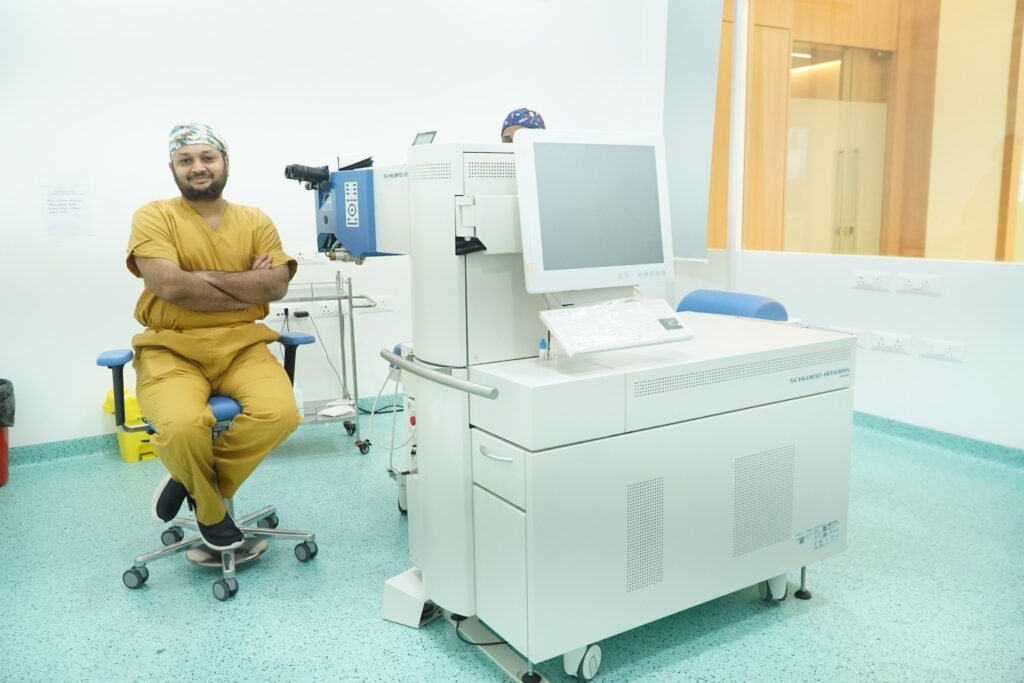
SmartSurfACE/CustomEyes (SCHWIND AMARIS)
The SCHWIND AMARIS platform offers two distinct modalities:
- SmartSurfACE: A touchless, single-step transepithelial surface ablation (TransPRK) where the excimer laser removes the epithelium and corrects refractive error without mechanical contact, suction, or flap creation. The laser uses SmartPulse technology to create a smooth stromal surface, and the Intelligent Thermal Effect Control (ITEC) algorithm distributes pulses to keep corneal temperature rise below 5°C .
- CustomEyes: A wavefront-guided or corneal wavefront-guided treatment that integrates data from the SCHWIND PERAMIS ocular aberrometer and MS-39 anterior segment OCT. It uses a 0.54 mm Super-Gaussian spot profile—the smallest beam among clinically available excimer lasers—and operates at up to 1050 Hz on the AMARIS 1050RS model .
The system employs 7D eye tracking (x, y, rolling, cyclotorsion, z-axis, and latency-free prediction) with a 1050 Hz acquisition rate and approximately 1.6 ms latency
.
WaveLight Plus InnovEyes (Alcon)
WaveLight Plus InnovEyes is a ray tracing-guided LASIK (RT-LASIK) platform built on the WaveLight EX500 excimer laser (500 Hz). Its distinguishing feature is the InnovEyes Sightmap, a single diagnostic device that captures biometry, keratometry, pachymetry, topography, and wavefront refraction. This data generates an EyeVatar—a 3D digital eye model used to simulate light ray propagation through the entire optical system before surgery
.
The EX500 uses a 1050 Hz eye tracker with 2 ms latency and can create optical zones up to 6.5 mm with transition zones up to 3.0 mm
.
2. Clinical Outcomes: What the FDA Data Shows
A 2025 comparative analysis of FDA premarket approval trials directly compared outcomes between topography-guided LASIK (Alcon’s earlier platform) and ray tracing-guided LASIK (WaveLight Plus InnovEyes) for myopia and myopic astigmatism
.
Visual Acuity:
- Uncorrected distance visual acuity (UDVA) of 20/20 or better at 12 months: 92.6% (TG-LASIK) vs. 94.4% (RT-LASIK)—no statistically significant difference.
- UDVA of 20/16 or better: 64.8% vs. 70.2%—also not statistically different.
- However, more TG-LASIK eyes achieved 20/12.5 or better (34.4% vs. 26.4%) and 20/10 or better (15.7% vs. 2.5%), both statistically significant .
Refractive Predictability:
- Both platforms exceeded FDA safety thresholds.
- For spherical equivalent within ±0.50 D, both platforms performed comparably in myopic cohorts.
- For preoperative cylinder between -1.00 D and -4.00 D, RT-LASIK showed significantly greater astigmatic overcorrection compared to TG-LASIK .
Contrast Sensitivity:
- At 3 months, RT-LASIK demonstrated higher mesopic contrast sensitivity at 3, 6, and 12 cycles per degree under glare conditions, with more eyes achieving clinically significant gains compared to TG-LASIK .
Aberrations:
- RT-LASIK reduced spherical aberration from baseline.
- Both platforms induced changes in total higher-order aberrations, though these were not clinically significant .
Important caveat: This study compared topography-guided LASIK to ray tracing-guided LASIK, not CustomEyes specifically. Direct comparative trials between SCHWIND CustomEyes and WaveLight Plus InnovEyes remain limited in the peer-reviewed literature.
3. Laser Engineering and Safety Features
Table
| Feature | SCHWIND AMARIS 1050RS | Alcon WaveLight EX500 |
|---|---|---|
| Repetition Rate | 1050 Hz | 500 Hz |
| Spot Size (FWHM) | 0.54 mm | ~0.9 mm (reported) |
| Eye Tracker Rate | 1050 Hz | 1050 Hz |
| Tracking Dimensions | 7D (including latency-free prediction) | 5D/6D |
| Latency | ~1.6 ms | ~2 ms |
| Thermal Control | ITEC algorithm | Standard distribution |
| Surface Ablation | SmartSurfACE (touchless TransPRK) | PRK/LASEK available |
| Flap-Based LASIK | Yes | Yes |
The SCHWIND platform’s higher repetition rate and smaller spot size theoretically allow for finer ablation profiles and shorter treatment times, particularly for high myopia. The SmartSurfACE option is unique in offering a truly touchless, no-suction surface ablation, eliminating flap-related risks entirely
.
4. Patient Selection Considerations
Neither platform is universally superior; selection depends on individual anatomy and goals:
SCHWIND SmartSurfACE/CustomEyes may be preferable when:
- Corneal thickness is borderline (surface ablation preserves more stromal tissue)
- Dry eye or contact lens intolerance is present (avoiding flap creation reduces neurotrophic effects)
- The patient engages in contact sports or has occupational flap-risk factors
- Higher myopia requiring efficient ablation (1050 Hz speed)
WaveLight Plus InnovEyes may be preferable when:
- Complex higher-order aberrations require whole-eye optical modeling
- Mesopic contrast sensitivity is a priority (demonstrated advantage in FDA trials)
- The patient has adequate corneal thickness for flap-based LASIK
- The surgeon has specific nomogram experience with the EX500 platform
5. Regulatory Status
- SCHWIND AMARIS: The AMARIS 1050RS and earlier models have FDA clearance for LASIK and surface ablation treatments in the United States .
- WaveLight Plus InnovEyes: Received FDA premarket approval (P020050/S043) for ray tracing-guided myopic LASIK using the EX500 and InnovEyes Sightmap .
Both platforms meet international safety standards, though availability varies by region and clinic infrastructure.
6. Clinical Practice Context: Mumbai
In Mumbai, refractive surgeons have adopted both platforms. Dr. Jignesh M. Gala, a vitreoretinal and cataract surgeon practicing at Crystal Clear Eye Clinic in Andheri West, performs bladeless LASIK using the SCHWIND AMARIS excimer laser system with 7D eye tracking and SmartPulse technology, alongside CSO Sirius+ Scheimpflug screening for candidate selection
.
Dr. Gala’s credentials include FRCS (Glasgow), MRCS (Edinburgh), subspecialty fellowship training at L V Prasad Eye Institute, and peer-reviewed publications in BMJ Case Reports and the Indian Journal of Ophthalmology. His practice emphasizes continuity of care with personal evaluation, surgery, and follow-up by the same surgeon
.
Crystal Clear Eye Clinic is rated approximately 4.8/5 based on public review aggregators, with patient feedback noting detailed consultations and transparent pricing structures
.
7. Summary
Both the SCHWIND AMARIS (SmartSurfACE/CustomEyes) and WaveLight Plus InnovEyes platforms represent legitimate, FDA-reviewed advances in customized refractive surgery. The choice between them should rest on:
- Individual corneal anatomy (thickness, curvature, epithelial profile)
- Aberration profile (corneal vs. whole-eye optical errors)
- Lifestyle factors (contact sports, night driving, screen use)
- Surgeon expertise and nomogram refinement on a specific platform
- Patient preference regarding flap vs. flapless approaches
The peer-reviewed FDA trial data suggests trade-offs, not categorical superiority: WaveLight Plus InnovEyes showed advantages in mesopic contrast sensitivity under glare, while the topography-guided platform in the same study achieved higher rates of 20/10 and 20/12.5 vision and less astigmatic overcorrection in higher-cylinder patients
.
Patients considering either technology should undergo comprehensive preoperative diagnostics including topography, tomography, aberrometry, and pachymetry, and select a surgeon with documented experience on their chosen platform.
Disclaimer: This article is for educational purposes only and does not constitute medical advice. Refractive surgery outcomes depend on individual candidacy, surgeon skill, and postoperative care. Consult a qualified ophthalmologist for personalized recommendations.
Book your SmartSurf with CustomEyes consultation today with Dr. Jignesh Gala — Mumbai’s trusted name in advanced refractive surgery. Call +91 77188 85245 WhatsApp Now crystalcleareye.in
Visit Us — Conveniently Located in Western Mumbai
Crystal Clear Eye Hospital (Andheri West): B-125, Laram Centre, Ground Floor (Behind Sunil Jewellers), S.V. Road, Opposite Andheri West Railway Station, Andheri West, Mumbai – 400058
Topax Eye Hospital (Vile Parle East) — for SmartSurf with CustomEyes: Vile Parle East, Mumbai
Phone / WhatsApp: +91 77188 85245
Website: www.crystalcleareye.in
Specialities: LASIK & Specs Removal Surgery, Cataract Surgery, Retina & Vitreoretinal Surgery, Glaucoma Treatment, Diabetic Retinopathy, Paediatric Ophthalmology, ROP Screening, Squint, Dry Eye Care.
Areas We Serve: Andheri West, Andheri East, Vile Parle East, Vile Parle West, Santacruz East, Santacruz West, Khar, Bandra, Juhu, Goregaon, Malad, Borivali, Jogeshwari, Versova, Lokhandwala, BKC, Powai, Dadar, Mahim and across Mumbai.
© 2026 Dr. Jignesh Gala | Crystal Clear Eye Hospital & Topax Eye Hospital, Mumbai. This article is for educational purposes. Individual surgical candidacy and outcomes vary and require an in-person evaluation.