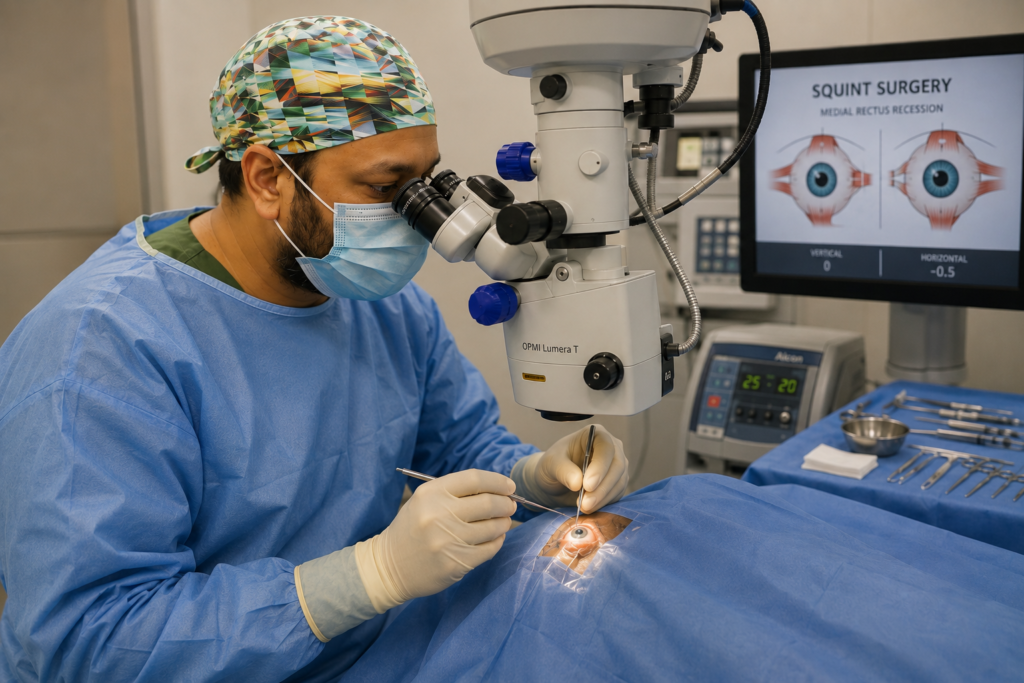
Expert Squint Surgery for Children & Adults in Mumbai
Specialised strabismus correction by Dr. Jignesh Gala – Mumbai’s trusted squint surgeon. From infants to adults, we treat all types of squint with advanced surgical techniques and comprehensive care.

All Ages Treated | Cashless Available
What is Squint (Strabismus)?
Squint, medically known as strabismus, is a condition in which the eyes do not properly align with each other when looking at an object. While one eye looks straight ahead, the other eye may turn inward, outward, upward, or downward. This misalignment can be constant or intermittent and may affect one or both eyes.
Squint is one of the most common eye conditions in children, affecting approximately 4-5% of the Indian population. However, it can also develop in adults due to various medical conditions, trauma, or neurological issues. Beyond the cosmetic concern, untreated squint can lead to serious vision problems including lazy eye (amblyopia) and permanent loss of 3D vision (stereopsis).
At Crystal Clear Eye and Topax Eye Care, Dr. Jignesh Gala has successfully treated thousands of squint patients across all age groups – from infants as young as 6 months to adults in their 60s – restoring both alignment and functional vision.
Types of Squint by Direction
👁️ Esotropia (Inward Turn)
One eye turns inward toward the nose. This is the most common type of squint in children and can be congenital (present at birth) or accommodative (related to focusing effort and glasses).
👀 Exotropia (Outward Turn)
One eye turns outward toward the ear. Often starts as intermittent (visible when tired or daydreaming) and may become constant over time if untreated.
🔝 Hypertropia (Upward Turn)
One eye turns upward relative to the other. This is less common and often associated with specific muscle weakness (cranial nerve palsy) or mechanical restriction.
🔟 Hypotropia (Downward Turn)
One eye turns downward relative to the other. May occur due to muscle weakness, thyroid eye disease, or orbital floor fractures.
Common Causes of Squint
- Genetic/hereditary factors (family history of squint)
- Refractive errors (high hyperopia, myopia, astigmatism)
- Poor vision in one eye (amblyopia)
- Cranial nerve palsy (III, IV, VI nerve)
- Thyroid eye disease (Grave’s disease)
- Trauma or head injury
- Brain tumours or neurological conditions
- Myasthenia gravis (neuromuscular disorder)

Strabismus affects approximately 4% of children worldwide. In India, the prevalence is estimated at 5-8% in some regions due to higher rates of uncorrected refractive errors. Early detection and treatment before age 7 offers the best chance for developing normal binocular vision and 3D perception.
Types of Squint by Age Group
Understanding the type of squint is crucial for determining the right treatment approach. Dr. Jignesh Gala evaluates each patient thoroughly to classify the squint and recommend the most effective treatment plan.
👶 Congenital/Infantile Esotropia (Present within 6 months)
This is a large-angle inward squint that appears within the first 6 months of life. It is not associated with significant refractive error and does not improve with glasses. Surgery is typically the primary treatment and is ideally performed between 6-18 months of age. Early surgery gives the child the best chance to develop normal binocular vision and 3D perception. Dr. Gala performs a detailed examination under anesthesia to measure the exact deviation and plan the muscle surgery.
🧒 Accommodative Esotropia (Age 2-3 years)
This type of squint develops around 2-3 years of age and is closely related to uncorrected hyperopia (farsightedness). When the child focuses to see clearly, the eyes turn inward. Wearing the correct glasses often fully corrects the squint. Some children may need bifocal glasses. Surgery is reserved for cases where glasses correct only part of the squint (partially accommodative) or where the child cannot wear glasses consistently. Regular follow-ups are essential as the prescription changes with growth.
😶 Intermittent Exotropia (Outward drift)
The most common type of squint in older children, where one eye drifts outward, especially when the child is tired, daydreaming, or looking into the distance. It often starts intermittently and may become constant. Treatment options include vision therapy exercises, minus lens glasses, and prism therapy. Surgery is recommended if the exotropia is becoming more frequent, affecting 3D vision, or causing social/psychological issues. Dr. Gala carefully monitors the progression to determine optimal surgery timing.
🧑💼 Adult-Onset Squint
Squint that develops in adulthood is often associated with underlying medical conditions. Common causes include thyroid eye disease, trauma, cranial nerve palsy (III, IV, VI nerves), myasthenia gravis, brain tumours, stroke, and post-surgical complications. Adult squint often causes double vision (diplopia) which can be debilitating. Treatment addresses the underlying cause first, followed by prism therapy, Botox injections, or surgery depending on the case. Dr. Gala works closely with neurologists and endocrinologists for comprehensive care.
🧠 Paralytic Strabismus (Cranial Nerve Palsy)
Caused by dysfunction of the third (oculomotor), fourth (trochlear), or sixth (abducens) cranial nerves that control eye movement. Sixth nerve palsy causes inability to move the eye outward. Fourth nerve palsy causes upward deviation and head tilt. Third nerve palsy is the most serious, affecting multiple eye muscles and potentially involving the pupil. Causes include diabetes, hypertension, trauma, brain aneurysm, and intracranial tumours. Urgent neuro-ophthalmic evaluation is essential. Treatment may include observation (some cases resolve spontaneously), prism glasses, Botox, or surgery once stable.
A squint that appears suddenly in an adult, especially with double vision, headache, or other neurological symptoms, can be a sign of a serious underlying condition such as stroke, brain aneurysm, or tumour. Seek immediate medical attention. Dr. Jignesh Gala provides urgent evaluation and coordinates with neurologists and neurosurgeons when needed. Call 077188 85245 for emergency appointments.
Why Squint Should Be Treated
Many parents mistakenly believe that squint is only a cosmetic issue and that their child will “outgrow” it. This is a dangerous misconception. Untreated squint can cause permanent, irreversible vision loss and significant psychosocial impact.
Lazy Eye (Amblyopia)
When the eyes are misaligned, the brain receives two different images. To avoid confusion, the brain suppresses (ignores) the image from the deviated eye. Over time, this leads to permanent vision loss in the affected eye that cannot be corrected with glasses. The critical period for treatment is before age 7.
Loss of 3D Vision
Normal depth perception (stereopsis) requires both eyes to work together. Squint disrupts binocular vision, preventing the development of 3D vision in children and causing loss of depth perception in adults. This affects activities like driving, playing sports, and judging distances. Early treatment offers the best chance for 3D vision recovery.
Psychosocial Impact
Children with visible squint often face teasing, bullying, and social isolation. They may develop low self-esteem, anxiety, and depression. Adults with squint may experience professional and social difficulties. Correcting the eye alignment restores not just vision but also confidence and quality of life.
Underlying Disease
In adults, new-onset squint can indicate serious neurological conditions including brain tumour, stroke, aneurysm, thyroid disease, or myasthenia gravis. Ignoring the squint may delay diagnosis of a life-threatening condition. Comprehensive evaluation by Dr. Gala includes ruling out these causes.
Abnormal Head Posture
Many squint patients develop compensatory head tilts or turns to avoid double vision. Over years, this can cause neck problems, facial asymmetry, and social awkwardness. Correcting the squint eliminates the need for abnormal head posture.
Window of Opportunity
The brain’s visual system is most plastic (able to adapt) during childhood. After approximately age 7-8, treatment becomes less effective for developing normal binocular vision. However, surgery can still improve alignment, appearance, and in some cases, fusion even in adults. The sooner treatment begins, the better the outcomes.
“No child is too young for a squint evaluation. I have operated on infants as young as 6 months with excellent results. Parents often delay thinking the child is too small for surgery – but early intervention gives the best chance for normal vision development. Similarly, adults with squint should not accept it as ‘too late’ – modern surgical techniques can achieve excellent alignment and functional improvement at any age. If you notice any eye misalignment in your child or yourself, book a consultation today.”
Squint Treatment Options
Dr. Jignesh Gala follows a structured treatment ladder, starting with the least invasive options and progressing to surgery when necessary. The choice of treatment depends on the type of squint, age of the patient, severity, and response to conservative measures.
🕶️ Glasses (First-Line Treatment)
For children with accommodative esotropia, wearing the correct glasses is often the only treatment needed. The glasses correct the hyperopia, eliminating the need for excessive focusing that causes the eyes to turn inward. It is essential that the child wears glasses full-time. Regular follow-ups are needed to update the prescription as the child grows. At Crystal Clear Eye, we partner with leading optical shops to provide high-quality pediatric frames.
🔭 Patching / Occlusion Therapy
Used to treat amblyopia (lazy eye) that often accompanies squint. The stronger eye is patched for a few hours daily, forcing the brain to use and develop the vision in the weaker eye. The duration of patching depends on the child’s age and severity. Patching is most effective before age 7 but can still help older children. Dr. Gala creates personalised patching schedules for each child.
▼ Prism Therapy
Fresnel prisms (thin plastic sheets) are added to glasses to bend light and help align the images from both eyes. Useful for small-angle squints, temporary squints (such as those after nerve palsy that may recover), and adults who cannot undergo surgery. Prisms can also be used preoperatively to assess fusion potential. Dr. Gala uses prism adaptation testing to predict surgical outcomes.
💉 Botox Injections
Botulinum toxin is injected directly into an overactive eye muscle, causing temporary weakness that allows the eyes to realign. Used for sixth nerve palsy, small-angle deviations, reoperations, and select adult cases. Effects last 3-4 months. May be repeated if needed. Botox is particularly useful when surgery needs to be delayed or when the squint is expected to resolve spontaneously.
Squint surgery is recommended when: 1) Glasses do not fully correct the squint (partially accommodative), 2) The squint is large-angle and not responding to conservative measures, 3) The squint is becoming more frequent (intermittent becoming constant), 4) Amblyopia treatment requires alignment first, 5) Double vision in adults is not manageable with prisms, 6) Cosmetically significant misalignment affecting self-confidence, 7) Abnormal head posture is developing. Dr. Jignesh Gala will discuss all options and recommend the best approach for your specific case. WhatsApp us to discuss your condition.
Squint Surgery Cost & Coverage
| Parameter | Details |
|---|---|
| Surgery Cost (per eye) | Rs. 20,000 – 35,000 depending on complexity and number of muscles |
| Both Eyes Same Day | Yes, bilateral surgery possible depending on case complexity |
| Anesthesia | General anesthesia for children | Local anesthesia with sedation for adults |
| Hospital Stay | Day-care (same day discharge) for most cases |
| Insurance Coverage | ✓ Covered under most health insurance policies |
| Cashless Available | ✓ Direct at Topax Eye Care | TPA at Crystal Clear Eye |
| Government Schemes | ✓ CGHS, ECHS, Ayushman Bharat covered |
| Family Floater for Children | ✓ Children’s squint surgery covered under parents’ family floater |
| Recovery Time | 3-5 days for normal activities; 4-6 weeks for full healing |
| Success Rate | 80-90% achieve satisfactory alignment after single surgery |
* Costs are indicative and may vary based on complexity, anesthesia type, and hospital. Cashless coverage is subject to policy terms and waiting period.
Squint Surgery Procedure
Squint surgery (strabismus surgery) involves adjusting the position or length of the extraocular muscles that control eye movement. Dr. Jignesh Gala performs this procedure with precision techniques to achieve optimal alignment and functional outcomes.

How Squint Surgery Works
The eye is moved by six extraocular muscles attached to the outer surface of the eyeball. In squint surgery, Dr. Gala adjusts these muscles to change the eye’s position:
▼ Muscle Recession (Weakening)
The muscle is detached and reattached further back from its original position. This weakens the muscle’s pull, used when a muscle is too strong. Common for medial rectus recession in esotropia.
▲ Muscle Resection (Strengthening)
A portion of the muscle is removed and the muscle is reattached at its original position. This strengthens the muscle’s pull, used when a muscle is too weak. Common for lateral rectus resection in esotropia.
📐 Adjustable Sutures (For Adults)
The muscle is attached with a special slip-knot suture that allows Dr. Gala to fine-tune the eye position within 24 hours after surgery while the patient is awake. This technique offers greater precision, especially for complex or reoperation cases.
🖥️ Transposition Procedures
In cases of paralytic strabismus (nerve palsy), muscles are repositioned to compensate for the paralysed muscle. Examples include Jensen’s procedure and Hummelsheim procedure for sixth nerve palsy.
Anesthesia by Age Group
👶 Children (Under 14 years)
General Anesthesia – The child is fully asleep throughout the procedure. A pediatric anesthesiologist monitors the child continuously. Pre-operative fasting instructions are provided. Parents can be with the child until the anesthesia takes effect. Most children can go home 3-4 hours after surgery once fully awake and stable.
- Completely pain-free during surgery
- Child has no memory of the procedure
- Allows precise measurements in uncooperative children
- Pediatric anesthesia team ensures safety
🧑💼 Adults (14+ years)
Local Anesthesia with IV Sedation – Numbing eye drops and local injection ensure a painless procedure. Mild sedation keeps the patient relaxed but awake. Adjustable sutures can be used with local anesthesia, allowing post-operative fine-tuning. The procedure is comfortable and patients can communicate with the surgical team.
- Faster recovery from anesthesia
- Enables adjustable suture technique
- Lower anesthesia risks compared to general
- Same-day discharge typical
What Happens During Surgery
Squint surgery may be performed on one eye (unilateral) or both eyes (bilateral) depending on the type and angle of squint. Bilateral surgery is common for large-angle esotropia where both medial rectus muscles need recession, or for certain types of exotropia. Unilateral surgery involves recessing one muscle and resecting the opposing muscle on the same eye. Dr. Gala determines the optimal surgical plan for each individual case. Both eyes can be operated on the same day.
Pediatric vs Adult Squint Surgery
While the surgical technique is similar, there are important differences in approach, goals, and outcomes between pediatric and adult squint surgery. Dr. Jignesh Gala tailors the treatment plan to each age group.
| Parameter | Pediatric Surgery | Adult Surgery |
|---|---|---|
| Ideal Age | 6 months – 7 years (earlier is better) | Any age (14 years and above) |
| Anesthesia | General anesthesia | Local anesthesia with sedation |
| Primary Goal | Develop normal binocular vision & 3D perception | Restore alignment, eliminate double vision, improve appearance |
| Adjustable Sutures | Not used (child is under GA) | Available – allows fine-tuning post-surgery |
| Pre-Op Assessment | May need examination under anesthesia (EUA) | Comprehensive office-based testing |
| Amblyopia Treatment | Patching needed before/after surgery | Usually not needed (amblyopia rarely new in adults) |
| Binocular Vision Recovery | Excellent potential (if early) | Variable – depends on history of prior alignment |
| Cosmetic Outcome Priority | Secondary to functional goals | Primary concern for many adults |
| Double Vision Risk | Low (brain adapts easily in children) | Higher (may need prism adaptation period) |
| Recovery Time | 3-5 days | 3-7 days |
| Reoperation Rate | 15-20% may need second surgery | 10-15% may need adjustment |
| Insurance Coverage | Family floater policy | Individual / family floater / corporate policy |
* Outcomes vary by individual case, type of squint, and compliance with follow-up care. Dr. Gala will discuss realistic expectations for your specific situation during consultation.
Why Choose Dr. Jignesh Gala?

Dr. Jignesh Gala is one of Mumbai’s most experienced squint surgeons, having treated over 162,000 patients and performed 25,780+ surgeries with exceptional outcomes in strabismus correction across all age groups.
World-Class Credentials
- FRCS Glasgow – Royal College of Physicians & Surgeons of Glasgow
- MRCS Edinburgh – Royal College of Surgeons of Edinburgh
- FICO London – Fellow of International Council of Ophthalmology
- Dual Fellowship from LV Prasad Eye Institute, Hyderabad
- 12+ years of dedicated ophthalmic surgical experience
Why Squint Patients Trust Dr. Gala
🏆 All Ages Expertise
From 6-month-old infants to 60+ adults, Dr. Gala has successfully corrected squints across all age groups with precision.
📐 Advanced Techniques
Adjustable sutures for adults, EUA for children, Hess charting, synoptophore assessment, and complex reoperations.
👥 Complete Care Team
Along with co-director Dr. Namrata Bhuta, provides comprehensive care including pre-op orthoptic assessment and post-op vision therapy.
💎 Cashless Convenience
Direct cashless at Topax Eye Care, TPA cashless at Crystal Clear Eye – all insurance companies covered for squint surgery.
Dr. Jignesh Gala is joined by Dr. Namrata Bhuta, Co-Director at Topax Eye Care. Together, they provide comprehensive squint assessment including orthoptic evaluation, vision therapy, and surgical correction. The team approach ensures the best functional and cosmetic outcomes for every patient.
Dr. Gala vs Other Squint Surgeons in Mumbai
| Parameter | Dr. Jignesh Gala | Other Eye Hospitals |
|---|---|---|
| Experience | 12+ years, 25,780+ surgeries | Variable |
| Age Range Treated | Infants (6 months) to Adults (60+) | Often limited to specific age groups |
| Adjustable Sutures | Available for adults | Not always available |
| Cashless Facility | Direct + TPA (30+ companies) | Limited coverage |
| Pediatric Anesthesia | Dedicated pediatric anesthesia team | General anesthesia available |
| Vision Therapy | Post-surgical orthoptic exercises | Often not provided |
| Contact | 077188 85245 | Variable |
Dr. Gala offers specialised squint surgery expertise with the convenience of complete cashless facility and personalised care. Book your consultation to experience the difference.
Insurance Coverage for Squint Surgery
Squint surgery is classified as a medically necessary procedure and is covered under most health insurance policies in India. Dr. Jignesh Gala’s facilities offer comprehensive cashless coverage for squint surgery for both children and adults.
👪 Family Floater for Children
Children’s squint surgery is covered under their parents’ family floater health insurance policy. Since squint surgery is a day-care procedure, it is covered under the day-care surgery benefit. Most family floater policies include coverage for dependent children up to age 25. Parents should verify their policy’s day-care surgery coverage and waiting period (typically 2-4 years for new policies).
👮 Individual/Corporate for Adults
Adult squint surgery is covered under individual health insurance, family floater, or corporate group policies. Since adult-onset squint often indicates underlying medical conditions, the surgery is medically necessary and eligible for coverage. Corporate policies typically have shorter waiting periods (0-1 year) and higher coverage limits.
🏛️ Government Schemes
Squint surgery is covered under CGHS, ECHS, Ayushman Bharat (PM-JAY), and ESIC at empaneled hospitals. Government beneficiaries can avail of cashless squint surgery with minimal or no out-of-pocket expenses. Dr. Gala’s facilities are empaneled under all major government health schemes.
💻 Day-Care Coverage
Modern squint surgery is performed as a day-care procedure (same-day discharge), which is covered under day-care surgery benefits in all health insurance policies. Hospital admission is not required overnight. Our insurance desk handles all pre-authorization paperwork for smooth cashless processing.
Insurance Companies We Accept for Squint Surgery
Dr. Jignesh Gala’s facilities are empaneled with all major insurance companies for cashless squint surgery:
Squint surgery is a day-care procedure, meaning the patient is discharged the same day. Ensure your health insurance policy includes day-care surgery coverage – most modern policies do. The typical coverage for squint surgery ranges from Rs. 20,000 to Rs. 50,000 depending on your sum insured. Our insurance desk will verify your exact coverage, waiting period, and any co-payment requirements before surgery. Call 077188 85245 for insurance verification.
Recovery & Aftercare
Recovery after squint surgery is relatively quick. Most patients resume normal activities within 3-5 days. Following post-operative instructions carefully ensures the best cosmetic and functional outcome.
Post-Surgery Do’s and Don’ts
✅ Do’s
- Use prescribed eye drops regularly as instructed
- Wear protective glasses when outdoors
- Sleep with eye shield for the first week
- Wash hands before instilling eye drops
- Attend all follow-up appointments
- Use lubricating drops if eyes feel dry
- Continue patching as advised for amblyopia
- Perform orthoptic exercises if recommended
❌ Don’ts (First 2 Weeks)
- Do NOT rub or press on the operated eye
- Avoid getting water directly in the eye
- No swimming or water sports for 1 month
- Avoid heavy lifting and strenuous exercise
- No contact lens wear for 4 weeks
- Avoid dusty environments and sand play
- No eye makeup for 2 weeks
Eye Exercises After Squint Surgery
Orthoptic Exercises
Structured eye exercises performed under orthoptist supervision to improve eye coordination, convergence, and 3D vision. Essential for children to develop binocular function after surgery.
Home Vision Therapy
Computer-based vision therapy programs and home exercises using tools like brock string, prism bars, and stereogram cards to reinforce surgical alignment and improve fusion.
Follow-Up Patching
For children with amblyopia, patching of the stronger eye continues after surgery to strengthen vision in the lazy eye. The schedule is adjusted based on progress at each visit.
Contact us immediately at 077188 85245 or WhatsApp if you notice: severe pain not relieved by medication, increasing redness or swelling after day 3, pus-like discharge from the eye, fever above 100.4F (38C), sudden decrease in vision, or the eye appears to be turning again. Our team is available for post-operative concerns.
Frequently Asked Questions
Get answers to the most common questions about squint surgery, age considerations, recovery, insurance, and more. For personalised queries, message us on WhatsApp.
Squint, also known as strabismus, is a condition where the eyes do not align properly. One eye may turn inward (esotropia), outward (exotropia), upward (hypertropia), or downward (hypotropia) while the other eye looks straight. It can be constant or intermittent and affects children and adults. Untreated squint can lead to lazy eye (amblyopia) and permanent loss of 3D vision.
The best age depends on the type of squint. For congenital esotropia, surgery is ideally performed between 6-18 months. For accommodative esotropia, glasses are tried first and surgery may be needed at 2-4 years if glasses alone don’t work. For intermittent exotropia, surgery timing varies based on progression. Adults can undergo squint surgery at any age. Early treatment gives the best chance for developing 3D vision and preventing lazy eye.
Squint surgery in Mumbai typically costs between Rs. 20,000 to Rs. 35,000 per eye depending on the complexity, number of muscles operated, type of anesthesia, and hospital. The procedure is covered by most health insurance policies under day-care surgery benefits. Cashless facility is available at Dr. Jignesh Gala’s facilities through Topax Eye Care (direct cashless) and Crystal Clear Eye (TPA cashless). WhatsApp us for a personalised cost estimate.
No, squint surgery is not painful. Children receive general anesthesia and are fully asleep throughout the procedure. Adults typically receive local anesthesia with mild sedation, keeping them comfortable and relaxed. After surgery, there may be mild discomfort, a gritty sensation, or redness for a few days, which is managed with prescribed eye drops and pain medication. Most patients find the recovery very manageable.
Squint surgery typically takes 30 minutes to 1 hour depending on the number of eye muscles being adjusted and the complexity of the case. Most procedures are done as day-care, meaning the patient can go home the same day. Surgery on both eyes can be performed in the same session if needed. Dr. Gala will give you a specific time estimate during your pre-operative consultation.
In most cases (80-90%), squint surgery provides a permanent correction. However, in some cases the squint may gradually recur over time, especially in children with certain types of strabismus or rapidly changing refractive errors. Regular follow-ups with Dr. Jignesh Gala help detect any recurrence early. If needed, a second surgery (reoperation) can be performed. The risk of recurrence is higher in complex cases, neurologic causes, and certain genetic conditions.
Squint surgery primarily corrects eye alignment, which improves binocular vision and depth perception (3D vision). However, if lazy eye (amblyopia) has already developed, additional treatment like patching or vision therapy is needed to improve vision in the affected eye. Early surgery in children offers the best chance for developing normal vision and 3D perception. In adults, surgery improves appearance, eliminates double vision, and may restore some binocular function.
Yes, squint surgery is covered by most health insurance policies in India as it is classified as a medically necessary day-care procedure. Children’s squint surgery is covered under parents’ family floater policies. Adults are covered under individual or corporate policies. Government schemes like CGHS, ECHS, and Ayushman Bharat also cover squint surgery. Dr. Jignesh Gala offers cashless facility at both Topax Eye Care (direct) and Crystal Clear Eye (TPA). Call 077188 85245 to verify your coverage.
Most patients resume normal activities within 3-5 days. The eye will be red for 1-2 weeks (this is normal). Eye drops are prescribed for 2-4 weeks. Follow-up visits are scheduled at day 1, week 1, and month 1. Swimming and strenuous activities should be avoided for 2 weeks. Full healing takes about 4-6 weeks. Children can usually return to school within 3-5 days. Adults can return to office work within 3-7 days.
Adjustable suture squint surgery is an advanced technique where the muscle stitches are placed in a way that allows Dr. Gala to fine-tune the eye position within 24 hours after surgery while the patient is awake. The adjustment is painless and takes only a few minutes. This technique offers greater precision in alignment and is particularly useful for adult patients, complex cases, and reoperations. It is not used in children as they are under general anesthesia.
Yes, many children will still need glasses after squint surgery, especially those with accommodative or partially accommodative esotropia. Surgery corrects the eye alignment, but glasses are still needed to correct the underlying refractive error (especially hyperopia). The glasses prescription may change after surgery and will be updated at follow-up visits. Some children may outgrow their glasses need over time as the prescription changes with growth.
Yes, some types of squint can be treated without surgery. Fully accommodative esotropia often corrects completely with glasses. Intermittent exotropia may be managed with vision therapy, minus lens glasses, and prism therapy. Small-angle adult squints may respond to prism glasses or Botox injections. However, large-angle squints, congenital esotropia, and squints causing amblyopia typically require surgery for optimal outcomes. Dr. Gala always tries conservative options first when appropriate.
Yes, squint surgery is safe for infants when performed by an experienced surgeon with a dedicated pediatric anesthesia team. Dr. Gala has successfully operated on infants as young as 6 months. The surgery is brief (30-45 minutes), and modern anesthesia techniques make it very safe. Early surgery (before 18 months) gives the child the best chance to develop normal binocular vision and 3D perception. A thorough pre-operative evaluation ensures the infant is fit for anesthesia.
Sudden onset squint in adults can be caused by several conditions including: cranial nerve palsy (3rd, 4th, or 6th nerve), thyroid eye disease, trauma, myasthenia gravis, brain tumour, stroke, aneurysm, or post-surgical complications. It is often accompanied by double vision (diplopia). This requires urgent evaluation by an ophthalmologist and may need neurological workup. Dr. Jignesh Gala provides comprehensive evaluation and coordinates with neurologists when needed. Call 077188 85245 for urgent appointments.
Signs of squint in children include: one eye appearing to turn inward or outward, eyes not moving together, child tilting or turning their head to see, closing or covering one eye, squinting in bright light, poor depth perception, and bumping into objects. Sometimes the squint is only visible when the child is tired. If you notice any of these signs, book an appointment with Dr. Gala immediately. Early detection and treatment are crucial for the best outcomes.
Amblyopia, or lazy eye, is reduced vision in one eye that occurs when the brain ignores the image from the deviated eye in squint. It affects approximately 2-4% of children and is the leading cause of vision loss in children. Treatment involves: correcting refractive errors with glasses, patching the stronger eye for a few hours daily, atropine drops in the stronger eye, and vision therapy. Treatment is most effective before age 7. Squint surgery may be needed first to align the eyes before amblyopia treatment can be fully effective.
Yes, surgery on both eyes can be performed on the same day (bilateral squint surgery). This is common for large-angle esotropia where both medial rectus muscles need to be recessed, or for certain types of exotropia. Bilateral surgery means one anesthesia session and one recovery period. Dr. Gala determines whether unilateral or bilateral surgery is appropriate based on the type and angle of squint, patient age, and overall health.
Squint surgery is generally very safe with a low complication rate. Possible risks include: under-correction or over-correction (may need reoperation, 15-20% in children), infection (rare with proper care), double vision (usually temporary), scarring on the white of the eye (usually minimal), and allergic reaction to sutures or medications. Serious complications are extremely rare. Dr. Gala uses advanced surgical techniques and meticulous care to minimize all risks.
Most adults can return to office work within 3-7 days after squint surgery. Children can return to school within 3-5 days. Strenuous physical work should be avoided for 2 weeks. Swimming and contact sports should be avoided for 4 weeks. Driving can usually be resumed after the first follow-up visit (day 1 or day 3) if vision is adequate. Dr. Gala provides specific return-to-work guidance based on your job type and healing progress.
No, squint surgery typically leaves no visible scar. The incision is made on the white part of the eye (sclera) covered by the conjunctiva (thin transparent membrane). The conjunctiva heals very well and the surgical site becomes virtually invisible within a few weeks. Any temporary redness resolves within 1-2 weeks. The cosmetic outcome is excellent, which is why squint surgery is often called “cosmetic” – though it has important functional benefits too.
Book a consultation by calling 077188 85245, sending a WhatsApp message to https://wa.me/917718885245, or visiting our website at https://www.crystalcleareye.in. During the consultation, Dr. Gala will examine the eye alignment, measure the squint angle, check for amblyopia, discuss treatment options, and our insurance desk will verify your cashless eligibility. Same-day appointments are often available for urgent cases.
Book Your Squint Consultation Today
Don’t delay squint treatment – early intervention gives the best outcomes for both children and adults. With comprehensive cashless facility and Dr. Jignesh Gala’s expertise, proper eye alignment is just a call away. Same-day consultations available.
What Our Squint Patients Say
“My 4-year-old daughter had a very obvious inward squint since she was 8 months old. We were terrified of surgery but Dr. Gala explained everything so patiently. The surgery took just 45 minutes and her eyes are now perfectly straight. She is so much more confident at school. We are forever grateful!”
“I developed sudden double vision at age 45 due to sixth nerve palsy. It was affecting my work and driving. Dr. Gala performed the squint surgery with adjustable sutures and fine-tuned the alignment the next day. My double vision is completely gone. The cashless facility through my corporate insurance was seamless.”
“My son’s squint was corrected through our family floater insurance at zero upfront cost. Dr. Gala’s team handled all the paperwork. The surgery was done at Topax Eye Care and the entire experience was smooth. My son’s patching therapy continues and his vision is improving steadily.”