Premature Baby Eye Screening: When Should It Be Done? Complete Parent’s Guide
Everything you need to know about ROP screening for your premature baby. Learn the right timing, who needs it, treatment options, and costs from Mumbai’s trusted paediatric retina specialist.
Thank you for reading this post, don't forget to subscribe!If your baby was born early, their eyes need special attention.
Premature babies face a unique eye condition called Retinopathy of Prematurity (ROP). Without timely screening and treatment, ROP can cause lifelong blindness. The good news? It is 100% preventable when caught early.
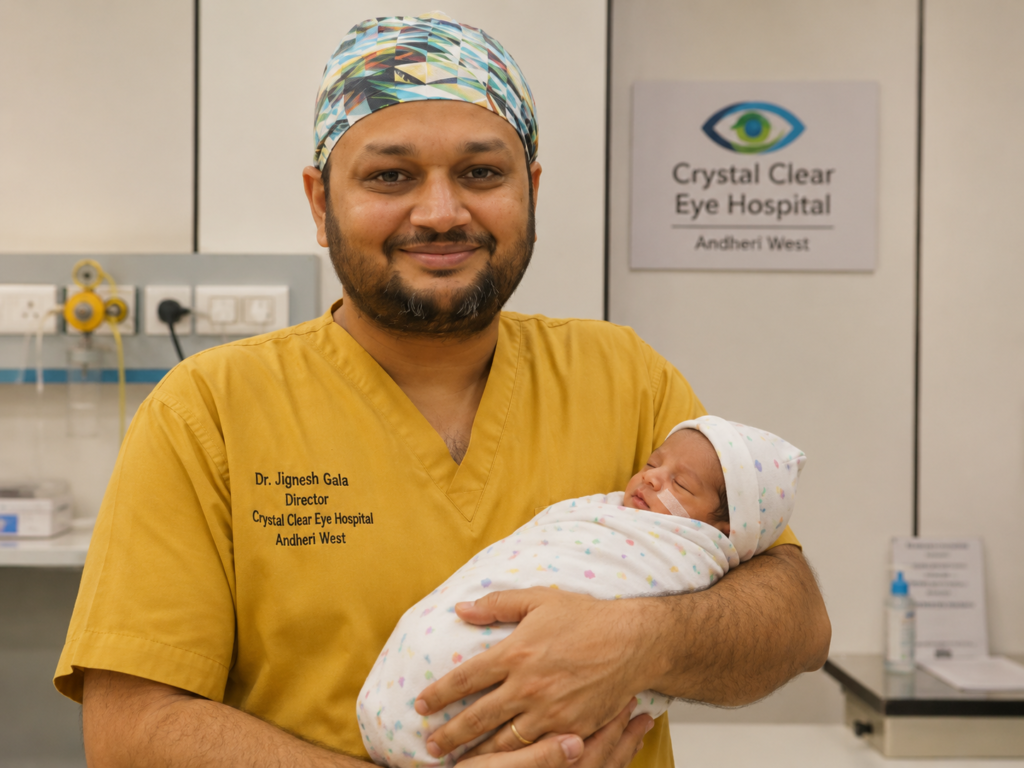
At Crystal Clear Eye Clinic in Andheri West, Mumbai, Dr. Jignesh Gala has performed 300+ ROP procedures, helping premature babies protect their precious sight. This guide answers every question parents have about premature baby eye screening.
What Is Retinopathy of Prematurity (ROP)?
Retinopathy of Prematurity (ROP) is an eye disease that affects premature babies. It occurs when abnormal blood vessels grow in the retina — the light-sensitive tissue at the back of the eye. These abnormal vessels can leak, scar, and eventually cause the retina to detach, leading to permanent blindness.
ROP is the leading cause of preventable childhood blindness globally (Gilbert et al., Lancet, 2022). In India, where neonatal care is improving and more premature babies are surviving, ROP has become a significant public health concern. The condition affects babies whose eyes have not fully developed before birth.
Who Is at Risk for ROP?
- All babies born before 32 weeks of gestation
- All babies weighing less than 1500 grams at birth
- Selected babies between 1500-2000 grams with additional risk factors such as prolonged oxygen therapy, respiratory distress syndrome, or multiple births
- Babies with unstable clinical course in the NICU
Warning: The earlier a baby is born and the lower their birth weight, the higher their risk of developing severe ROP. Babies born before 28 weeks or weighing under 1000 grams are at the highest risk and need the most vigilant monitoring.
When a baby is born prematurely, the blood vessels in their retina have not finished growing. These vessels normally grow from the center of the retina toward the edges during the last 12 weeks of pregnancy. In premature babies, this process is disrupted. The retina then releases signals that trigger abnormal, fragile blood vessel growth. These vessels can bleed, form scar tissue, and pull the retina away from the back of the eye — a condition called retinal detachment that causes permanent vision loss.
ROP is classified into five stages, from mild (Stage 1) to severe (Stage 5). Stages 1 and 2 often resolve on their own. However, Stage 3 and beyond require immediate treatment to prevent progression to retinal detachment and blindness.
When Should Premature Babies Be Screened for ROP?
Timing is everything in premature baby eye screening. Screen too early, and the disease may not be visible yet. Screen too late, and precious treatment time may be lost. Following the correct schedule is critical.
First Screening Timing: The first ROP screening should be performed at 4 weeks of chronological age OR at 31 weeks post-menstrual age (PMA) — whichever is later. Post-menstrual age is calculated by adding gestational age at birth to chronological age. (Dogra & Vinekar, 2023)
Who Needs ROP Screening?
According to the revised 2018 Indian ROP screening guidelines (Dogra & Vinekar, 2023), the following babies require screening:
- All babies born at less than 32 weeks of gestational age
- All babies with birth weight less than 1500 grams
- Selected babies between 1500-2000 grams with risk factors including:
- Prolonged oxygen therapy
- Respiratory distress syndrome
- Sepsis or infections
- Multiple blood transfusions
- Twins, triplets, or higher-order multiples
- Intraventricular hemorrhage
Follow-Up Schedule
After the initial screening, follow-up examinations are scheduled based on the findings:
- Immature retina: Re-screen every 1-2 weeks until retinal maturity is achieved
- Stage 1-2 ROP: Weekly follow-up until regression
- Stage 3 ROP (pre-threshold): Follow-up every 2-3 days
- Treatment-required ROP: Treatment within 48-72 hours
Screening continues until the retina is fully mature or until the baby is no longer at risk. For very preterm infants, this may mean 6-10 screening sessions over several weeks or months. Parents should never miss a scheduled follow-up, as ROP can progress rapidly.
Key Takeaway: The window for effective ROP treatment is narrow. Missing even one follow-up appointment can mean the difference between normal vision and lifelong blindness. Always adhere to your eye doctor’s screening schedule.
ROP Treatment Options: What Parents Should Know
If your baby’s ROP screening shows disease requiring treatment, several effective options are available. Modern ROP treatment has transformed outcomes for premature babies, with most treated infants retaining good vision.
1. Laser Photocoagulation
Laser treatment has been the gold standard for ROP treatment for decades. The procedure involves using a laser to burn away the peripheral areas of the retina that lack normal blood vessels. This stops the release of signals that drive abnormal vessel growth.
- Performed under anaesthesia in the operating room
- Takes 45-90 minutes per eye
- Destroys peripheral retina to save central vision
- May reduce peripheral (side) vision permanently
- Success rate: 80-90% for preventing progression
2. Anti-VEGF Injections (Bevacizumab/Ranibizumab)
Anti-VEGF (Anti-Vascular Endothelial Growth Factor) injections are the modern preferred treatment for many cases of ROP. A tiny needle is used to inject medication directly into the eye, which stops abnormal blood vessel growth.
- Quick procedure: 5-10 minutes per eye
- Requires only sedation, not general anaesthesia
- Preserves peripheral retina and vision
- Lower risk of high myopia compared to laser
- 66% less retinal detachment risk compared to laser (Cochrane Review, BMC Ophthalmology, 2024)
Research Update: Bilateral same-day anti-VEGF treatment is safe and effective, with endophthalmitis (serious infection) rates as low as 0.07% (Gangwe et al., Ophthalmology Retina, 2025). This means both eyes can be treated on the same day safely.
3. Surgery for Advanced ROP (Stage 4-5)
When ROP progresses to retinal detachment (Stage 4 or 5), surgery becomes necessary:
- Scleral buckling: A band is placed around the eye to support the retina
- Vitrectomy: Removal of the vitreous gel and scar tissue pulling on the retina
- Lensectomy: Removal of the lens in severe cases
Surgical outcomes for Stage 4 are moderate, but Stage 5 ROP has poor visual prognosis even with surgery. This underscores why early screening and treatment before progression is so critical.
ROP Treatment Cost in Mumbai
| Procedure | Cost Range (Per Eye) | Notes |
|---|---|---|
| ROP Screening | ₹2,000 – ₹5,000 | Each screening session |
| Laser Photocoagulation | ₹15,000 – ₹30,000 | One-time treatment per eye |
| Anti-VEGF Injection | ₹10,000 – ₹20,000 | May need repeat injection |
| ROP Surgery (Stage 4-5) | ₹50,000 – ₹1,00,000 | Includes hospital stay |
Note: Costs vary based on hospital, surgeon experience, and complexity. Some insurance plans cover ROP treatment. Contact Crystal Clear Eye Clinic at +91 77188 85245 for package details.
Why Choose Dr. Jignesh Gala for ROP Screening in Mumbai?
Dr. Jignesh M. Gala — Paediatric Retina & ROP Specialist
Dr. Jignesh M. Gala is one of Mumbai’s most experienced paediatric retina specialists. He holds prestigious international qualifications including FRCS (Glasgow), MRCS (Edinburgh), and FICO (London).
Specialized ROP Training
- Trained under Dr. Subhadra Jalali — India’s foremost ROP authority and pioneer of ROP screening programs in the country
- Dual fellowship training from the renowned LV Prasad Eye Institute, one of Asia’s top eye care centers
- Specialized in NICU-based ROP screening and same-day bilateral anti-VEGF treatment
Comprehensive ROP Care at Crystal Clear Eye Clinic
- NICU referrals accepted from all major hospitals in western Mumbai
- Same-day bilateral treatment capability for urgent cases
- Portable screening equipment for in-hospital NICU examinations when needed
- Multilingual consultations: English, Hindi, Gujarati, Marathi, and Telugu
- Convenient evening appointments for working parents
- Complete long-term follow-up care until retinal maturity and beyond
Is Your Premature Baby Due for ROP Screening?
Don’t delay. Early detection saves sight. Contact Dr. Jignesh Gala today.
📲 WhatsApp: +91 77188 85245 📞 Call NowHow Is ROP Screening Performed? What Parents Can Expect
Understanding what happens during ROP screening can help parents feel more prepared and less anxious. The procedure is safe when performed by a trained specialist.
Step-by-Step Process
- Dilating eye drops: Administered 30-60 minutes before the exam to widen the pupils. Multiple sets of drops may be needed for full dilation.
- Topical anaesthetic: Numbing drops are applied to minimize discomfort.
- Eye speculum: A small, paediatric-sized instrument gently holds the eyelids open. This prevents blinking during examination.
- Retinal examination: The doctor uses an indirect ophthalmoscope (a special microscope with a bright light) and a scleral depressor (a tiny instrument) to examine the entire retina.
- Documentation: Findings are recorded, often with drawings or photographs, to track changes over time.
Duration and Discomfort
- The examination takes approximately 10-15 minutes
- Babies may cry during the procedure due to the bright light and sensation of pressure
- Feeding is usually paused for 30-60 minutes before the exam
- Babies can be fed immediately after screening
After the Screening
After ROP screening, babies may experience:
- Temporary eye redness from the speculum — resolves within hours
- Light sensitivity due to dilation — normal for 4-6 hours
- Minimal swelling of the eyelids in some cases
Comfort Tip: Feeding your baby immediately after screening helps soothe them quickly. Most babies settle within minutes of the examination ending.
Warning Signs Parents Should Watch For
Between scheduled screenings, parents should watch for these signs that may indicate a problem:
- White pupil (leukocoria): A white reflection in the pupil instead of the normal red reflex
- Abnormal eye movements: Rapid, uncontrolled eye movements (nystagmus)
- Not following objects: By 3-4 months corrected age, babies should follow faces and toys
- Extreme light sensitivity
- Eyes that don’t align properly (squint/strabismus)
Urgent: If you notice a white reflex in your baby’s eye, seek immediate evaluation. This can indicate advanced ROP, retinoblastoma, or other serious conditions requiring emergency treatment.
Long-Term Eye Care for Premature Babies
Even after ROP resolves or is successfully treated, premature babies need lifelong eye monitoring. They are at higher risk for several eye conditions:
- Refractive errors: Premature babies have higher rates of myopia (nearsightedness), hyperopia, and astigmatism
- Amblyopia (lazy eye): Due to unequal vision between eyes
- Squint (strabismus): Misalignment of eyes is more common in preterm infants
- Glaucoma: Increased eye pressure can develop years after ROP
- Retinal detachment: Late detachment can occur even after successful treatment
- Cortical visual impairment: Vision processing issues from brain development
Follow-up schedule after ROP resolution:
- Every 3-6 months until age 2
- Every 6-12 months from age 2 to 5
- Annual check-ups thereafter or as advised
At Crystal Clear Eye Clinic, we provide comprehensive long-term monitoring for all premature babies who have undergone ROP screening or treatment.
Frequently Asked Questions About Premature Baby Eye Screening
1. What is ROP screening for premature babies?
ROP (Retinopathy of Prematurity) screening is a specialised eye examination for premature babies to detect abnormal blood vessel growth in the retina. It involves dilating the baby’s pupils and examining the retina using an indirect ophthalmoscope. ROP is the leading cause of preventable childhood blindness globally (Gilbert et al., Lancet, 2022), but it can be treated successfully when detected early through timely screening.
2. When should premature babies get their first eye exam?
Premature babies should receive their first ROP screening at 4 weeks of chronological age OR at 31 weeks post-menstrual age (whichever is later). All babies born before 32 weeks gestation or weighing less than 1500 grams at birth require screening. Selected babies between 1500-2000 grams with additional risk factors may also need evaluation. (Dogra & Vinekar, 2023)
3. How is ROP screening done?
ROP screening is performed by a trained paediatric retina specialist. The procedure involves: 1) Instilling dilating eye drops to widen the pupils, 2) Using paediatric eye speculums to gently hold the eyelids open, 3) Examining the entire retina with an indirect ophthalmoscope and scleral depressor. The examination takes 10-15 minutes and may cause mild temporary discomfort.
4. What are the stages of ROP?
ROP is classified into 5 stages: Stage 1 — Mild abnormal blood vessel growth with a demarcation line; Stage 2 — Slightly more severe with a ridge; Stage 3 — Severe abnormal vessel growth toward the center of the eye; Stage 4 — Partial retinal detachment (4A: not involving macula, 4B: involving macula); Stage 5 — Complete retinal detachment causing permanent blindness. Treatment is typically required at Stage 3 or beyond.
5. What is the treatment for ROP?
ROP treatment options include: 1) Laser photocoagulation — burning abnormal blood vessels with a laser; 2) Anti-VEGF injections (bevacizumab or ranibizumab) — injecting medication that stops abnormal vessel growth, with 66% less retinal detachment risk compared to laser (Cochrane Review, BMC Ophthalmology, 2024); 3) Surgery for advanced ROP (Stage 4-5) including vitrectomy and scleral buckling. Dr. Jignesh Gala at Crystal Clear Eye Clinic offers same-day bilateral anti-VEGF treatment with an endophthalmitis rate of only 0.07% (Gangwe et al., Ophthalmology Retina, 2025).
6. Can ROP cause permanent blindness?
Yes, untreated ROP can cause permanent blindness. If ROP progresses to Stage 4 or 5, retinal detachment occurs which can lead to irreversible vision loss. However, ROP-related blindness is 100% preventable with timely screening and treatment. The key is early detection through screening at the recommended time and prompt treatment when indicated. This is why following screening guidelines is absolutely critical for all premature babies.
7. What is the cost of ROP screening in Mumbai?
In Mumbai, ROP screening costs range from ₹2,000 to ₹5,000 per session. Laser photocoagulation treatment costs ₹15,000 to ₹30,000 per eye. Anti-VEGF injection treatment costs ₹10,000 to ₹20,000 per eye. Advanced surgical treatment for Stage 4-5 ROP costs ₹50,000 to ₹1,00,000. At Crystal Clear Eye Clinic in Andheri West, we offer comprehensive ROP packages at competitive rates. Contact +91 77188 85245 for details.
8. Which doctor does ROP screening in Andheri?
Dr. Jignesh M. Gala at Crystal Clear Eye Clinic, Andheri West, Mumbai, is a fellowship-trained paediatric retina and ROP specialist. With FRCS (Glasgow), MRCS (Edinburgh), and FICO (London) qualifications, Dr. Gala has performed 300+ ROP procedures and trained under Dr. Subhadra Jalali, India’s top ROP authority. The clinic is located at A1-202, Laram Centre, SV Road, Andheri West, Mumbai 400058. WhatsApp: +91 77188 85245.
Protect Your Premature Baby’s Vision Today
ROP screening is simple, quick, and can save your child’s sight for life. Don’t wait — schedule your baby’s screening with Mumbai’s trusted ROP specialist.
📲 WhatsApp Now: +91 77188 85245 🌐 Visit WebsiteCrystal Clear Eye Clinic | A1-202, Laram Centre, SV Road, Andheri West, Mumbai 400058
Mon-Sat: 10 AM – 8 PM | YouTube: @DrJMgala