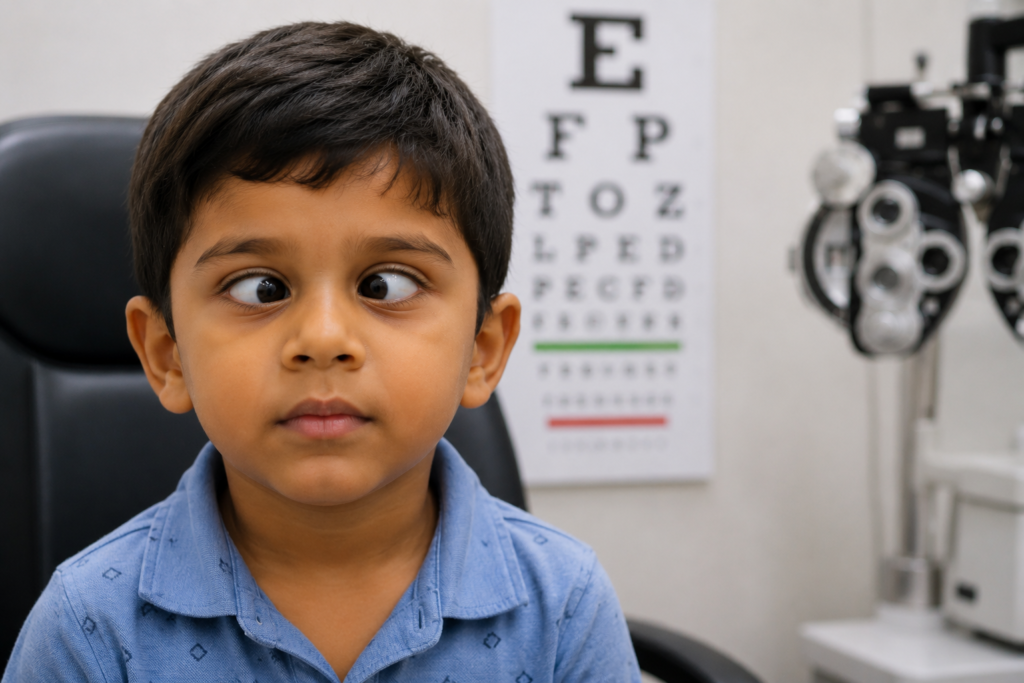
Congenital Eye Anomalies Treatment in Mumbai | Dr. Jignesh Gala | Andheri
Expert care for children born with structural eye abnormalities — Coloboma, Microphthalmos, Anophthalmos & more. Fellowship-trained at LV Prasad Eye Institute with 12+ years of specialized experience.
Thank you for reading this post, don't forget to subscribe!“Every child deserves the best start in life — including clear vision”

What Are Congenital Eye Anomalies?
Congenital eye anomalies are structural abnormalities present at birth that can significantly impact vision and facial aesthetics in children. These conditions develop during fetal growth when the eye structures fail to form properly. Early diagnosis and intervention are critical — not only for preserving vision but also for ensuring normal facial development and the child’s emotional well-being.
At Crystal Clear Eye Clinic, Andheri West, Dr. Jignesh Gala manages a full spectrum of congenital eye anomalies with compassion, expertise, and cutting-edge technology.
Dr. Gala’s extensive training at LV Prasad Eye Institute and his experience with 300+ ROP procedures in premature babies make him uniquely qualified to handle the most complex congenital eye conditions in children.
From the delicate iris coloboma repairs to comprehensive microphthalmos management and conformer fitting for anophthalmos, every treatment plan is tailored to give your child the best possible visual and cosmetic outcome.

Dr. Gala & Dr. Bhuta — Co-Directors, Topax Eye Care
Understanding Specific Congenital Eye Conditions
Detailed information on the most common congenital eye anomalies treated by Dr. Gala at Crystal Clear Eye Clinic
Coloboma — Incomplete Closure of Fetal Optic Fissure
What is Coloboma: Coloboma results from incomplete closure of the fetal optic fissure during the 5th-7th week of pregnancy. This gap can affect any structure along the fissure line — from the iris to the optic nerve — creating a “keyhole” or “cat-eye” appearance. The severity depends entirely on which structures are involved and how large the defect is.

State-of-the-art diagnostic equipment for precise congenital anomaly assessment
Types of Coloboma
1Iris Coloboma
Keyhole-shaped pupil, causes glare and reduced vision. Most visible type. Often the first sign parents notice in a newborn. Causes significant light sensitivity and may be associated with other ocular abnormalities.
2Lens Coloboma
Notching of the lens, causes significant refractive error and astigmatism. May lead to lens subluxation or cataract formation requiring surgical intervention.
3Choroidal Coloboma
Defect in the vascular layer beneath the retina. High risk for retinal detachment — one of the most serious complications requiring lifelong monitoring.
4Retinal Coloboma
Direct retinal tissue defect causing visual field loss. Extent of vision loss correlates with size and location of the coloboma.
5Optic Nerve Coloboma
Most concerning type — associated with significant visual acuity loss and risk of fluid leakage. May be linked to brain anomalies requiring MRI evaluation.
Causes of Coloboma
- Genetic Mutations: PAX2, SHH gene mutations most commonly identified
- Chromosomal Abnormalities: Trisomy 13, Trisomy 18, Cat Eye syndrome (chromosome 22)
- Environmental Factors: Alcohol consumption during pregnancy, vitamin A deficiency, certain teratogenic medications
- Syndromic Associations: Often part of larger genetic syndromes requiring comprehensive evaluation
Symptoms of Coloboma
- Keyhole-shaped or “cat-eye” pupil appearance
- Reduced vision (variable severity)
- Significant light sensitivity (photophobia)
- Strabismus (eye misalignment)
- Nystagmus (involuntary eye movements)
- Visual field defects
- Glare and difficulty in bright light
- Refractive errors (high astigmatism)
- Cosmetic concerns affecting self-esteem
- Associated hearing loss (CHARGE syndrome)
Comprehensive Evaluation at Crystal Clear Eye Clinic
- Detailed Slit-Lamp Examination: Gold standard for anterior segment coloboma assessment
- OCT (Optical Coherence Tomography): High-resolution imaging of retinal and choroidal coloboma
- B-Scan Ultrasonography: For posterior segment evaluation when media is opaque
- Visual Field Testing: Maps extent of vision loss (age-dependent)
- Genetic Counselling: Family planning guidance and recurrence risk assessment
- Systemic Evaluation: For associated syndromes (CHARGE, Goldenhar)
Management & Treatment Options
Non-Surgical Management
- Optical Correction: Spectacles for refractive errors
- Colored Contact Lenses: Custom-tinted lenses to mask iris defects cosmetically
- Low Vision Rehabilitation: Aids and strategies for functional vision
- Photophobia Management: Photochromic lenses, brimmed hats
- Genetic Counselling: For family planning decisions
- Retinal Surveillance: Regular monitoring for detachment risk
Surgical Management
- Iris Coloboma Repair: Suturing techniques to reduce keyhole appearance and glare
- Artificial Iris Implants: Customized colored silicone implants for large defects
- Retinal Laser: Prophylactic photocoagulation around coloboma margins
- Retinal Detachment Surgery: When complications arise
- Cataract Surgery: If lens is involved
Associated Conditions Requiring Screening
CHARGE Syndrome: Coloboma, Heart defects, choanal Atresia, Retarded growth, Genital abnormalities, Ear abnormalities. Goldenhar Syndrome: Ocular dermoids, ear tags, vertebral anomalies. Cat Eye Syndrome: Chromosome 22 duplication — coloboma with anal atresia. All patients with coloboma require comprehensive systemic evaluation.
Microphthalmos — Abnormally Small Eye
What is Microphthalmos: Microphthalmos is a developmental condition where the eye has an axial length significantly smaller than normal (typically less than 20mm in adults, proportionally less in children). This occurs due to arrested eye development during the first trimester of pregnancy. The condition ranges from mild (near-normal eye size) to severe (dramatically reduced eye size with significant functional impairment).
Types of Microphthalmos
ASimple Microphthalmos
Small eye with relatively preserved internal structure. The eye is proportionally small but otherwise anatomically normal. Typically associated with extreme hyperopia (farsightedness) requiring very high-plus power glasses.
BComplex Microphthalmos
Small eye with internal structural abnormalities — may include cataract, coloboma, retinal dysplasia, or optic nerve hypoplasia. Visual prognosis is more guarded and requires comprehensive management.
CMicrophthalmos with Cyst
Most severe form — the small eye is associated with a colobomatous cyst that may extend into the orbit. Requires urgent surgical intervention to prevent orbital bone development problems and cosmetic deformity.
Causes of Microphthalmos
Genetic Causes
- VSX2 gene mutations
- BCOR gene mutations
- RAX gene mutations
- SOX2 gene mutations (often bilateral)
- PAX6 gene mutations
- Chromosomal abnormalities
Environmental Causes
- Teratogenic exposure during pregnancy
- Maternal infections (rubella, toxoplasmosis)
- Maternal alcohol abuse
- Vitamin A deficiency
- Certain medications (thalidomide, retinoids)
- Radiation exposure
Associated Ocular Findings
- Cataract: Lens opacities common in microphthalmic eyes
- Glaucoma: Increased risk of angle-closure due to shallow anterior chamber
- Coloboma: Frequently co-exists with microphthalmos
- Retinal Dysplasia: Abnormal retinal development
- Optic Nerve Hypoplasia: Underdeveloped optic nerve
- Persistent Fetal Vasculature: Remnant blood vessels from fetal development
- Uveal Effusion: Fluid accumulation in the eye
Management Challenges in Microphthalmos
Microphthalmos presents unique management challenges: extreme hyperopia (often +10 to +30 diopters), high risk of angle-closure glaucoma due to shallow anterior chamber, increased risk of retinal detachment, significant amblyopia risk even with best correction, and cosmetic concerns affecting facial symmetry and psychosocial development.
Treatment Approach at Crystal Clear Eye Clinic
Optical & Medical Management
- Early Spectacle Correction: Very high plus power lenses — fitted as early as possible
- Contact Lenses: Often better tolerated than thick glasses; better cosmesis
- Amblyopia Therapy: Patching, atropine penalization for the better eye
- Glaucoma Management: Medications, laser, or surgery as needed
- Retinal Surveillance: Regular monitoring for detachment
Surgical & Cosmetic Interventions
- Cataract Extraction: Specialized techniques for small eyes
- Glaucoma Surgery: Trabeculectomy or tube shunts
- Conformer Fitting: For severe microphthalmos to promote orbit growth
- Orbital Expansion: Dermis-fat grafts, orbital implants
- Cosmetic Prosthetics: Custom shells for appearance
Why Early Intervention Matters
Early intervention in microphthalmos is essential for multiple reasons. First, the critical period of visual development occurs in the first 7-8 years of life — prompt refractive correction and amblyopia therapy can mean the difference between useful vision and severe visual impairment. Second, orbital bone growth is stimulated by the presence of a normally sized eye; when the eye is significantly small, the orbit fails to develop normally, leading to facial asymmetry. Early conformer fitting can promote normal orbital development and facial symmetry. Third, early detection and management of associated glaucoma can prevent irreversible optic nerve damage. At Crystal Clear Eye Clinic, Dr. Gala emphasizes newborn screening and early referral for the best outcomes.
Anophthalmos — Absent Eye
What is Anophthalmos: Anophthalmos is the complete absence of the eyeball — the rarest but most challenging congenital eye anomaly. This condition occurs when the optic vesicle fails to develop from the neural tube during the 2nd-4th week of gestation. While true anophthalmos is extremely rare, clinical variants with only a rudimentary ocular structure are more commonly encountered. Management requires a coordinated, long-term approach involving multiple specialists.
Types of Anophthalmos
TTrue Anophthalmos
Complete failure of optic vesicle development. No ocular tissue exists. Extremely rare. Usually associated with severe genetic mutations affecting early eye development.
CClinical Anophthalmos
Very small rudimentary eye exists but is not visible clinically. May have some microscopic ocular tissue. Requires imaging to distinguish from true anophthalmos.
SSevere Microphthalmos
May be clinically indistinguishable from anophthalmos. A tiny eye is present but not visible without specialized imaging. Management approach is similar to anophthalmos.
Management of Anophthalmos
Early fitting of conformers is ESSENTIAL for normal orbital bone growth and cosmetic development. Without early intervention, the bony orbit fails to develop, leading to severe facial asymmetry that becomes increasingly difficult to correct later.
Treatment Timeline for Anophthalmos
| Age | Intervention | Purpose |
|---|---|---|
| 2-4 weeks | Initial conformer fitting | Begin orbital stimulation; smallest conformer placed |
| Every 2-4 weeks | Conformer expansion | Gradually increase size to match contralateral eye growth |
| 4-6 months | Cosmetic shell fitting | First painted prosthetic shell for improved appearance |
| 3-5 years | Definitive prosthetic eye | Custom-fitted, fully cosmetic prosthetic by ocularist |
| As needed | Orbital expansion surgery | Dermis-fat grafts, orbital implants for severe cases |
Comprehensive Care Components
Medical Management
- Graduated Conformer Expansion: Sequential sizing to stimulate orbit growth
- Cosmetic Prosthesis: Custom-matched to fellow eye color and size
- Coordinated Oculoplastic Surgery: Socket reconstruction, eyelid repair
- Genetic Evaluation: SOX2, OTX2, RAX mutations often implicated
Supportive Care
- Psychological Support: Essential for family coping strategies
- Genetic Counselling: Recurrence risk for future pregnancies
- Occupational Therapy: Monocular vision adaptation strategies
- Regular Follow-up: Lifelong monitoring and prosthesis adjustments
Key Point: The first 2 years of life represent the critical window for orbital development. Starting conformer therapy within the first month of life can achieve near-normal orbital growth. Delay beyond 3-6 months results in permanently compromised orbital development that is extremely difficult to correct surgically later.
Other Congenital Eyelid Anomalies
Eyelid abnormalities present at birth that require expert evaluation and management
PCongenital Ptosis
Drooping eyelid present at birth due to poorly developed levator muscle. Can block vision and cause amblyopia (lazy eye) if the pupil is covered. Critical to assess whether the lid covers the visual axis.
Management: Early surgical correction with levator resection or Mullerectomy if visual axis is threatened. Frontalis sling for severe cases. Timing depends on severity — urgent if amblyopia risk.
EEpiblepharon
Inward-turning eyelashes touching the cornea. Common in Asian children. Causes corneal irritation, tearing, and risk of corneal scarring if chronic.
Management: Many cases resolve spontaneously as facial bones grow. Lubricating eye drops for mild cases. Surgical correction (Hotz procedure) if corneal irritation persists or scarring develops.
DDistichiasis
An extra row of eyelashes emerging from the meibomian gland orifices. Lashes are often fine but can cause corneal irritation, especially if they grow backward toward the eye.
Management: Lubrication for mild cases. Electrolysis to permanently remove problematic lashes. Cryotherapy or surgical excision for severe cases with multiple affected lashes.
CCongenital Entropion
Inward turning of the eyelid margin causing lashes to rub against the cornea. Less common than epiblepharon but more likely to cause corneal damage.
Management: Taping or sutures as temporary measures. Definitive surgical correction with lid margin repositioning if persistent.
XCongenital Ectropion
Outward turning of the eyelid margin exposing the inner conjunctival surface. Causes dryness, irritation, and chronic conjunctivitis.
Management: Lubricating ointments for mild cases. Surgical correction with lid tightening or skin grafts for severe cases. Often associated with other facial anomalies requiring comprehensive evaluation.
CCongenital Coloboma of Eyelid
Notch or defect in the eyelid margin due to incomplete fusion of embryonic lid folds. Can range from small notches to large defects involving up to one-third of the lid.
Management: Surgical repair depending on size and location. Large defects may require skin flaps or grafts. Must rule out associated Goldenhar syndrome.
Diagnostic Technology at Crystal Clear Eye Clinic
State-of-the-art diagnostic capabilities for accurate assessment of congenital eye anomalies in children

Dr. Gala performing microsurgical procedures with advanced operating microscope
EExamination Under Anesthesia (EUA)
For uncooperative infants and young children, EUA allows thorough examination without distress. Essential for accurate diagnosis when office examination is impossible. Enables detailed anterior and posterior segment evaluation, measurement of intraocular pressure, and photography for documentation.
UUltrasound Biomicroscopy (UBM)
High-frequency ultrasound imaging for anterior segment structures invisible on standard examination. Critical for evaluating angle structures in microphthalmos, detecting iris and ciliary body coloboma, and planning glaucoma surgery in small eyes.
BB-Scan Ultrasonography
Evaluates the posterior segment when the media is opaque (corneal scar, cataract, vitreous hemorrhage). Essential for assessing retinal development in microphthalmos, detecting optic nerve coloboma, and differentiating severe microphthalmos from anophthalmos.
OOptical Coherence Tomography (OCT)
High-resolution cross-sectional imaging of the retina and optic nerve. Non-invasive and increasingly possible in cooperative children. Essential for characterizing the extent of coloboma, monitoring retinal health, and detecting subtle structural abnormalities.
AOCT Angiography
Vascular assessment of the retina and choroid without dye injection. Particularly valuable for evaluating blood flow in colobomatous areas and detecting subtle vascular abnormalities in microphthalmos.
VVisual Evoked Potential (VEP)
Objectively assesses visual pathway function from retina to visual cortex. Invaluable in infants and preverbal children who cannot perform standard vision testing. Provides quantitative data on visual function to guide treatment decisions.
RElectroretinography (ERG)
Evaluates retinal function objectively — particularly rod and cone photoreceptor function. Essential when retinal dysplasia or degeneration is suspected. Helps distinguish between retinal and optic nerve causes of vision loss.
GGenetic Testing
Targeted gene panels for known congenital eye anomaly genes including PAX6, SOX2, VSX2, RAX, SHH, PAX2. Whole exome sequencing for atypical cases. Essential for diagnosis, prognosis, family counselling, and recurrence risk assessment.
MMRI Orbit & Brain
Imaging for associated central nervous system abnormalities. Optic nerve coloboma, anophthalmos, and severe microphthalmos are frequently associated with brain anomalies (holoprosencephaly, midline defects). MRI is essential for complete evaluation.
33D Orbital Imaging
Advanced CT/MRI-based 3D reconstruction for surgical planning in microphthalmos and anophthalmos. Enables precise measurement of orbital volume, planning of implant size and position, and prediction of surgical outcomes.
Multidisciplinary Management Approach
Dr. Gala coordinates comprehensive care with a network of specialists across Mumbai
Congenital eye anomalies rarely exist in isolation. Many are associated with systemic conditions, require multiple types of intervention, and need long-term follow-up across different specialties. Dr. Gala has established a coordinated network of specialists across Mumbai to provide seamless, comprehensive care for every child.
Core Team Members
- Pediatric Ophthalmology: Primary eye care, monitoring, and coordination
- Oculoplastic Surgery: Eyelid anomalies, socket reconstruction, conformer fitting
- Retina Specialists: Coloboma-related retinal detachment risk management
- Glaucoma Specialists: Associated angle-closure or developmental glaucoma
- Geneticists: Diagnosis, family counselling, recurrence risk assessment
- Low Vision Rehabilitation: Functional vision optimization and aids
Extended Support Team
NPediatric Neurology
For associated brain abnormalities, developmental delay assessment, and neuroimaging interpretation.
CChild Psychologists
Emotional support, family coping strategies, and guidance on discussing condition with the child.
PProsthetic Specialists
Custom cosmetic shells and artificial eyes matched to the fellow eye for anophthalmos/microphthalmos.
OOccupational Therapists
Developmental support, visual adaptation training, and assistance with activities of daily living.
Surgical Options for Congenital Eye Anomalies
Specialized surgical interventions available at Crystal Clear Eye Clinic and partner facilities
IIris Coloboma Repair
Suturing techniques to approximate iris edges and reduce the keyhole appearance. Artificial iris implants — customized colored silicone implants for large defects that cannot be repaired primarily. Improves cosmesis and reduces glare and light sensitivity.
CPediatric Cataract Extraction
Specialized techniques for cataract surgery in coloboma and microphthalmos — small eyes require modified approaches, careful wound construction, and often secondary lens implantation at a later date. Critical to prevent amblyopia.
GPediatric Glaucoma Surgery
Trabeculectomy, tube shunts (Ahmed, Baerveldt) for associated glaucoma in microphthalmos and coloboma. High success rates when performed early. Lifelong monitoring essential.
LRetinal Laser Treatment
Prophylactic laser photocoagulation around coloboma margins to prevent retinal detachment. Reduces lifetime risk of this blinding complication by strengthening adhesion between retina and underlying tissue.
PPtosis Correction
Levator resection, Mullerectomy for moderate ptosis. Frontalis sling (using silicone rod or fascia lata) for severe congenital ptosis with poor levator function. Timing critical to prevent amblyopia.
FConformer Fitting & Expansion
Serial conformer fitting for microphthalmos and anophthalmos. Graduated expansion stimulates orbital bone growth. Requires expertise in pediatric oculoplastics and coordination with prosthetic specialists.
OOrbital Expansion Surgery
Orbital implants, dermis-fat grafts for severe microphthalmos/anophthalmos where conformer therapy alone is insufficient. Provides volume and stimulates further orbital growth. Often combined with soft tissue procedures.
SSocket Reconstruction
Comprehensive socket reconstruction for anophthalmos and severe microphthalmos. May include mucous membrane grafting, lid tightening, and placement of integrated orbital implants to allow prosthetic eye movement.
Why Dr. Jignesh Gala is the Best for Congenital Eye Anomalies
Credentials, experience, and outcomes that set Dr. Gala apart

Dr. Jignesh Gala — FRCS Glasgow, Founder & Director, Crystal Clear Eye Clinic
Dr. Jignesh Gala
FRCS Glasgow, MRCS Edinburgh, FICO London, BMJ Peer Reviewer
With over 12 years of specialized experience and 25,780+ surgical procedures, Dr. Gala has established himself as one of Mumbai’s leading pediatric and congenital eye specialists. His unique combination of international training, research credentials, and clinical volume makes him uniquely qualified for the most complex congenital eye cases.
Key Differentiators
- Direct + Third-party cashless facility through Topax Eye Care and Crystal Clear Eye Clinic
- Child-friendly clinic environment designed for pediatric comfort
- Multidisciplinary network across Mumbai for comprehensive care
- Long-term care planning expertise — from infancy through adulthood
- Founder & Director of Crystal Clear Eye Clinic, Co-Director of Topax Eye Care
Comparison: Dr. Gala vs Other Mumbai Eye Hospitals
| Feature | Dr. Jignesh Gala | Doctor Eye Institute | ASG Eye Hospital | Arohi Eye Hospital | Aggarwal Eye Hospital |
|---|---|---|---|---|---|
| Experience (Years) | 12+ Years | 60+ Years (Institution) | Multi-location chain | NABH accredited | Established practice |
| Fellowship Training | LV Prasad Eye Institute (Dual) | Varies by doctor | Varies by location | Not specified | Not specified |
| International Training | Tan Tock Seng Hospital, Singapore | Not specified | Limited | Not specified | Not specified |
| ROP Procedures | 300+ (Mumbai’s highest private practice) | Not disclosed | Not disclosed | Not disclosed | Not disclosed |
| Research Credentials | BMJ Case Reports Peer Reviewer | Limited | Not specified | Not specified | Not specified |
| Pediatric EUA Facility | Yes — In-house | Limited | Varies | Not specified | Not specified |
| Conformer Fitting | Yes — Specialized | Not specified | Not specified | Not specified | Not specified |
| Cashless Facility | Direct + Third Party | Third party only | Third party only | Third party only | Limited |
| Multidisciplinary Network | Yes — Coordinated | Limited | Fragmented | Not specified | Not specified |
| Personalized Care | Founder-director led | Institutional | Corporate | Institutional | Individual |
Insurance & Cashless Facility
Comprehensive insurance coverage for congenital eye anomaly treatment
Private Insurers (24+)
ICICI Lombard, HDFC Ergo, Star Health, Max Bupa, Bajaj Allianz, New India Assurance, United India, Oriental Insurance, National Insurance, Apollo Munich, Religare, Cigna TTK, Aditya Birla Health, and more.
Government / PSU (8)
CGHS, ECHS, PMJAY (Ayushman Bharat), ESIC, Railways, Defence, Maharashtra Government Employees, and Central Government Schemes.
TPA Networks (12)
Medi Assist, Paramount Health, Family Health Plan, East West Assist, Medicare, Vidal Health, Genins India, Raksha, Safeway, and more third-party administrators.
Important Note on Congenital Condition Coverage: Congenital anomaly treatment may have waiting periods under some private insurance policies (typically 2-4 years). However, CGHS, ECHS, and PMJAY (Ayushman Bharat) provide coverage for congenital conditions without such waiting periods. For newborn additions under family floater policies, addition must be completed within 30-90 days of birth for coverage to apply. Dr. Gala’s team provides complete documentation support for pre-authorization and claims processing.
Cost of Treatment
Transparent pricing for congenital eye anomaly procedures in Mumbai
| Procedure | Cost Range (Mumbai) | Insurance Coverage |
|---|---|---|
| Consultation + EUA | Rs. 3,000 – 8,000 | OPD rider |
| EUA + Detailed Examination | Rs. 8,000 – 15,000 | Covered |
| Iris Coloboma Repair | Rs. 35,000 – 60,000 | Covered |
| Cataract Surgery (Pediatric) | Rs. 40,000 – 70,000 | Covered |
| Conformer Fitting | Rs. 10,000 – 25,000 | Partial |
| Ptosis Correction | Rs. 25,000 – 40,000 | Covered |
| Glaucoma Surgery (Pediatric) | Rs. 30,000 – 55,000 | Covered |
| Retinal Laser | Rs. 8,000 – 15,000 | Covered |
| Genetic Testing | Rs. 15,000 – 50,000 | Varies |
| Cosmetic Shell / Prosthesis | Rs. 15,000 – 40,000 | Partial |
| Low Vision Rehabilitation | Rs. 5,000 – 15,000/session | Partial |
* Costs are indicative and may vary based on case complexity, anesthesia requirements, and implant choices. Final estimate provided after consultation.
Documents Required for Cashless (Pediatric Cases)
Ensure smooth insurance processing by keeping these documents ready
1Insurance Documents
- Health Insurance Card (original + photocopy)
- TPA pre-authorization form (filled and signed)
- Employer ID (for corporate policies)
2Identity & Age Proof
- Government ID (Aadhaar/PAN/Passport of parent + child)
- Child’s Birth Certificate (MANDATORY for age verification)
- 2 Passport-size photographs
3Medical Records
- Previous eye examination reports
- Doctor’s recommendation for surgery/procedure
- Genetic test reports (if available)
4Financial Details
- Bank account details (for reimbursement if needed)
- Cancelled cheque (for refund processing)
- Admission letter from treating hospital/clinic
Pro Tip: Dr. Gala’s insurance coordination team assists with pre-authorization documentation, claim form filling, and follow-up with insurance companies. Most cashless approvals are processed within 24-48 hours for emergency procedures and 3-5 days for planned surgeries.
Frequently Asked Questions
Everything you need to know about congenital eye anomaly treatment
Give Your Child the Gift of Clear Vision
Book a consultation with Dr. Jignesh Gala, Mumbai’s leading congenital eye specialist. Early intervention makes all the difference.
World-Class Facility at Crystal Clear Eye Clinic
Our Andheri West clinic is equipped with the latest diagnostic and surgical technology specifically for pediatric and congenital eye care. From examination under anesthesia capabilities to advanced OCT imaging, we provide comprehensive care under one roof.
- Child-friendly, welcoming environment
- Pediatric anesthesia support for EUA
- In-house OCT, B-scan, and UBM
- Coordination with Topax Eye Care for surgical facilities
- Dedicated pediatric vision testing area
- Insurance desk for cashless processing

Crystal Clear Eye Clinic — Modern, child-friendly facility