Expert Retina Care & Surgery in Mumbai
Advanced vitreoretinal surgery by Dr. Jignesh Gala (FRCS Glasgow), specialist vitreoretinal surgeon. Treating retinal detachment, diabetic retinopathy, macular hole, AMD with precision. Dual fellowship trained at LV Prasad Eye Institute.

Understanding the Retina
The light-sensitive tissue at the back of your eye that makes vision possible
The retina is a thin, light-sensitive layer of tissue located at the back of the eye, near the optic nerve. Its primary function is to receive light that the lens has focused on, convert the light into neural signals, and send these signals to the brain for visual recognition. Without a healthy retina, clear vision is impossible.
The retina contains millions of specialized photoreceptor cells called rods and cones. Rods are responsible for vision in low light conditions, while cones handle color vision and fine detail in bright light. The central part of the retina, called the macula, contains the fovea - the area with the highest concentration of cones and provides our sharpest, most detailed central vision.
The vitreous is a clear gel-like substance that fills the space between the lens and the retina. As we age, this gel can shrink, liquefy, or pull away from the retina - sometimes causing serious complications like retinal tears or detachment. A vitreoretinal surgeon like Dr. Jignesh Gala specializes in treating conditions affecting both the vitreous and retina.
The retina is considered part of the central nervous system and is the only part of the CNS that can be directly visualized non-invasively. This is why retinal examination can also reveal signs of systemic diseases like diabetes, hypertension, and even brain tumors.
Common Retina Conditions We Treat
Emergency - retina separates from back of eye
Diabetes damaging retinal blood vessels
Leading cause of vision loss in seniors
Small break in the macula affecting central vision
Fluid buildup in the macula
Blocked vein causing retinal bleeding
Retina Conditions We Treat
Comprehensive diagnosis and treatment for all vitreoretinal disorders
At Crystal Clear Eye and Topax Eye Care, Dr. Jignesh Gala provides comprehensive medical and surgical management for all retinal conditions. From emergency retinal detachment surgery to routine diabetic eye screening, our centre is equipped to handle the full spectrum of vitreoretinal diseases with internationally trained expertise.
| Condition | Common Symptoms | Treatment Options | Cost Range (Approx.) | Insurance Coverage |
|---|---|---|---|---|
| Retinal Detachment (RD) ⚠️ EMERGENCY | Flashes of light, sudden floaters, curtain/shadow over vision | Vitrectomy, Scleral Buckling, Pneumatic Retinopexy | ₹50,000 - 1,00,000 | ✅ Covered (emergency) |
| Diabetic Retinopathy | Blurry vision, floaters, dark spots, difficulty reading | Laser Photocoagulation, Anti-VEGF Injections, Vitrectomy | ₹15,000 - 40,000 | ✅ Covered |
| Age-related Macular Degeneration (AMD) | Distorted central vision, wavy lines, dark spot in center | Anti-VEGF Injections (Avastin, Accentrix, Eylea) | ₹20,000 - 60,000 | ✅ Partially covered |
| Macular Hole | Blurred/distorted central vision, difficulty with fine tasks | Vitrectomy + ILM Peel + Gas | ₹45,000 - 75,000 | ✅ Covered |
| Macular Edema | Central blurriness, washed-out colors | Anti-VEGF Injections, Steroid Implants, Laser | ₹15,000 - 35,000 | ✅ Covered |
| Retinal Vein Occlusion (RVO) | Sudden painless vision loss, hemorrhages | Anti-VEGF Injections, Laser, Steroids | ₹20,000 - 50,000 | ✅ Covered |
| Epiretinal Membrane (ERM) | Gradual central vision distortion, double vision in one eye | Vitrectomy + Membrane Peel | ₹40,000 - 70,000 | ✅ Covered |
| ROP (Retinopathy of Prematurity) | Abnormal blood vessels in premature infants | Laser Photocoagulation, Anti-VEGF | ₹15,000 - 25,000/session | ✅ Covered (pediatric) |
| Ocular Trauma | Vision loss after injury, blood in eye | Emergency Vitrectomy, Repair | Variable (emergency) | ✅ Usually covered |
* Costs are indicative and may vary based on complexity, implants used, and hospital stay. Final cost determined after clinical evaluation. Insurance coverage subject to policy terms.
If you experience sudden flashes of light, a shower of new floaters, or a dark curtain/shadow077188 85245 now for emergency retina evaluation. Delay in treatment can lead to permanent blindness.
Retina Surgeries We Perform
Advanced vitreoretinal surgical procedures with international standards
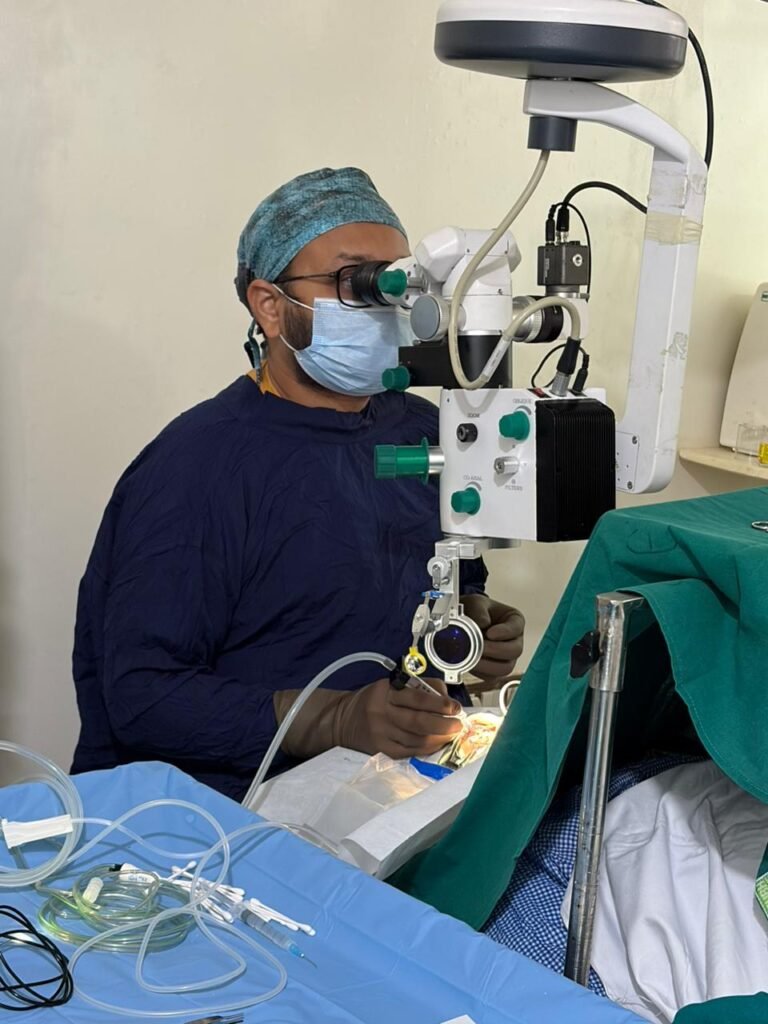
Dr. Jignesh Gala performs the complete range of vitreoretinal surgical procedures using state-of-the-art operating microscopes, advanced visualization systems, and microsurgical instrumentation. Every surgery is tailored to the patient's specific condition for optimal outcomes.
Vitrectomy
₹50,000 - 1,00,000Surgical removal of the vitreous gel from inside the eye to treat retinal detachment, macular hole, vitreous hemorrhage, diabetic complications, and epiretinal membrane. Performed through tiny self-sealing incisions under operating microscope.
Retinal detachment, macular hole, diabetic traction, vitreous hemorrhage, ERM
Scleral Buckling
₹50,000 - 70,000An external silicone band is placed around the eye to gently indent the sclera and support the detached retina. Best suited for younger patients with simple retinal detachments. No entry into the eye required. Combined with cryotherapy to seal retinal tears.
Simple retinal detachments, young patients, intact vitreous
Pneumatic Retinopexy
₹15,000 - 25,000Office-based procedure where a gas bubble is injected into the eye to push the retina back into place, combined with laser or cryotherapy to seal the tear. Requires specific head positioning post-procedure. Less invasive with faster recovery.
Simple upper retinal detachments, single small tear
Laser Photocoagulation (Green/PASCAL)
₹8,000 - 20,000Advanced laser treatment using Green Laser or PASCAL (Pattern Scan Laser) to seal retinal tears, treat diabetic retinopathy, and prevent abnormal blood vessel growth. Office-based, non-invasive procedure completed in 10-20 minutes.
Diabetic retinopathy, retinal tears, ROP, vein occlusion
Barrage Laser
₹8,000 - 15,000Preventive laser treatment that creates a barrier (barrage) around areas of retinal thinning, holes, or lattice degeneration to prevent retinal detachment. Highly recommended for high myopia patients and those with family history of retinal detachment.
Retinal holes, lattice degeneration, high myopia prevention
Intravitreal Injections (Anti-VEGF)
₹8,000 - 25,000/injInjection of medications (Avastin, Accentrix/Ranibizumab, Eylea/Aflibercept, Razumab) directly into the eye to treat wet AMD, diabetic macular edema, and retinal vein occlusion. Quick outpatient procedure under topical anesthesia.
Wet AMD, DME, RVO, proliferative diabetic retinopathy
Membrane Peel (ILM Peel)
Included in VitrectomyDelicate microsurgical removal of scar tissue or the internal limiting membrane from the retinal surface during vitrectomy. Essential for macular hole closure and treatment of epiretinal membrane. Requires exceptional surgical skill and precision.
Macular hole, epiretinal membrane, macular pucker
Combined Phaco + Vitrectomy
₹75,000 - 1,25,000When cataract coexists with a retinal condition (common in diabetics and elderly), combined cataract surgery (phacoemulsification with IOL implantation) and vitrectomy can be performed in a single sitting. This reduces total operating time, fewer anesthesia episodes, faster overall recovery, and better visual outcomes. Dr. Jignesh Gala's expertise in both anterior and posterior segment surgery makes him uniquely qualified for these complex combined procedures.
Cataract + retinal detachment, cataract + diabetic vitrectomy, cataract + ERM
Advanced Diagnostic Technology
Cutting-edge imaging for precise retina diagnosis and treatment planning

State-of-the-art diagnostic suite at Crystal Clear Eye, Andheri West
Comprehensive Retina Diagnostics
Accurate diagnosis is the foundation of successful retina treatment. At Crystal Clear Eye and Topax Eye Care, we invest in the latest diagnostic technology to ensure every retinal condition is identified precisely and monitored effectively throughout treatment.
📷 OCT (Optical Coherence Tomography)
Non-invasive imaging that captures high-resolution cross-sectional images of the retina. Essential for diagnosing macular edema, macular holes, epiretinal membranes, and monitoring treatment response. Results available immediately.
🌙 FFA (Fundus Fluorescein Angiography)
Specialized photography using fluorescent dye to evaluate blood flow in retinal vessels. Gold standard for diagnosing diabetic retinopathy, retinal vein occlusion, AMD, and identifying areas needing laser treatment.
🎨 B-Scan Ultrasonography
Ultrasound imaging of the eye used when the retina cannot be directly visualized due to dense cataract or vitreous hemorrhage. Helps plan surgery in complex cases.
🔬 Slit-Lamp Biomicroscopy with 90D/78D Lens
Detailed examination of the retina using specialized high-magnification lenses. The first-line diagnostic tool for all retinal evaluations, providing stereoscopic views of the fundus.
⚡ Green Laser / PASCAL Laser
Advanced laser systems for precise retinal photocoagulation. PASCAL (Pattern Scan Laser) delivers multiple spots simultaneously, reducing treatment time and patient discomfort significantly.
Why Dr. Jignesh Gala for Retina Surgery?
Mumbai's trusted vitreoretinal surgeon with international training

Dr. Gala in expert retina surgery consultation at Crystal Clear Eye
Specialist Vitreoretinal Surgeon
Dr. Jignesh Gala is not just a general ophthalmologist who performs occasional retina procedures - he is a dedicated vitreoretinal surgeon with specialized fellowship training from the prestigious LV Prasad Eye Institute, one of Asia's premier eye hospitals. This advanced training specifically focused on the diagnosis and surgical management of complex retinal diseases.
Dr. Gala's FRCS (Fellowship of the Royal College of Physicians and Surgeons of Glasgow) and MRCS (Membership of the Royal College of Surgeons of Edinburgh) are among the most respected surgical qualifications worldwide. His dual fellowship in vitreoretinal surgery from LV Prasad Eye Institute - a WHO Collaborating Centre - ensures you receive care that meets international standards right here in Mumbai.
Cashless Facility for Retina Surgery
Insurance coverage available for all medically necessary retina procedures
Direct Cashless (Topax Eye Care)
Get treated without paying upfront. We handle insurance claims directly with your provider. Pre-authorization support provided. Available for all major insurance companies and TPA panels.
Visit Topax Eye CareThird Party Reimbursement (Crystal Clear Eye)
Pay at the time of treatment and claim reimbursement from your insurer. We provide all necessary documentation, bills, and medical reports to ensure smooth claim processing.
Visit Crystal Clear EyeInsurance Coverage by Procedure
| Procedure | Typical Coverage | Waiting Period | Notes |
|---|---|---|---|
| Vitrectomy (RD, Macular Hole, ERM) | 100% up to sum insured | Usually none (emergency) | Cashless available |
| Scleral Buckling | 100% up to sum insured | Usually none (emergency) | Cashless available |
| Laser Photocoagulation (DR, RVO) | 80-100% | None | OPD/Daycare basis |
| Barrage Laser (Preventive) | 50-80% | As per policy | Some plans cover fully |
| Anti-VEGF Injections | Limited (4-6/year typical) | None | Sub-limits may apply |
| ROP Treatment (Pediatric) | 100% (covered under maternity/pediatric) | As per maternity cover | Cashless at Topax |
| Ocular Trauma Surgery | 100% (accident cover) | None | Emergency admission |
Coverage varies by insurance provider and specific policy. We recommend verifying your coverage before treatment. Our insurance desk assists with pre-authorization and claim processing.
Star Health
ICICI Lombard
Bajaj Allianz
HDFC Ergo
New India Assurance
⚠️ Retinal Detachment is an EYE EMERGENCY
If you experience sudden flashes, new floaters, or a curtain over your vision, every minute counts. Delays can lead to permanent blindness.
Sudden Flashes of Light
Bright flashes in your peripheral vision, especially in dark conditions
New Floaters
Sudden appearance of many spots, cobwebs, or debris in your vision
Dark Curtain/Shadow
A shadow or dark area spreading across your visual field
Remember: Macula-on detachment must be repaired within 24-72 hours for best vision recovery.
Don't wait - retinal detachment does not heal on its own.
Recovery Timeline After Retina Surgery
What to expect during your healing journey after vitrectomy or retinal surgery
Post-Vitrectomy Recovery
Post-Laser Treatment Care
If your surgery included a gas bubble:
- NO air travel until gas fully resolves (2-8 weeks)
- NO nitrous oxide anesthesia for any procedure
- Face-down positioning as instructed by Dr. Gala
- Gas bubble will gradually shrink and disappear on its own
Macular hole surgery: 90-95% closure rate
Retinal detachment (vitrectomy): 85-95% success
Epiretinal membrane peel: 90%+ visual improvement
Diabetic vitrectomy: 80-90% anatomical success
Meet Our Expert Team
Dedicated eye care professionals committed to preserving your vision

Dr. Jignesh Gala and Dr. Namrata Bhuta at Topax Eye Care
Dr. Jignesh Gala, FRCS
Senior Consultant Ophthalmologist & Vitreoretinal Surgeon
FRCS Glasgow | MRCS Edinburgh | FICO London
Dual Fellowship - LV Prasad Eye Institute
12+ years experience | 25,780+ surgeries | 162,000+ patients
Dr. Namrata Bhuta
Co-director, Topax Eye Care
Advanced expertise in LASIK and refractive surgery, comprehensive ophthalmology, and retina care. Together with Dr. Gala, they provide complete eye care under one roof.
Frequently Asked Questions
Everything you need to know about retina surgery and treatment
A retina specialist is an ophthalmologist who has completed additional fellowship training in diseases and surgery of the retina, macula, and vitreous. They diagnose and treat conditions like retinal detachment, diabetic retinopathy, age-related macular degeneration (AMD), macular hole, macular edema, retinal vein occlusion, and epiretinal membrane. They perform advanced surgeries including vitrectomy, scleral buckling, laser photocoagulation, and intravitreal injections.
Retinal detachment surgery cost in Mumbai ranges from Rs. 50,000 to Rs. 1,00,000 depending on the type of procedure, complexity of the detachment, and whether gas or silicone oil is used. Scleral buckling costs Rs. 50,000-70,000, while vitrectomy with gas/silicone oil costs Rs. 60,000-1,00,000. Most health insurance plans cover retinal detachment surgery as it is considered a medical emergency. Cashless facility is available at Crystal Clear Eye and Topax Eye Care.
Yes, most retina surgeries are covered by health insurance in India as they are medically necessary procedures. Retinal detachment surgery, diabetic retinopathy treatment, macular hole surgery, and treatment for retinal vein occlusion are typically covered. Some insurers may have limits on anti-VEGF injections (4-6 per year). Cashless facility is available at Crystal Clear Eye and Topax Eye Care through major insurers including Star Health, ICICI Lombard, Bajaj Allianz, HDFC Ergo, New India Assurance, and PSU insurance.
Vitrectomy is a surgical procedure where the vitreous gel inside the eye is removed and replaced with a saline solution, gas bubble, or silicone oil. It is performed to treat retinal detachment, macular hole, diabetic retinopathy complications, vitreous hemorrhage, epiretinal membrane, and severe eye trauma. The surgery is done through tiny incisions using microsurgical instruments and an operating microscope. It typically takes 1-2 hours and is performed under local or general anesthesia. Recovery takes 2-8 weeks depending on the complexity.
Retinal detachment is a MEDICAL EMERGENCY that requires immediate surgical treatment. If left untreated, it causes permanent vision loss within hours to days. Symptoms include sudden onset of floaters, flashes of light (photopsia), and a curtain or shadow spreading across your vision. The urgency depends on whether the macula (central retina) is detached - macula-on detachment must be repaired within 24-72 hours for best outcomes, while macula-off detachment should be treated within 1-2 weeks. If you experience these symptoms, contact Dr. Jignesh Gala immediately at 077188 85245 for emergency evaluation.
Diabetic retinopathy is a complication of diabetes that affects the blood vessels in the retina. High blood sugar levels damage these vessels, causing them to leak fluid or bleed, leading to vision loss. There are two main stages: Non-Proliferative Diabetic Retinopathy (NPDR) - early stage with mild symptoms; and Proliferative Diabetic Retinopathy (PDR) - advanced stage with abnormal blood vessel growth. Treatment options include laser photocoagulation (Green Laser/PASCAL), intravitreal anti-VEGF injections (Avastin, Accentrix, Razumab, Eylea), and vitrectomy surgery for advanced cases. Early detection through annual dilated eye exams is crucial.
Recovery after vitrectomy varies by procedure type. Week 1: Eye patch for first 24 hours, blurry vision normal, use prescribed eye drops, avoid rubbing the eye, maintain face-down positioning if gas was used. Week 2-4: Vision gradually improves, can resume light activities, avoid strenuous exercise and heavy lifting. Week 4-8: Vision continues to improve, most normal activities can resume. If gas was placed, you cannot fly until the gas resolves (2-8 weeks). If silicone oil was used, a second surgery is needed to remove it (usually 3-6 months later). Full visual recovery may take 3-6 months.
Anti-VEGF (Vascular Endothelial Growth Factor) injections are medications injected into the eye (intravitreally) to treat conditions involving abnormal blood vessel growth or fluid leakage. Common anti-VEGF drugs include Bevacizumab (Avastin), Ranibizumab (Accentrix), and Aflibercept (Eylea). They are used to treat wet AMD, diabetic macular edema, retinal vein occlusion, and proliferative diabetic retinopathy. The injection is performed in the clinic under topical anesthesia, takes about 5 minutes, and is typically repeated monthly or as needed. Cost ranges from Rs. 8,000-25,000 per injection depending on the drug used.
Macular hole surgery involves a vitrectomy combined with peeling of the internal limiting membrane (ILM) and injection of a gas bubble to close the hole in the macula (the central part of the retina responsible for sharp vision). The surgery takes 1-2 hours under local anesthesia. Success rate is excellent - approximately 90-95% of Stage 2-3 macular holes close after one surgery. Post-operative face-down positioning for 3-7 days is crucial for success. Cost ranges from Rs. 45,000 to Rs. 75,000. Most insurance plans cover this procedure. Visual improvement continues for 3-6 months after surgery.
Diabetic retinopathy cannot be completely reversed, but its progression can be slowed significantly and vision can be preserved with timely treatment. Early-stage (mild NPDR) may only require blood sugar, blood pressure, and cholesterol control with regular monitoring. Moderate to severe NPDR and PDR require active treatment with laser photocoagulation and/or anti-VEGF injections. Advanced cases with vitreous hemorrhage or tractional retinal detachment require vitrectomy surgery. The key is early detection through annual comprehensive dilated eye exams for all diabetics. Good glycemic control (HbA1c less than 7%) is the most important factor in preventing progression.
OCT (Optical Coherence Tomography) is a non-invasive imaging test that uses light waves to capture high-resolution cross-sectional images of the retina. It is essential for retina diagnosis because it reveals detailed structural information that cannot be seen during a regular eye examination. OCT can detect macular edema, macular holes, epiretinal membranes, retinal thinning, fluid under the retina, and monitor treatment response. The test takes only 5-10 minutes, requires no preparation, and is completely painless. At Crystal Clear Eye and Topax Eye Care, we use advanced OCT technology for accurate diagnosis and treatment planning.
Common symptoms of retinal diseases include: sudden or gradual onset of floaters (spots or cobwebs in vision), flashes of light (photopsia), blurred or distorted central vision (metamorphopsia), straight lines appearing wavy, a dark curtain or shadow over part of your visual field, sudden vision loss, difficulty reading or recognizing faces, and colors appearing faded. Any sudden change in vision is an emergency. If you experience any of these symptoms, contact Dr. Jignesh Gala immediately at 077188 85245 for urgent evaluation.
Scleral buckling is an external procedure where a silicone band is placed around the eye to indent the sclera (white of the eye) and push it toward the detached retina, supporting the retina while it heals. It is best for simple retinal detachments in younger patients with intact vitreous. Vitrectomy is an internal procedure where the vitreous gel is removed, the retina is reattached from inside the eye, and a gas bubble or silicone oil is used to hold the retina in place. Vitrectomy is preferred for complex detachments, large tears, diabetic tractional detachments, and in older patients. Sometimes both procedures are combined. Dr. Jignesh Gala will recommend the best approach based on your specific case.
Dr. Jignesh Gala is a triple board-certified eye surgeon (FRCS Glasgow, MRCS Edinburgh, FICO London) with dual fellowship training in vitreoretinal surgery from the prestigious LV Prasad Eye Institute. With 12+ years of experience, 25,780+ surgeries, and 162,000+ patients treated, he is one of Mumbai's most experienced retina specialists. He offers comprehensive retina care including vitrectomy, scleral buckling, advanced laser treatments, and intravitreal injections at Crystal Clear Eye and Topax Eye Care. Both centres feature state-of-the-art diagnostic equipment including OCT, FFA, and B-Scan. Cashless insurance facility is available. Emergency retina services are provided with 24/7 availability for urgent cases.
Pneumatic retinopexy is an office-based procedure for select cases of retinal detachment. A gas bubble is injected into the eye, and laser or cryotherapy is applied to seal the retinal tear. The patient must maintain a specific head position for several days to allow the gas bubble to push the retina back into place. It is suitable for simple retinal detachments with a single small tear in the upper part of the retina. Advantages include avoiding major surgery, lower cost (Rs. 15,000-25,000), and faster recovery. However, it has a slightly lower success rate (80-90%) compared to scleral buckling or vitrectomy, and may require conversion to surgery if unsuccessful.
All diabetics should have a comprehensive dilated retinal examination at least once a year, even if they have no vision problems. Those with existing diabetic retinopathy may need examinations every 3-6 months depending on severity. Type 1 diabetics should start annual screening within 5 years of diagnosis. Type 2 diabetics should be screened at the time of diagnosis. Pregnant women with diabetes need screening in the first trimester and every trimester thereafter. Early detection is critical because diabetic retinopathy often has no symptoms in its early stages when treatment is most effective. Call 077188 85245 to schedule your diabetic eye check-up.
Age-related macular degeneration (AMD) is a progressive eye condition affecting the macula, the central part of the retina responsible for sharp, detailed vision. It is the leading cause of vision loss in people over 50. Dry AMD (atrophic) is the more common form where the macula thins gradually. Wet AMD (neovascular) is more severe, characterized by abnormal blood vessel growth under the retina causing leakage and scarring. Wet AMD is treated with intravitreal anti-VEGF injections (Avastin, Accentrix, Eylea) which can stabilize and sometimes improve vision. Dry AMD has no cure but progression can be slowed with antioxidant supplements and lifestyle changes. Regular monitoring with OCT is essential.
Face-down positioning is required after certain retina surgeries (macular hole repair, retinal detachment with gas bubble) to ensure the gas bubble inside the eye presses against the healing retina or macular hole. The positioning maintains the bubble in the correct position, promoting proper healing and closure. Typically required for 3-7 days (up to 2 weeks in some cases), for 50 minutes of every hour, including during sleep. Special face-down chairs, pillows, and mirrors are available to make this more comfortable. The gas bubble gradually absorbs on its own over 2-8 weeks. During this period, you cannot fly in an airplane or receive anesthesia using nitrous oxide.
A barrage laser (laser retinopexy) is a preventive laser treatment used to seal retinal holes, tears, or areas of thinning (lattice degeneration) to prevent retinal detachment. The laser creates tiny burns around the weak area, forming scar tissue that welds the retina to the underlying tissue. It is an outpatient procedure performed in the clinic, takes 10-20 minutes per eye, and requires only topical anesthesia (numbing eye drops). Patients can resume normal activities immediately. Cost ranges from Rs. 8,000 to Rs. 15,000 per eye. It is highly effective in preventing retinal detachment in at-risk eyes. If you have high myopia or a family history of retinal detachment, ask about preventive laser barrage.
Retinopathy of Prematurity (ROP) is a potentially blinding eye disorder that primarily affects premature infants born before 31 weeks of gestation or weighing less than 1500 grams. It occurs when abnormal blood vessels grow and spread throughout the retina. ROP is screened in all at-risk premature babies before discharge from the NICU and at regular intervals thereafter. Treatment options include laser photocoagulation (Rs. 15,000-25,000 per session), cryotherapy, and intravitreal anti-VEGF injections. Early screening and timely treatment can prevent blindness in most cases. Dr. Jignesh Gala provides specialized pediatric retina services including ROP screening and treatment at Crystal Clear Eye.
Protect Your Vision with Expert Retina Care
Don't ignore symptoms like flashes, floaters, or blurred vision. Early diagnosis and treatment can save your sight. Book your consultation with Dr. Jignesh Gala today.
Walk-in
Visit our clinic in Andheri West, Mumbai
Open 10 AM - 9 PMOur Facility
Advanced eye care infrastructure meeting international standards

Crystal Clear Eye - State-of-the-art diagnostic and surgical facility in Andheri West, Mumbai
Advanced OCT Imaging
High-resolution retinal scanning
Green/PASCAL Laser
Precision laser treatment
B-Scan Ultrasonography
For opaque media evaluation
Injection Suite
Sterile intravitreal injections
Contact Us
Reach out for appointments, emergencies, or any eye-related queries