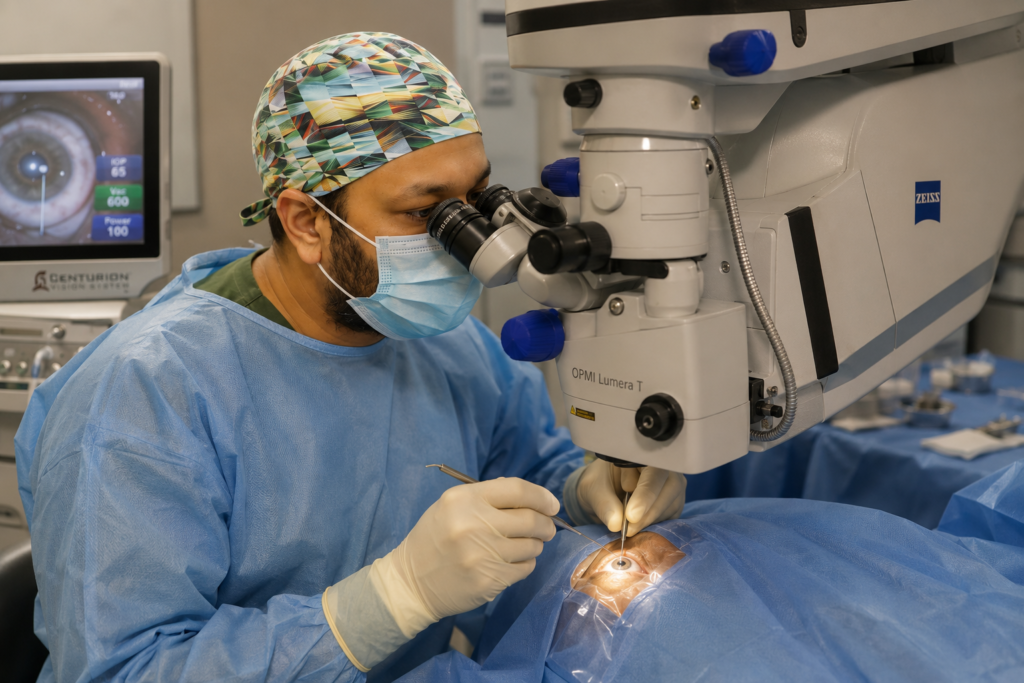
Advanced Cornea Care & Transplant Surgery in Mumbai
Expert cornea treatment by Dr. Jignesh Gala – Cornea Transplant (PK, DSEK, DMEK), Keratoconus treatment with C3R, and advanced corneal care. 162,000+ patients treated with cutting-edge technology and compassionate care.

Pentacam | OCT | Topography
Understanding the Cornea
The cornea is the clear, dome-shaped front surface of the eye that acts as a powerful lens, focusing light onto the retina to create clear vision. Often called the “window of the eye,” the cornea is responsible for approximately two-thirds of the eye’s focusing power.
The cornea is unique among body tissues because it contains no blood vessels, receiving its nutrients from tears and the aqueous humour inside the eye. This avascular nature makes the cornea both highly transparent and susceptible to certain diseases. It is composed of five distinct layers, each playing a critical role in maintaining clear vision.
At Crystal Clear Eye and Topax Eye Care, Dr. Jignesh Gala provides comprehensive cornea care ranging from routine examinations to complex transplant surgeries, using the most advanced diagnostic and surgical technology available in Mumbai.
The Five Layers of the Cornea
- Epithelium – Outer protective layer, heals quickly from minor injuries
- Bowman’s Layer – Strong collagen barrier preventing corneal swelling
- Stroma – Thickest layer (90% of cornea), provides structure and strength
- Descemet’s Membrane – Thin but strong membrane protecting the endothelium
- Endothelium – Single cell layer that pumps fluid out, keeping cornea clear

The cornea is the most sensitive tissue in the human body, with approximately 7,000 nerve endings per square millimetre – 300-600 times more sensitive than skin. This is why even a tiny eyelash or speck of dust causes immediate discomfort. The cornea is also the fastest healing tissue in the body, with the epithelium able to regenerate completely within 24-48 hours after minor injuries.
Cornea Diseases We Treat
Dr. Jignesh Gala diagnoses and treats all types of corneal conditions, from common infections to complex diseases requiring advanced surgical intervention. Early diagnosis and treatment are crucial for preserving vision.
| Cornea Disease | Description | Symptoms | Treatment Options |
|---|---|---|---|
| Keratoconus | Progressive thinning causing cone-shaped cornea, typically begins in teens/20s | Blurred vision, frequent glasses prescription changes, glare, halos at night, ghosting of images | RGP lenses, C3R Cross-Linking, INTACS rings, Cornea Transplant |
| Corneal Scarring | Opaque scar tissue from previous infection, injury, or inflammation | Cloudy vision, light sensitivity, reduced visual acuity, cosmetic disfigurement | Topical medications (if active), PK/DMEK Transplant, Phototherapeutic Keratectomy (PTK) |
| Fuchs’ Dystrophy | Gradual loss of endothelial cells causing corneal swelling and clouding | Blurry morning vision that clears during the day, glare, halos, gritty sensation, pain from bullae | Hypertonic saline drops (early), DMEK/DSEK Transplant (advanced) |
| Corneal Ulcer | Serious infection of the cornea (bacterial, viral, fungal, or parasitic) | Severe pain, redness, discharge, white spot on cornea, blurred vision, photophobia | Intensive antimicrobial eye drops, oral medications, therapeutic contact lenses, Emergency PK if perforated |
| Pterygium | Fleshy growth extending from conjunctiva onto the cornea | Redness, irritation, foreign body sensation, blurred vision if over pupil, cosmetically visible growth | Lubricating drops (small), Pterygium Excision with Graft (large/symptomatic) |
| Dry Eye Disease | Chronic insufficient tear production or poor tear quality affecting corneal surface | Burning, gritty sensation, redness, fluctuating vision, excessive tearing (reflex), discomfort with contact lenses | Artificial tears, prescription drops (Cyclosporine/Lifitegrast), punctal plugs, intense pulsed light (IPL), amniotic membrane |
| Bullous Keratopathy | Swelling of the cornea with blister-like formations causing pain and vision loss | Severe pain (especially on waking), blurred vision, foreign body sensation, photophobia | Hypertonic saline, bandage contact lens, DMEK/DSEK Transplant |
| Corneal Dystrophies | Genetic disorders causing abnormal material buildup in cornea layers | Variable – gradual vision decline, glare, halos, foreign body sensation, epithelial erosions | Observation (mild), PTK, PK/DMEK (severe), specialized contact lenses |
* Early diagnosis is critical for all corneal diseases. If you experience any of these symptoms, call 077188 85245 immediately for an appointment with Dr. Jignesh Gala.
Types of Cornea Transplant
Dr. Jignesh Gala performs all modern cornea transplant techniques at his state-of-the-art surgical facilities in Mumbai. The choice of procedure depends on which corneal layer is affected and the underlying condition.
| Feature | PK (Penetrating Keratoplasty) | DSEK | DMEK |
|---|---|---|---|
| Full Name | Penetrating Keratoplasty | Descemet’s Stripping Endothelial Keratoplasty | Descemet’s Membrane Endothelial Keratoplasty |
| What is Transplanted | Full-thickness cornea (all 5 layers) | Endothelium + Descemet’s membrane + thin stromal layer (100-150 microns) | Endothelium + Descemet’s membrane only (15-20 microns) |
| Incision Size | 360-degree circular (full circumference) | 4-5 mm small incision | 2-3 mm micro-incision |
| Sutures Required | Yes (16-24 sutures, removed over 1-2 years) | Minimal or none (self-sealing) | No sutures (air bubble holds graft) |
| Best For | Deep corneal scars, Keratoconus (severe), Corneal infections, Trauma | Fuchs’ dystrophy, Bullous keratopathy, Failed previous PK | Fuchs’ dystrophy, Bullous keratopathy (preferred), Pseudophakic corneal edema |
| Recovery Time | 6-12 months | 2-3 months | 1-2 months |
| Visual Quality | Good (may need RGP lenses for best vision) | Very good | Excellent (best visual acuity) |
| Rejection Rate | 15-20% | 12-15% | <10% (lowest) |
| Cost in Mumbai | Rs. 50,000 – 1,00,000 | Rs. 60,000 – 1,00,000 | Rs. 70,000 – 1,20,000 |
| Insurance Coverage | ✓ Covered | ✓ Covered | ✓ Covered |
* Costs are indicative and include donor cornea, surgical fees, hospital charges, and initial medications. Actual costs vary by case complexity. Cashless facility available.
💉 PK – Full Thickness
Penetrating Keratoplasty replaces the entire damaged cornea with a full-thickness donor cornea. It is the traditional and most established technique, used when all layers of the cornea are affected. Dr. Gala uses advanced suturing techniques to minimize astigmatism and optimize visual outcomes.
⚡ DSEK – Partial Thickness
DSEK replaces only the inner endothelial layer along with a thin stromal backing. This minimally invasive approach preserves the patient’s own corneal structure, resulting in faster recovery, fewer complications, and no suture-related issues.
🌟 DMEK – Most Advanced
DMEK is the most advanced cornea transplant technique, replacing only the Descemet’s membrane and endothelium (15-20 microns thick). It offers the fastest visual recovery, best visual quality, lowest rejection rate, and strongest post-operative eye. Dr. Gala is among the few surgeons in Mumbai performing DMEK regularly.
DMEK has revolutionized cornea transplant surgery for endothelial disorders. By transplanting only the thinnest possible tissue, DMEK preserves the patient’s corneal structure completely, resulting in: faster visual recovery (days vs months), better visual acuity (often 20/20 or better), lowest rejection rate (<10%), no suture-related complications, and stronger eye after surgery. Dr. Jignesh Gala recommends DMEK for all suitable patients with Fuchs’ dystrophy, bullous keratopathy, and other endothelial conditions.
Keratoconus Treatment in Mumbai

Keratoconus is a progressive eye disease where the normally round cornea thins and begins to bulge into a cone-like shape. This distortion causes light entering the eye to be defocused, resulting in blurred and distorted vision that cannot be corrected with regular glasses.
Keratoconus typically begins during adolescence or early adulthood and progressively worsens through the 20s and early 30s. Early detection and treatment are crucial to halt progression and preserve vision. Dr. Jignesh Gala has extensive experience in managing Keratoconus at all stages, from early diagnosis with advanced topography to complex cornea transplant for advanced cases.
At Crystal Clear Eye and Topax Eye Care, we follow a progressive treatment approach based on disease severity:
Keratoconus Treatment Ladder – From Early to Advanced
Keratoconus is a bilateral progressive condition that worsens over time without treatment. The earlier C3R is performed, the better the outcome. If you or your child experiences frequent prescription changes, blurry vision not corrected by glasses, or increased glare, schedule a comprehensive corneal evaluation with Dr. Jignesh Gala immediately. Our advanced Pentacam HR and Corneal Topography can detect Keratoconus years before symptoms become severe. WhatsApp us for a Keratoconus screening appointment.
Signs You May Have Keratoconus
Frequent Prescription Changes
Your glasses prescription changes significantly every 3-6 months, especially increasing astigmatism.
Blurry/Distorted Vision
Vision remains blurry or distorted even with new glasses, with shadowing or ghosting of images.
Glare and Light Sensitivity
Increased glare, halos around lights, and difficulty driving at night due to light scatter.
Advanced Diagnostic Technology
Accurate diagnosis is the foundation of successful cornea treatment. Dr. Jignesh Gala’s clinic is equipped with the most advanced corneal diagnostic equipment available, ensuring precise diagnosis and treatment planning for every patient.
🌀 Corneal Topography
Creates a detailed color map of the corneal surface, measuring thousands of points to detect irregularities like Keratoconus, astigmatism, and post-surgical changes. Essential for Keratoconus diagnosis, contact lens fitting, and pre-operative planning for cornea transplant.
🎯 Pentacam HR
The gold standard for 3D corneal analysis. Uses Scheimpflug imaging to capture 25,000 data points per scan, creating a complete three-dimensional model of the entire cornea. Measures corneal thickness (pachymetry) at every point, critical for Keratoconus detection and C3R candidacy assessment.
🔭 OCT Anterior Segment
High-resolution cross-sectional imaging of the cornea and anterior eye structures. Provides micron-level detail of corneal layers, measures graft thickness after DMEK/DSEK, and monitors healing progress after surgery.
📡 Specular Microscopy
Counts and analyses the endothelial cells that keep the cornea clear. Critical for evaluating Fuchs’ dystrophy, monitoring cell loss after surgery, and determining candidacy for endothelial keratoplasty (DMEK/DSEK).
📏 Pachymetry
Measures corneal thickness at multiple locations. Essential for diagnosing Keratoconus (thinned cornea), evaluating glaucoma risk, determining C3R candidacy (minimum thickness required), and planning refractive surgery.
🔧 Biomicroscopy
High-magnification slit-lamp examination for detailed evaluation of all corneal layers, detecting infections, inflammation, dystrophies, and structural abnormalities. Combined with fluorescein staining for epithelial defect detection.
Dr. Jignesh Gala offers a complete cornea evaluation package including all the above diagnostic tests, consultation, and personalized treatment planning. The evaluation typically takes 45-60 minutes and provides a complete picture of your corneal health. Call 077188 85245 or WhatsApp to schedule your cornea evaluation.
Why Choose Dr. Jignesh Gala?

Dr. Jignesh Gala is one of Mumbai’s leading cornea specialists, with extensive fellowship training and over 12 years of experience in diagnosing and treating complex corneal conditions. His expertise spans from routine cornea care to advanced transplant surgery with exceptional outcomes.
World-Class Credentials
- FRCS Glasgow – Royal College of Physicians & Surgeons of Glasgow
- MRCS Edinburgh – Royal College of Surgeons of Edinburgh
- FICO London – Fellow of International Council of Ophthalmology
- Cornea Fellowship from LV Prasad Eye Institute, Hyderabad
- 12+ years of dedicated ophthalmic surgical experience
Why Patients Trust Dr. Gala for Cornea Care
🏆 Cornea Specialist Expertise
Specialized fellowship training in cornea and external diseases, with expertise in all transplant techniques including advanced DMEK.
🔦 Advanced Technology
Pentacam HR, OCT Anterior Segment, Specular Microscopy, and advanced surgical microscopes for precise diagnosis and treatment.
💳 Complete Cashless
Direct cashless at Topax Eye Care, TPA cashless at Crystal Clear Eye – all major insurers covered for cornea procedures.
👩⚕️ Personalised Care
Individual treatment plans tailored to each patient’s condition, lifestyle, and visual needs with compassionate follow-up care.
Dr. Jignesh Gala is joined by Dr. Namrata Bhuta, Co-Director at Topax Eye Care. Together, they provide comprehensive ophthalmic care including cornea, cataract, retina, glaucoma, LASIK, and paediatric eye services. Their combined expertise ensures every patient receives the most appropriate and effective treatment.
Insurance Coverage for Cornea Surgery
Cornea transplant surgery and related procedures are covered under most health insurance policies in India as they are medically necessary treatments. At Dr. Jignesh Gala’s facilities, we have empaneled 30+ insurance companies to ensure seamless cashless treatment for cornea patients.
Coverage by Insurance Type
| Insurance Type | Coverage for Cornea Transplant | Waiting Period | Cashless at Our Centres |
|---|---|---|---|
| Individual / Family Floater | Covered up to Sum Insured (typically Rs. 50,000-2,00,000) | 2 – 4 years | ✓ Available |
| Senior Citizen Policy | Covered up to policy limit | 1 – 2 years | ✓ Available |
| Group / Employer Policy | Full coverage as per policy terms | 0 – 1 year | ✓ Available |
| CGHS (Central Govt.) | Full cashless coverage for PK/DSEK/DMEK | No waiting period | ✓ Empanelled |
| ECHS (Ex-Servicemen) | Full cashless coverage | No waiting period | ✓ Empanelled |
| Ayushman Bharat (PM-JAY) | Up to Rs. 5 lakh family/year | No waiting period | ✓ Empanelled |
| ESIC (Employees) | Full cashless coverage | No waiting period | ✓ Empanelled |
| Star Health | Covered up to SI | 24 months (varies by plan) | ✓ Direct Cashless |
| HDFC ERGO | Covered up to SI | 24 months | ✓ Direct Cashless |
| ICICI Lombard | Covered up to SI | 24 months | ✓ Direct Cashless |
| Bajaj Allianz | Covered up to SI | 24 months | ✓ Direct Cashless |
| Care Health | Covered up to SI | 24 – 48 months | ✓ Direct Cashless |
| Niva Bupa | Covered up to SI | 24 months | ✓ Direct Cashless |
* Coverage limits and waiting periods are indicative and may vary by specific policy/plan. Our insurance desk will verify your exact coverage. IRDAI guidelines mandate coverage for medically necessary procedures including cornea transplant.
Insurance Companies We Accept for Cornea Surgery
Dr. Jignesh Gala’s facilities are empaneled with all major insurance companies for direct and TPA cashless cornea surgery:
We are empaneled for CGHS (cghs.nic.in), ECHS, Ayushman Bharat PM-JAY (pmjay.gov.in), and ESIC. Government beneficiaries can avail of completely cashless cornea surgery including cornea transplant at no out-of-pocket cost. Our insurance desk assists with all documentation for government scheme patients.
Cashless Process for Cornea Transplant
Our dedicated insurance desk at Topax Eye Care and Crystal Clear Eye handles the entire cashless process from start to finish. Here’s what to expect:

Required Documents for Cashless Cornea Surgery
- Health Insurance Policy / Card (Original + Photocopy)
- Government Photo ID Proof (Aadhaar/PAN/Passport)
- 2 Passport-size Photographs
- Dr. Gala’s Prescription recommending surgery
- Pre-operative Investigation Reports
- Previous Eye Check-up Reports (if any)
- Filled Pre-Authorisation Form
- Bank Account Details (for reimbursement if needed)
Donor cornea is arranged through registered eye banks and its cost is typically included in the surgical package. For government scheme patients (CGHS/ECHS/Ayushman), donor cornea cost is fully covered. Our team coordinates with the eye bank to ensure availability before scheduling surgery.
Recovery Timeline After Cornea Transplant
Understanding the recovery process helps patients prepare for their post-operative journey. Recovery varies by transplant type and individual healing factors. Dr. Jignesh Gala provides detailed post-operative instructions and closely monitors every patient’s healing progress.
💉 After PK (Penetrating Keratoplasty)
⚡ After DSEK
🌟 After DMEK (Fastest Recovery)
Critical for successful outcomes: Use ALL prescribed eye drops exactly as directed (especially steroid drops to prevent rejection). Do NOT rub or press on the operated eye. Wear protective eyewear (glasses/shield) as advised. Avoid dusty environments, swimming, and heavy lifting for 4-6 weeks. Attend ALL scheduled follow-up appointments. Report immediately if you experience increased redness, pain, decreased vision, or light sensitivity – these could be signs of rejection. Dr. Gala provides 24/7 support for post-operative concerns.
Frequently Asked Questions About Cornea Transplant
Find answers to the most commonly asked questions about cornea transplant surgery, Keratoconus treatment, and recovery. For personalized advice, consult Dr. Jignesh Gala directly.
A cornea transplant (keratoplasty) is a surgical procedure where a damaged or diseased cornea is replaced with healthy donor corneal tissue. It is one of the most common and successful transplant surgeries, with over 90% success rate. Types include PK (full-thickness), DSEK (partial thickness), and DMEK (thinnest layer transplant). The cornea is the most transplanted human tissue worldwide because it has no blood vessels, making rejection less common than other organ transplants.
The three main types are: 1) PK (Penetrating Keratoplasty) – full-thickness cornea replacement for deep scars, infections, and advanced Keratoconus. 2) DSEK (Descemet’s Stripping Endothelial Keratoplasty) – replaces the inner endothelial layer, used for conditions like Fuchs’ dystrophy. 3) DMEK (Descemet’s Membrane Endothelial Keratoplasty) – the most advanced technique, transplanting only the Descemet’s membrane and endothelium (15-20 microns), offering fastest recovery, best vision, and lowest rejection rate. Dr. Gala will recommend the best type based on your specific condition.
Keratoconus is a progressive eye disease where the normally round cornea thins and bulges into a cone shape, causing distorted vision. Treatment follows a progression: Early stage – Rigid Gas Permeable (RGP) Contact Lenses. Moderate stage – C3R (Corneal Collagen Cross-Linking with Riboflavin) to halt progression. Advanced stage – INTACS (Corneal Ring Segments). Severe stage – Cornea Transplant (PK/DMEK/DSEK). Dr. Jignesh Gala offers all Keratoconus treatments in Mumbai with advanced diagnostic technology.
Cornea transplant cost in Mumbai varies by procedure: PK (Penetrating Keratoplasty) costs Rs. 50,000-1,00,000. DSEK costs Rs. 60,000-1,00,000. DMEK costs Rs. 70,000-1,20,000. This includes donor cornea, surgery, hospital stay, and initial medications. C3R for Keratoconus costs Rs. 25,000-40,000. Pterygium surgery costs Rs. 15,000-30,000. Most insurance companies cover cornea transplant surgery. Our insurance desk provides detailed cost estimates and verifies coverage before surgery.
Recovery varies by procedure: DMEK offers the fastest recovery at 1-2 months for functional vision. DSEK takes 2-3 months. PK requires 6-12 months for full visual rehabilitation. Most patients notice significant vision improvement within 2-4 weeks after DMEK/DSEK. Regular follow-ups with steroid eye drops are essential during recovery. Dr. Jignesh Gala schedules follow-ups at Day 1, Week 1, Month 1, Month 3, Month 6, and Year 1 to monitor healing.
Cornea transplant rejection occurs when the body’s immune system attacks the donor cornea. Signs include redness, light sensitivity, blurred vision, and pain. Rejection rates vary: DMEK has the lowest rate (under 10%), DSEK has 12-15%, and PK has 15-20%. Prevention is crucial: use steroid eye drops exactly as prescribed, attend all follow-ups, avoid eye trauma, treat any infection promptly, and wear protective eyewear. If caught early, rejection can often be reversed with intensive steroid treatment. Contact Dr. Gala immediately if you notice any warning signs.
Yes, cornea transplant surgery is covered by most health insurance policies in India as it is a medically necessary procedure. All major insurers including Star Health, HDFC ERGO, ICICI Lombard, Bajaj Allianz, Care Health, Niva Bupa, and Aditya Birla cover cornea transplant. Government schemes like CGHS, ECHS, Ayushman Bharat, and ESIC also provide full cashless coverage. Our insurance desk verifies your coverage and handles all documentation for cashless processing.
C3R (Corneal Collagen Cross-Linking) is a minimally invasive procedure that strengthens the cornea to halt the progression of Keratoconus. Riboflavin (Vitamin B2) eye drops are applied to the cornea, which is then exposed to controlled UV-A light. This creates new cross-links between collagen fibres, stiffening the cornea. C3R does not reverse existing damage but stops further progression permanently. The procedure takes about 30 minutes per eye, is performed as day-care, and costs Rs. 25,000-40,000. Ideal for patients with progressive Keratoconus.
A cornea transplant may be needed when: 1) Corneal scarring from infection, trauma, or previous surgery severely affects vision. 2) Keratoconus has progressed beyond what glasses or contact lenses can correct. 3) Fuchs’ dystrophy causes corneal swelling and cloudy vision. 4) Corneal ulcers do not heal with medication and threaten vision. 5) A previous cornea transplant has failed. 6) Congenital corneal opacities block vision. Dr. Jignesh Gala will thoroughly evaluate your condition using advanced diagnostics to determine if a transplant is necessary.
Donor corneas are obtained from registered eye banks after individuals pledge their eyes for donation upon death. In India, eye banks affiliated with AIIMS, state governments, and NGOs collect donor tissue. The donor tissue undergoes rigorous screening for infections (HIV, hepatitis B/C, syphilis) and quality assessment. The waiting time for a donor cornea in Mumbai is typically 1-4 weeks. Eye donation is a noble act – one donor can give sight to two corneal blind individuals. To pledge your eyes, contact your nearest eye bank or hospital.
Cornea transplant has the highest success rate among all organ transplants: DMEK has over 95% success rate for Fuchs’ dystrophy. DSEK has 90-95% success rate. PK has 85-90% for Keratoconus and 70-80% for corneal scarring. Success depends on the underlying condition, patient compliance with medications, regular follow-ups, and surgeon expertise. Dr. Jignesh Gala’s advanced surgical techniques, meticulous patient selection, and comprehensive post-operative care ensure the best possible outcomes for every patient.
Generally, cornea transplant is performed on one eye at a time. The second eye is operated only after the first eye has fully stabilized, typically 6-12 months later. This is because recovery requires close monitoring for signs of rejection, infection, and healing complications. Operating both eyes simultaneously would make monitoring difficult and could leave the patient temporarily without functional vision. The staged approach ensures the best possible outcome for each eye.
While cornea transplant is generally safe, potential complications include: Graft rejection (most common, usually manageable with increased steroids), Infection (rare but serious), Glaucoma (increased eye pressure from steroid drops), Astigmatism (especially after PK), Graft failure (requires re-transplant in 5-10% of cases), and Cataract formation. With Dr. Jignesh Gala’s expertise and meticulous post-operative care, the risk of serious complications is minimal. Regular follow-ups ensure any issues are caught and treated early.
Pterygium is a fleshy, triangular growth from the white of the eye onto the cornea, often caused by UV exposure and dust. Surgery is needed when it grows over the pupil causing vision problems, causes persistent irritation, affects astigmatism, or is cosmetically concerning. Pterygium excision with conjunctival autograft (using the patient’s own tissue) has the lowest recurrence rate (under 5%). The procedure takes 30-45 minutes, is performed under local anaesthesia, and is typically covered by insurance. Recovery takes 2-4 weeks.
Dr. Jignesh Gala performs comprehensive pre-operative diagnostics: Corneal Topography (maps corneal shape), Pentacam HR (3D corneal analysis), OCT Anterior Segment (high-resolution cross-sectional imaging), Specular Microscopy (counts endothelial cells), Pachymetry (measures corneal thickness), Visual Acuity Test, Slit-lamp Examination, Tear Film Analysis, and Blood Tests. These tests determine the exact condition, best surgical approach, and baseline measurements for comparison.
Fuchs’ Endothelial Corneal Dystrophy (FECD) is a progressive genetic disease where the endothelial cells (innermost layer of the cornea) gradually die off. These cells pump fluid out of the cornea to keep it clear. As they decline, the cornea swells and becomes cloudy, causing blurred vision (especially on waking), glare, and discomfort. Early Fuchs’ can be managed with hypertonic saline drops. Advanced cases require DMEK or DSEK surgery to replace the damaged endothelial layer. DMEK is the preferred treatment offering the fastest recovery and best visual outcomes.
You can book a cornea consultation by calling 077188 85245, sending a WhatsApp message to https://wa.me/917718885245, or visiting https://www.crystalcleareye.in. During the consultation, Dr. Jignesh Gala will perform a detailed corneal examination using advanced diagnostic equipment, discuss your condition, recommend the best treatment plan, and our insurance desk will verify your cashless eligibility for surgery if needed.
Both are partial-thickness endothelial keratoplasty procedures. DSEK transplants Descemet’s membrane with a thin stromal backing (100-150 microns thick). DMEK transplants only Descemet’s membrane and endothelium (15-20 microns thick) – the thinnest possible graft. DMEK offers faster visual recovery (weeks vs months), better visual quality (often 20/20), lower rejection rate (under 10% vs 12-15%), and stronger post-operative eye. However, DMEK is more technically demanding and requires an experienced surgeon like Dr. Jignesh Gala.
Yes, most patients need glasses or contact lenses after cornea transplant. After PK, rigid gas permeable (RGP) contact lenses often provide better vision than glasses due to residual astigmatism. After DMEK/DSEK, glasses are usually sufficient. Scleral lenses are an excellent option for post-transplant patients with irregular corneas. Dr. Gala’s team provides comprehensive contact lens fitting services. Final glasses or contact lens prescription is typically given 6-12 months after surgery once the cornea has fully stabilized.
Cornea transplant surgery is performed as a day-care procedure under local or general anaesthesia: DMEK takes 30-45 minutes, DSEK takes 45-60 minutes, and PK takes 60-90 minutes. The patient can go home the same day. Surgery is painless, and most patients experience only mild discomfort, gritty sensation, and light sensitivity for the first few days. Dr. Jignesh Gala uses the latest surgical techniques and equipment to ensure optimal outcomes and patient comfort throughout the procedure.
Book Your Cornea Consultation Today
Don’t let corneal disease compromise your vision. Dr. Jignesh Gala and his team are ready to provide expert diagnosis and personalized treatment. Whether you need Keratoconus screening, C3R treatment, or cornea transplant evaluation, we are here to help.