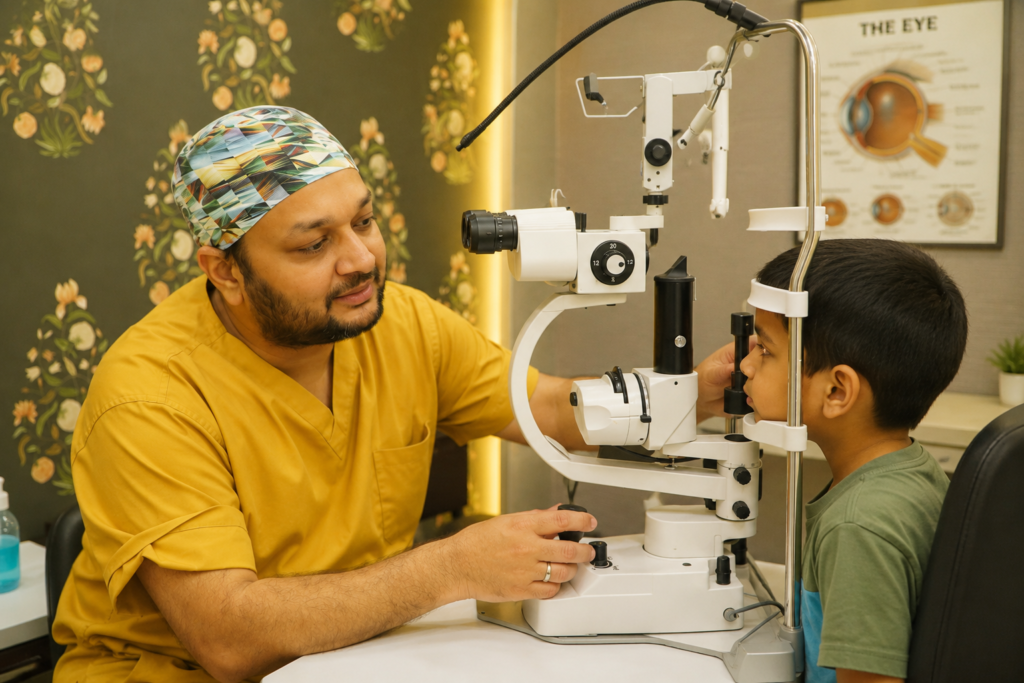
Complete Pediatric Eye Care: From 1 Month to 18 Years
Expert pediatric eye care in Mumbai by Dr. Jignesh Gala – ROP screening, squint surgery, lazy eye treatment, pediatric cataract & more. Child-friendly environment with cashless facility.

Cashless Facility Available
Why Children’s Eye Care is Different
Children’s eyes are not simply smaller versions of adult eyes. They are dynamic, developing organs that require specialized expertise, equipment, and a uniquely gentle approach. Early childhood is a critical window for visual development, and any problem during this period can have lifelong consequences.
At Crystal Clear Eye and Topax Eye Care, Dr. Jignesh Gala and Dr. Namrata Bhuta understand that examining a child’s eye requires patience, specialized skills, and child-friendly equipment. With over 15,000 children treated and 3,200+ pediatric surgeries performed, our team has the experience parents can trust.
Key Differences in Pediatric Eye Care
- Eyes are still developing – the visual system matures until age 8-10
- Children cannot communicate vision problems verbally
- Requires specialized pediatric examination equipment
- Surgery often needs general anesthesia
- Early treatment prevents permanent vision loss (amblyopia)
- Need for orthoptic assessment and vision therapy
- Parental counseling and involvement is essential
- Long-term follow-up for growing eyes

The first 8 years of life represent the “critical period” for visual development. During this time, the brain learns to process images from the eyes. If one eye sends a blurry image (due to refractive error, cataract, or squint), the brain will ignore that eye – leading to permanent vision loss (amblyopia or lazy eye). This is why early detection and treatment by a pediatric eye specialist like Dr. Jignesh Gala is absolutely essential. Once the critical period passes, vision lost to amblyopia cannot be recovered.
Pediatric Eye Conditions We Treat
Dr. Jignesh Gala treats the full spectrum of pediatric eye conditions across all age groups – from premature newborns to teenagers. Every child receives personalized, age-appropriate care.
👶 Newborn to 1 Year
- ROP Screening & Laser – for premature babies to prevent blindness
- Congenital Cataract – clouding present at birth, needs early surgery
- Congenital Glaucoma – rare but serious, causes enlarged cloudy eyes
- NLDO (Blocked Tear Ducts) – very common, causes constant watering
- Congenital Ptosis – drooping eyelid that may block vision
👦 1 to 5 Years
- Amblyopia (Lazy Eye) – patching, vision therapy to restore sight
- Strabismus (Squint) – eye muscle misalignment correction
- Refractive Errors – glasses for young children
- NLDO Surgery – if blocked tear duct persists beyond 12 months
- Pediatric Cataract Surgery – early intervention critical
👧 5 to 18 Years
- Myopia Management – progressive glasses, atropine drops
- Squint Surgery – most common pediatric eye surgery
- Pediatric Cataract Surgery – with IOL implantation
- Eye Allergies & Infections – seasonal and chronic
- Computer Vision Syndrome – digital eye strain in kids
- Sports Eye Injuries – trauma management and prevention
Squint (strabismus) affects 4-5% of children in India, and amblyopia (lazy eye) affects 2-3% of children. These conditions often go unnoticed by parents because children adapt well and may not complain. Regular eye checkups are the only way to catch these conditions early when treatment is most effective. Dr. Jignesh Gala recommends all children have their first comprehensive eye examination by age 1, and annually once they start school.
Pediatric Eye Surgeries
Dr. Jignesh Gala performs all major pediatric eye surgeries at Topax Eye Care with advanced equipment and pediatric anesthesia support. All procedures include comprehensive pre-operative evaluation and post-operative care.
| Surgery | Description | Age Group | Cost Range | Insurance |
|---|---|---|---|---|
| ROP Laser Treatment | Laser therapy to stop abnormal retinal blood vessel growth in premature babies | Preemies (4-12 weeks) | ₹15,000 – 25,000/session | Covered under family floater |
| Pediatric Cataract Surgery | Removal of cloudy lens with IOL implant or contact lens fitting | Newborn – 18 years | ₹30,000 – 50,000 | Covered |
| Squint/Strabismus Surgery | Eye muscle realignment for crossed or wandering eyes | 6 months – 18 years | ₹20,000 – 35,000 | Covered |
| Congenital Glaucoma Surgery | Goniotomy/trabeculotomy to reduce eye pressure | Newborn – 2 years | ₹25,000 – 40,000 | Covered |
| NLDO Surgery (Probing) | Opening blocked tear duct with a tiny probe | 12 months – 3 years | ₹15,000 – 25,000 | Covered |
| Ptosis Correction | Eyelid lift surgery for drooping eyelid | 3 – 18 years | ₹20,000 – 35,000 | Covered (if vision blocked) |
| Amblyopia Treatment | Patching, atropine drops, vision therapy – OPD based | 2 – 10 years | OPD based (₹500-2,000/visit) | OPD limits apply |
* Costs are indicative and may vary based on complexity, anesthesia type, and hospital stay. Insurance coverage is subject to policy terms and waiting periods.
ROP Screening: Saving Premature Babies’ Sight

Retinopathy of Prematurity (ROP) is a potentially blinding eye disorder that primarily affects premature babies born before 32 weeks of gestation or weighing less than 1.5 kg. It is one of the leading causes of preventable childhood blindness in India.
At Topax Eye Care, Dr. Jignesh Gala provides comprehensive ROP screening and treatment using advanced pediatric retinal imaging equipment. Our team works closely with NICU doctors across Mumbai to ensure no premature baby misses this critical screening.
Who Needs ROP Screening?
- Babies born before 32 weeks of gestation
- Birth weight less than 1,500 grams
- Babies who received oxygen therapy for extended periods
- Multiple births (twins, triplets) with prematurity
- Babies with associated risk factors (sepsis, blood transfusions)
ROP Screening Timeline
When detected early and treated promptly, ROP laser treatment has a success rate of over 90% in preventing blindness. The key is timely screening within the recommended window. Dr. Jignesh Gala has successfully treated hundreds of premature babies, preserving their vision for a lifetime. If your baby was born premature, do not delay ROP screening – call 077188 85245 today.
When to Bring Your Child: Warning Signs
Children often cannot communicate vision problems. As a parent, watch for these warning signs at different ages. If you notice any of these signs, book an appointment with Dr. Jignesh Gala immediately.
| Age Group | Warning Signs to Watch For | Action Needed |
|---|---|---|
| Newborn – 1 Year | Constant eye rubbing, excessive tearing/crusting, white pupil (leukocoria), inability to track objects by 3 months, extreme light sensitivity, one eye larger than other, drooping eyelid | Urgent consultation within 24-48 hours for white pupil or enlarged eye |
| 1 – 3 Years | Squinting, sitting too close to TV, misaligned eyes, frequent stumbling, not recognizing familiar faces, delayed speech or motor milestones | Schedule comprehensive eye exam within 1 week |
| 3 – 5 Years | Crossed or wandering eyes, complaints of headache, avoiding coloring/drawing, covering one eye, excessive blinking, red or watery eyes constantly | Book pediatric eye checkup as soon as possible |
| 5 – 12 Years | Difficulty reading, holding books too close, poor school performance, complaints of blurry vision, frequent eye rubbing, avoiding near-work, double vision | Schedule eye exam before next school term |
| Teenagers (13-18) | Rapidly increasing glasses power, difficulty seeing board, headaches with study, eye strain with screens, sports-related eye injuries, contact lens intolerance | Annual eye exam; urgent visit for injuries |
Bring your child for immediate emergency eye care if you notice: a white pupil in photos (could be retinoblastoma, a serious eye cancer), sudden vision loss, chemical splash in the eye, penetrating eye injury, severe eye pain, or sudden onset of crossed eyes with headache/vomiting. Call 077188 85245 immediately for eye emergencies.
Our Child-Friendly Approach

We understand that visiting an eye doctor can be intimidating for children. That’s why both Crystal Clear Eye Clinic and Topax Eye Care have been designed with your child’s comfort as our top priority.
Dr. Jignesh Gala and Dr. Namrata Bhuta have developed a reputation for being gentle, patient, and exceptionally skilled at putting anxious children at ease. Many parents tell us their children actually look forward to their follow-up visits!
What Makes Us Child-Friendly
- Warm, colorful waiting area with toys, books, and games
- Gentle examination techniques that don’t frighten children
- Child-sized examination equipment and furniture
- Experienced with anxious, non-cooperative, and special needs children
- Age-appropriate explanations that children understand
- Parents present during examination for reassurance
- Pediatric anesthesia team for surgical procedures
- Special needs children handled with extra care and patience
Schedule the appointment when your child is well-rested (morning is best). Bring their favorite toy or comfort item. Explain simply that the doctor will look at their eyes with special lights. Avoid using words like “pain,” “needle,” or “injection.” Be calm and positive – children pick up on parental anxiety. After the visit, praise your child for being brave. Dr. Gala’s team is experienced in handling first-time visits and will ensure your child feels comfortable throughout.
Insurance for Pediatric Eye Surgery
Most pediatric eye surgeries are covered by health insurance. At Topax Eye Care, our dedicated insurance desk helps parents navigate the claims process smoothly so they can focus on their child’s care.
Family Floater Policies
Pediatric eye surgeries including squint surgery, pediatric cataract, ROP treatment, NLDO surgery, and ptosis correction are covered under most family floater health insurance policies. The child must be covered as a dependent under the parent’s policy.
Maternity/Newborn Add-ons
Some policies offer maternity add-ons that cover congenital conditions in newborns from day 1. This is particularly important for ROP screening, congenital cataract surgery, and congenital glaucoma treatment in premature babies.
Government Schemes
CGHS (Central Government Health Scheme) covers all pediatric eye surgeries for eligible government employees and their dependents. PM-JAY (Ayushman Bharat) covers pediatric cataract and squint surgery for eligible families. ECHS covers defense personnel families.
Cashless at Topax Eye Care
Topax Eye Care offers cashless facility for all major insurance companies including Star Health, HDFC ERGO, ICICI Lombard, Bajaj Allianz, Care Health, Niva Bupa, Aditya Birla Health, and 25+ more. Our insurance desk handles pre-authorization for you.
Most health insurance policies have a waiting period of 2-4 years for specific illnesses, but accidental injuries and congenital conditions in newborns covered from day 1 under maternity add-ons are exceptions. Group/employer policies typically have shorter waiting periods. Always verify your policy coverage before scheduling surgery. Our insurance team at Topax Eye Care will check your eligibility and guide you through the process. Call 077188 85245 for insurance verification.
Cashless Process for Children
The cashless process for pediatric eye surgery involves some additional documentation for minors. Our insurance desk at Topax Eye Care guides parents through every step.
Documents Required for Pediatric Cashless Claims
| Document | Purpose | Provided By |
|---|---|---|
| Parent’s Health Insurance Card | Primary identification for cashless eligibility | Parent/Policyholder |
| Child’s Birth Certificate | Age proof and relationship to policyholder | Parent |
| Parent’s Government ID Proof | Identity verification of policyholder | Parent |
| Pediatrician/Doctor Referral | Medical necessity documentation | Referring Doctor |
| Previous Eye Reports | Medical history and baseline assessment | Parent |
| Passport Photos of Child | TPA documentation requirement | Parent |
| TPA Pre-Authorization Form | Cashless approval request form | Hospital Insurance Desk |
| NICU Discharge Summary | For ROP screening – prematurity documentation | NICU/Hospital |
Meet Mumbai’s Trusted Pediatric Eye Specialist

Dr. Jignesh Gala
Senior Consultant Ophthalmologist | Pediatric Eye Surgeon
Dr. Jignesh Gala is one of Mumbai’s most experienced pediatric eye specialists, with over 12 years of dedicated practice in children’s eye care. Having trained at the prestigious LV Prasad Eye Institute and earned international qualifications including FRCS Glasgow, MRCS Edinburgh, and FICO London, Dr. Gala brings world-class expertise to every pediatric patient.
As the founder of Crystal Clear Eye Clinic and co-director of Topax Eye Care, Dr. Gala has treated over 15,000 children and performed 3,200+ pediatric surgeries including complex squint corrections, pediatric cataracts, ROP treatments, and congenital eye disorder surgeries. His gentle approach and exceptional surgical skills have made him the preferred choice for parents across Mumbai.
Credentials & Training
- ● FRCS – Royal College of Physicians & Surgeons of Glasgow
- ● MRCS – Royal College of Surgeons of Edinburgh
- ● FICO – Fellowship of International Council of Ophthalmology, London
- ● Advanced Training – LV Prasad Eye Institute
Dr. Namrata Bhuta
Co-Director, Topax Eye Care | Pediatric Eye Specialist
Dr. Namrata Bhuta is the co-director at Topax Eye Care and specializes in pediatric ophthalmology. Her warm, nurturing approach makes her especially popular among young patients and their parents. She works closely with Dr. Gala to provide comprehensive children’s eye care services.
Dr. Bhuta’s expertise includes pediatric eye examination, amblyopia therapy, strabismus evaluation, and post-operative care for pediatric surgical patients. Her ability to connect with children and make them feel comfortable during examinations is invaluable in ensuring accurate diagnoses in young patients.
Together, Dr. Gala and Dr. Bhuta lead a dedicated pediatric eye care team that has helped thousands of children achieve their best possible vision across Mumbai.
Frequently Asked Questions
Find answers to common questions about pediatric eye care, surgery, anesthesia, and recovery. For personalized advice, consult Dr. Jignesh Gala.
Every child should have their first comprehensive eye examination between 6 months to 1 year of age. Premature babies (born before 32 weeks or weighing less than 1.5 kg) need ROP screening within 4-6 weeks after birth. School-age children should have annual eye checkups to detect refractive errors and other vision problems early.
ROP (Retinopathy of Prematurity) screening is a specialized eye examination for premature babies to detect abnormal blood vessel growth in the retina. Babies born before 32 weeks of gestation or weighing less than 1.5 kg are at risk. If left untreated, ROP can cause permanent blindness. Screening is done 4-6 weeks after birth using pediatric retinal imaging. Early-stage ROP can be treated with laser therapy, which has a success rate of over 90%.
Warning signs vary by age. In infants (0-1 year): constant eye rubbing, excessive tearing, white pupil, inability to track objects, and extreme sensitivity to light. In toddlers (1-5 years): squinting, sitting too close to TV, frequent headaches, misaligned eyes, and delayed developmental milestones. In school-age children (5-18 years): difficulty reading, holding books too close, complaints of blurry vision, poor school performance, frequent eye rubbing, and avoiding near-work activities. If you notice any of these signs, consult a pediatric eye specialist immediately.
Squint or strabismus is a condition where the eyes do not align properly and point in different directions. It affects 4-5% of children in India. Treatment options include prescription glasses, eye exercises (orthoptic therapy), prism therapy, and squint surgery. Squint surgery is a day-care procedure that takes 30-60 minutes under general anesthesia in children. The success rate is 85-95%, and most children recover within 1-2 weeks. Early treatment is crucial to prevent amblyopia (lazy eye).
Amblyopia or lazy eye is reduced vision in one eye due to abnormal visual development during childhood. It affects 2-3% of children and is the most common cause of vision loss in children. Treatment involves correcting the underlying cause (glasses for refractive errors), patching the stronger eye for 2-6 hours daily to force the lazy eye to work, atropine eye drops as an alternative to patching, and vision therapy exercises. Treatment is most effective before age 7, though older children can also show improvement.
Yes, pediatric eye surgery is very safe when performed by an experienced pediatric ophthalmologist. At Topax Eye Care and Crystal Clear Eye, Dr. Jignesh Gala uses advanced pediatric surgical equipment and techniques. All pediatric surgeries are performed under general anesthesia administered by a qualified pediatric anesthetist. Pre-operative evaluations include comprehensive health checks, and our child-friendly surgical protocols ensure minimal anxiety and optimal outcomes.
The cost of pediatric eye surgery in Mumbai ranges from Rs. 15,000 to Rs. 50,000 depending on the procedure. ROP laser treatment costs Rs. 15,000-25,000 per session. Squint surgery costs Rs. 20,000-35,000. Pediatric cataract surgery costs Rs. 30,000-50,000. Congenital glaucoma surgery costs Rs. 25,000-40,000. NLDO (blocked tear duct) surgery costs Rs. 15,000-25,000. Most procedures are covered by health insurance under family floater policies.
Yes, most pediatric eye surgeries are covered under family floater health insurance policies. Coverage includes ROP screening and treatment, squint surgery, pediatric cataract surgery, NLDO surgery, and congenital eye condition treatments. Some policies cover these under maternity/newborn add-ons. Government schemes like CGHS, ECHS, and PM-JAY also cover pediatric eye surgeries. Our insurance desk at Topax Eye Care assists with all cashless documentation for pediatric cases.
Congenital cataract is a clouding of the eye’s lens present at birth. It affects approximately 3-5 per 10,000 live births in India. If the cataract is dense and blocks the visual axis, surgery should ideally be performed within the first 6-8 weeks of life to prevent permanent vision loss (amblyopia). The procedure involves removing the cloudy lens and implanting a specialized pediatric IOL or using contact lenses. Post-surgery, the child needs regular follow-ups and amblyopia therapy.
Examining a baby’s eyes requires specialized techniques and equipment. At Crystal Clear Eye, we use handheld slit lamps, portable retinoscopes, pediatric autorefractors, and indirect ophthalmoscopy for retinal examination. For infants and non-cooperative children, we use cycloplegic eye drops to temporarily paralyze focusing muscles for accurate refraction. Dilating drops allow a thorough retinal examination. For premature babies, ROP screening is done using a pediatric RetCam or indirect ophthalmoscope in the NICU or clinic.
Myopia management refers to treatments aimed at slowing the progression of nearsightedness in children. Options include: progressive glasses lenses, low-dose atropine eye drops (0.01-0.05%), orthokeratology (overnight contact lenses), and increased outdoor time (2+ hours daily). At Crystal Clear Eye, Dr. Jignesh Gala provides customized myopia management plans based on the child’s age, rate of progression, and lifestyle. Regular monitoring every 6 months is essential to adjust treatment.
Yes, most blocked tear ducts (NLDO or nasolacrimal duct obstruction) in babies resolve spontaneously by 12 months of age. Conservative treatment includes gentle massage of the tear sac 2-3 times daily and antibiotic eye drops during infections. If the blockage persists beyond 12 months, a simple office procedure called probing can be done. If probing fails, a more permanent surgical procedure called dacryocystorhinostomy (DCR) or balloon dilatation may be needed. The success rate of probing is over 90%.
The ideal age for squint surgery depends on the type and severity. For congenital squints (present from birth), surgery is often recommended between 6-24 months of age to allow proper visual development. For accommodative squints (related to focusing), surgery is considered after glasses prescription, typically between 2-6 years. For intermittent squints, surgery timing is based on progression and frequency. Early surgery is crucial to prevent amblyopia and restore binocular vision (3D vision).
Squint surgery corrects the alignment of the eyes but does not replace the need for glasses if a refractive error exists. Many children with squint also have significant refractive errors (farsightedness, nearsightedness, or astigmatism). Glasses are often prescribed before surgery and may need to be continued after surgery. In some cases, the glasses prescription may need to be adjusted after surgery. Regular follow-ups are essential to monitor both eye alignment and vision.
Recovery time varies by procedure. For squint surgery, most children resume normal activities within 5-7 days, with complete healing in 2-3 weeks. For pediatric cataract surgery, vision improves within days, but glasses/contact lens fitting and amblyopia therapy continue for months. For ROP laser, recovery is immediate but follow-up is needed to ensure the retina remains stable. For NLDO probing, recovery is within 24 hours. Dr. Jignesh Gala provides detailed post-operative care instructions and schedules regular follow-ups.
Pediatric ophthalmologists undergo additional specialized fellowship training in children’s eye care after completing their ophthalmology residency. They are skilled in examining non-cooperative children, using specialized pediatric equipment, performing surgery under general anesthesia, and managing developmental eye conditions. Children’s eyes are not just smaller versions of adult eyes – they are still developing, which means early intervention can have a lifelong impact. A pediatric eye specialist like Dr. Jignesh Gala understands these unique aspects and provides age-appropriate care.
Yes, both Crystal Clear Eye Clinic and Topax Eye Care are designed with children in mind. We have a warm, welcoming environment with child-friendly decor, toys, and books in the waiting area. Our examination rooms are equipped with pediatric-sized instruments. Dr. Jignesh Gala and Dr. Namrata Bhuta are experienced in handling anxious children with patience and gentle techniques. We explain procedures in an age-appropriate way and involve parents throughout the process. Our staff is trained to make every child’s visit as comfortable as possible.
Congenital glaucoma is a rare but serious condition where increased eye pressure damages the optic nerve, present at birth or developing in early infancy. It affects 1 in 10,000 births. Warning signs include enlarged eyes, excessive tearing, light sensitivity, and cloudy corneas. Treatment is primarily surgical, with procedures like goniotomy or trabeculotomy to improve fluid drainage. Eye drops may be used as adjunct therapy. Early diagnosis and treatment within the first few months are critical to preserve vision.
To slow myopia progression, ensure your child spends at least 2 hours outdoors daily, as natural light exposure is protective. Limit continuous near-work activities like reading and screen time to 30-40 minute sessions with breaks. Ensure proper reading posture and good lighting. Consider low-dose atropine eye drops (0.01-0.05%) prescribed by Dr. Jignesh Gala, which can slow progression by 50-60%. Orthokeratology or specialized myopia-control spectacle lenses are also options. Regular 6-monthly eye checkups are essential to monitor progression.
For pediatric eye surgery cashless claims, you need: parent’s health insurance card (original + photocopy), child’s birth certificate for age proof, parent’s government ID proof, pediatrician referral letter, 2 passport-size photographs of the child, previous eye examination reports, filled TPA pre-authorization form, and doctor’s recommendation for surgery. For newborn babies covered under maternity add-on, additional documents like discharge summary and birth certificate may be required. Our insurance desk assists with all documentation.
You can book a pediatric eye consultation by calling 077188 85245, sending a WhatsApp message to https://wa.me/917718885245, or visiting our website at https://www.crystalcleareye.in. We recommend bringing your child’s previous medical records, glasses prescription if any, and a list of current medications. For ROP screening of premature babies, please bring the NICU discharge summary. Dr. Jignesh Gala sees pediatric patients at both Crystal Clear Eye Clinic in Andheri West and Topax Eye Care.
Give Your Child the Gift of Clear Vision
Early detection and treatment can make the difference between a lifetime of clear vision and permanent vision loss. Trust your child’s eyes to Mumbai’s most experienced pediatric eye specialist.
Visit Us
🏢 Crystal Clear Eye Clinic
Address: Laram Centre CHS, A1-202, Swami Vivekanand Rd, above Sunil Jewellers, near NADCO Shopping Centre, Railway Colony, Andheri West, Mumbai 400058
Phone: 077188 85245
Email: crystalcleareyeclinic@gmail.com
Hours: Open · Closes 9 PM
Website: www.crystalcleareye.in
🌆 Topax Eye Care
Address: Same location – Full-Service Eye Hospital
Phone: 077188 85245
Co-Director: Dr. Namrata Bhuta
Cashless: All major insurance accepted
Website: www.topaxeyecare.com
Dr. Jignesh Gala regularly conducts free pediatric eye screening camps at schools and community centers across Mumbai. If you are a school administrator or parent-teacher association member interested in organizing a screening camp at your school, please contact us at 077188 85245 or email crystalcleareyeclinic@gmail.com.