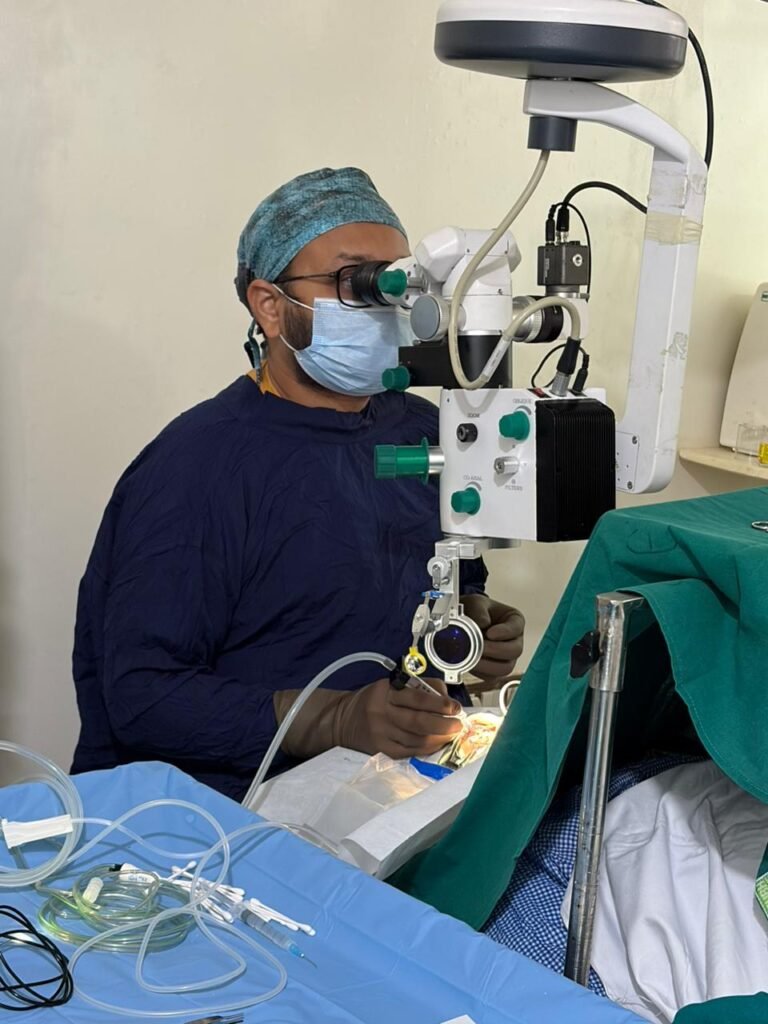
Best Vitrectomy Surgery in Mumbai | Expert Retinal Care | Dr. Jignesh Gala
Advanced Vitrectomy with Retikare Zeal System — From 1-Month Babies to 100-Year Seniors. Triple Royal College Certified Vitreoretinal Surgeon with 25,780+ procedures.
Thank you for reading this post, don't forget to subscribe!
What is Vitrectomy Surgery?
Understanding the gold-standard surgical procedure for retinal diseases performed by Dr. Jignesh Gala at Crystal Clear Eye Clinic, Andheri West, Mumbai.
Vitrectomy (also called Pars Plana Vitrectomy or PPV) is a specialized microsurgical procedure where the vitreous gel inside the eye is carefully removed to access and treat conditions affecting the retina — the light-sensitive tissue at the back of your eye. The vitreous is a clear, jelly-like substance that fills the space between the lens and the retina. While it serves important functions during eye development, it can become problematic when it pulls on the retina, becomes cloudy with blood, or allows scar tissue to form.
During vitrectomy surgery, Dr. Jignesh Gala makes tiny incisions (less than 1mm) in the white part of the eye (sclera) and uses the advanced Retikare Zeal vitrectomy system to precisely remove the vitreous gel, treat the underlying retinal condition, and then replace the removed gel with a sterile saline solution, gas bubble, or silicone oil depending on the condition being treated.
When is Vitrectomy Needed?
Vitrectomy becomes necessary when the vitreous gel causes or contributes to serious vision-threatening conditions. Common indications include retinal detachment where the retina pulls away from the back of the eye, diabetic vitreous hemorrhage when blood fills the vitreous cavity blocking vision, macular holes causing central vision loss, epiretinal membranes creating retinal wrinkling, and severe eye infections (endophthalmitis) that require emergency surgical intervention.
Types of Vitrectomy: Gauge Systems
20-Gauge Vitrectomy
The traditional standard with 0.89mm incisions. Requires sutures to close the wounds. Still used for very complex cases but has largely been replaced by smaller gauge systems. Recovery time is typically 4-6 weeks.
23-Gauge MIVS
Dr. Gala’s preferred system. Micro-incision of 0.65mm using the Retikare Zeal. Sutureless in most cases, faster healing, less discomfort, and quicker visual recovery. Ideal for most retinal detachment, diabetic vitrectomy, and macular hole surgeries.
25-Gauge MIVS
Ultra-small 0.5mm incisions for even faster recovery. Best suited for less complex cases, epiretinal membrane removal, and macular hole surgery. Minimal post-operative astigmatism and very comfortable for patients.
At Crystal Clear Eye Clinic in Andheri West, Mumbai, Dr. Jignesh Gala primarily performs 23g and 25g micro-incision vitrectomy surgery (MIVS) using the Retikare Zeal system, offering patients the benefits of sutureless surgery with faster recovery and better comfort compared to traditional 20-gauge approaches.
All Conditions Requiring Vitrectomy Surgery
Comprehensive table of retinal conditions treated by Dr. Jignesh Gala, vitreoretinal surgeon at Crystal Clear Eye Clinic, Andheri.
| Condition | Description | Surgery Type | Cost Range (Mumbai) | Insurance |
|---|---|---|---|---|
| Retinal Detachment (RD) | Retina separates from underlying tissue causing sudden vision loss, flashes, and floaters. Medical emergency requiring urgent surgery. | PPV (23g/25g) +/- Scleral Buckle | Rs. 60,000 – 1,50,000 | Covered by most insurers |
| Diabetic Vitreous Hemorrhage | Blood leaks into vitreous from damaged diabetic vessels, severely blocking vision. Common in proliferative diabetic retinopathy. | PPV + Endolaser PRP | Rs. 80,000 – 1,50,000 | Covered (diabetes-related) |
| Diabetic Tractional RD | Scar tissue pulls retina away from eye wall. Most complex diabetic complication requiring expert surgical skill. | Complex Diabetic Vitrectomy | Rs. 1,00,000 – 1,92,000 | Covered (higher limits) |
| Macular Hole | Small break in the macula (center of retina) causing central vision distortion and loss. Common in ages 60+. | 25g PPV + Gas | Rs. 60,000 – 1,20,000 | Covered by most policies |
| Epiretinal Membrane (ERM) | Thin scar tissue grows on macula causing wrinkling and distortion of central vision. Also called macular pucker. | 25g PPV + Membrane Peel | Rs. 60,000 – 1,40,000 | Covered |
| Refractory Macular Edema | Persistent swelling of macula unresponsive to anti-VEGF injections or steroids requiring surgical intervention. | PPV + Internal limiting membrane peel | Rs. 70,000 – 1,30,000 | Covered |
| Endophthalmitis | Severe infection inside the eye. Medical emergency requiring urgent vitrectomy with intravitreal antibiotics. | Emergency PPV + Injections | Rs. 50,000 – 1,00,000 | Emergency coverage |
| Intraocular Foreign Body | Metal, glass, or other objects penetrating the eye from industrial or domestic accidents. Requires immediate removal. | Emergency PPV + IOFB Removal | Rs. 50,000 – 1,20,000 | Accident/employer cover |
| Dislocated Lens/IOL | Lens or intraocular lens implant falls into the vitreous cavity, often after trauma or pseudoexfoliation syndrome. | PPV + Lens/IOL Repositioning | Rs. 70,000 – 1,40,000 | Covered |
| Ocular Trauma | Blunt or penetrating eye injuries causing vitreous hemorrhage, retinal tears, or choroidal rupture. | Emergency/Deferred PPV | Rs. 50,000 – 1,50,000 | Accident cover applicable |
| ROP Stage 4-5 | Retinopathy of Prematurity in premature babies where abnormal blood vessels cause retinal detachment. Dr. Gala has performed 300+ ROP procedures. | Pediatric Vitrectomy / Lensectomy | Rs. 80,000 – 1,50,000 | Govt schemes: CGHS, ESIC |
| Submacular Hemorrhage | Blood accumulates under the macula from AMD or trauma causing sudden severe central vision loss. | PPV + rTPA + Gas | Rs. 70,000 – 1,30,000 | Covered |
Types of Vitrectomy Procedures
Dr. Jignesh Gala specializes in multiple vitrectomy techniques at Crystal Clear Eye Clinic, Andheri West, Mumbai.
Pars Plana Vitrectomy (PPV)
The standard vitrectomy procedure where three small incisions are made in the pars plana region of the eye. Through these ports, the surgeon inserts a light pipe, infusion cannula, and vitreous cutter. Dr. Gala performs most PPVs using the 23g or 25g Retikare Zeal system, making the procedure sutureless with faster recovery. PPV is the foundation treatment for retinal detachment, macular hole, ERM, and vitreous hemorrhage.
Micro-Incision Vitrectomy (MIVS)
23g, 25g, and 27g systems represent the modern evolution of vitrectomy. These ultra-small incisions (0.4-0.7mm) are self-sealing in most cases, eliminating the need for sutures. Benefits include reduced surgical time, less postoperative inflammation, minimal discomfort, faster visual recovery (often within 1-2 weeks), and less induced astigmatism. Dr. Gala’s Retikare Zeal supports both 23g and 25g MIVS.
Combined Procedures
Complex retinal conditions often require combined surgical approaches: PPV + Scleral Buckle for complicated retinal detachments, PPV + Cataract Surgery (phacovitrectomy) when both conditions coexist, and PPV + Glaucoma Surgery for patients with concurrent elevated eye pressure. Dr. Gala plans these combined procedures to minimize the number of operations and optimize outcomes.
Complex Diabetic Vitrectomy
The most challenging type of vitrectomy surgery, performed for proliferative diabetic retinopathy with tractional retinal detachment, dense vitreous hemorrhage, or neovascularization. These surgeries can take 1-3 hours, requiring meticulous removal of fibrovascular membranes without damaging the retina. Dr. Gala’s fellowship training at LV Prasad Eye Institute under Dr. Raja Narayanan and experience at Tan Tock Seng Hospital, Singapore make him exceptionally skilled in these complex cases.
Pediatric Vitrectomy
Performed on infants and children for ROP (Retinopathy of Prematurity) stage 4-5, congenital cataract complications, pediatric trauma, and endophthalmitis. Pediatric eyes are significantly different from adult eyes — smaller, more delicate, with different anatomical proportions. Dr. Gala has performed 300+ ROP procedures and is one of the few vitreoretinal surgeons in Mumbai comfortable operating on babies as young as 1 month old.
Advanced Technology at Crystal Clear Eye Clinic
World-class vitrectomy and retinal surgery equipment at Crystal Clear Eye Clinic and Topax Eye Care, Andheri West, Mumbai.

Retikare Zeal Vitrectomy System
The Retikare Zeal is a state-of-the-art vitrectomy machine used by Dr. Jignesh Gala for all retinal surgeries at Crystal Clear Eye Clinic. This system represents the cutting edge of vitreoretinal surgical technology available in Mumbai.
The Retikare Zeal’s ultra-high cutter speed of up to 7,500 cuts per minute (CPM) allows Dr. Gala to remove vitreous gel with extreme precision, minimizing traction on the retina. The Venturi aspiration system at 500mmHg provides consistent, controlled suction for safe membrane peeling and fibrovascular tissue removal in complex diabetic cases. The independent dual LED light source is UV and IR free, protecting the retina from photochemical damage during long surgeries while providing brilliant, shadow-free illumination.
Quantel AEON Green Laser (532nm)
The Quantel AEON Green Laser delivers precise 532nm wavelength photocoagulation for retinal treatment. Dr. Gala uses this laser for:
- Pan-retinal photocoagulation (PRP) for diabetic retinopathy
- Barrage laser for retinal holes and tears
- Focal/grid laser for macular edema
- Laser retinopexy for retinal detachment prevention
Optopol/Huvitz OCT Imaging
High-resolution Optical Coherence Tomography (OCT) provides cross-sectional imaging of the retina with micron-level precision. Essential for:
- Pre-surgical planning and diagnosis
- Macular hole and ERM assessment
- Post-operative monitoring of healing
- Detection of subtle fluid or subretinal changes
Operating Microscope with Video Recording
Dr. Gala operates using a premium Zeiss/Topcon operating microscope with integrated video recording capability. This allows complete documentation of every surgery for medical records, teaching purposes (Dr. Gala is an ex-Assistant Professor at TNMC & Nair Hospital), and post-operative review. The microscope’s excellent depth of field and clarity are crucial for the delicate work of membrane peeling and retinal detachment repair.
How Retikare Zeal Compares to Other Systems
| Feature | Retikare Zeal (Dr. Gala) | Alcon Constellation | B&L Stellaris |
|---|---|---|---|
| Max Cutter Speed | 7,500 CPM | 7,500 CPM | 5,000 CPM |
| Venturi Aspiration | 500mmHg | 650mmHg | 500mmHg |
| Illumination | Dual LED UV/IR Free | Xenon/LED | Xenon |
| Micro-Incision | 23g / 25g | 23g / 25g / 27g | 23g / 25g |
| Diathermy | 10W Integrated | Yes | Yes |
Complete Range of Retina Laser Treatments
Dr. Jignesh Gala offers all major laser procedures for retinal conditions at Crystal Clear Eye Clinic, Andheri West.
Laser photocoagulation is a cornerstone of retinal treatment. Dr. Gala performs these procedures using the Quantel AEON Green Laser (532nm) and other advanced laser systems. Many laser procedures can be done in the clinic without admission, while others (like endolaser) are performed during vitrectomy surgery.
Green Laser Photocoagulation (532nm)
The standard wavelength for retinal laser treatment. Green light is well-absorbed by melanin and hemoglobin in the retina, making it ideal for treating vascular conditions.
Rs. 5,000 – 12,000 per sessionBarrage Laser (Retinopexy)
Laser barrier placed around retinal holes, tears, or degenerative areas to prevent retinal detachment. Creates scar tissue that welds the retina to the underlying layer.
Rs. 5,000 – 12,000Pan-Retinal Photocoagulation (PRP)
Extensive laser treatment for proliferative diabetic retinopathy. Destroys oxygen-starved peripheral retina to reduce VEGF production and neovascularization. May require 2-3 sessions.
Rs. 8,000 – 20,000 per sessionFocal / Grid Laser
Precise laser treatment targeting leaking microaneurysms in diabetic macular edema or creating a grid pattern to reduce diffuse edema. Often combined with anti-VEGF injections.
Rs. 5,000 – 12,000YAG Laser (Capsulotomy)
Neodymium-doped Yttrium Aluminum Garnet laser used to treat posterior capsular opacification (PCO) after cataract surgery — the “secondary cataract.” Quick, painless, no incision needed.
Rs. 3,000 – 8,000SLT Laser (Selective Laser Trabeculoplasty)
Selective laser treatment for open-angle glaucoma. Improves drainage of fluid from the eye to lower intraocular pressure. Can reduce or eliminate the need for glaucoma eye drops.
Rs. 5,000 – 10,000Endolaser
Laser treatment performed internally during vitrectomy surgery. Used for PRP in diabetic vitrectomy, retinopexy around detachment repairs, and treating bleeding vessels directly.
Included in vitrectomy costPattern Scanning Laser (PASCAL)
Advanced laser that delivers multiple spots in a predetermined pattern simultaneously, reducing treatment time for extensive PRP by up to 80% with more uniform burns.
Rs. 10,000 – 25,000Subthreshold MicroPulse Laser
Gentle laser treatment that delivers energy in short pulses below the visible damage threshold. Treats macular edema without creating visible laser scars, preserving retinal function.
Rs. 8,000 – 15,000All laser procedures at Crystal Clear Eye Clinic are performed by Dr. Jignesh Gala personally. To book a laser appointment, call 077188 85245 or WhatsApp.
Anti-VEGF Injections for Retinal Conditions
Latest anti-VEGF therapies including Vabysmo (Faricimab) available at Crystal Clear Eye Clinic, Andheri West, Mumbai.
Anti-VEGF (Vascular Endothelial Growth Factor) injections are medications injected into the eye (intravitreal injection) to treat conditions like wet age-related macular degeneration (AMD), diabetic macular edema (DME), retinal vein occlusion, and ROP. These medications block the growth of abnormal blood vessels and reduce fluid leakage. At Crystal Clear Eye Clinic, Dr. Jignesh Gala offers the complete range of anti-VEGF agents, including the latest Vabysmo (Faricimab) launched in India in March 2024.
| Drug | Generic Name | Cost per Injection | Dosing Interval | Best For |
|---|---|---|---|---|
| Avastin | Bevacizumab | Rs. 8,000 – 15,000 | 4 – 6 weeks | Cost-effective option for DME, RVO, wet AMD. Off-label but widely used. |
| Accentrix | Ranibizumab | Rs. 15,000 – 25,000 | 4 weeks | FDA-approved for wet AMD, DME, RVO. Established safety profile. |
| Eylea | Aflibercept | Rs. 25,000 – 35,000 | 8 weeks (after initial loading) | Longer-lasting, binds VEGF more tightly. Fewer injections needed. |
| Vabysmo | Faricimab | Rs. 30,000 – 45,000 | 8 – 16 weeks | Dual action: Anti-VEGF + Anti-Ang2. Longest interval. Roche, launched India March 2024. |
| Razumab | Ranibizumab biosimilar | Rs. 8,000 – 12,000 | 4 weeks | Affordable biosimilar option with similar efficacy to Accentrix. |
Vabysmo (Faricimab) — Now Available at Crystal Clear Eye Clinic
Vabysmo is Roche’s breakthrough dual-action antibody that simultaneously blocks both VEGF-A and Angiopoietin-2 (Ang-2), two key pathways that cause retinal vascular diseases. This dual mechanism not only reduces fluid leakage but also stabilizes blood vessels, potentially leading to better and longer-lasting vision outcomes. The extended dosing interval of up to 16 weeks means fewer hospital visits, injections, and less burden for patients. Launched in India in March 2024, Dr. Jignesh Gala is among the first retina specialists in Mumbai to offer Vabysmo at Crystal Clear Eye Clinic. Learn more about Vabysmo on Roche’s website.
Diagnostic Tests Available
| Test | Cost Range | Purpose |
|---|---|---|
| OCT Scan | Rs. 1,500 – 3,000 | Retinal cross-section imaging |
| FFA (Fundus Fluorescein Angiography) | Rs. 2,500 – 5,000 | Blood flow and leakage assessment |
| B-Scan Ultrasound | Rs. 1,000 – 2,000 | Imaging when media is opaque |
| VEP (Visual Evoked Potential) | Rs. 2,000 – 5,000 | Optic nerve function testing |

Advanced diagnostic equipment at Crystal Clear Eye Clinic
Vitrectomy Surgery Across All Age Groups
Dr. Jignesh Gala performs vitrectomy on patients from 1 month to 100 years at Crystal Clear Eye Clinic, Andheri West, Mumbai.
One of Dr. Gala’s unique strengths is his ability to perform vitrectomy on patients across the entire age spectrum. From premature babies with ROP to centenarians with retinal detachment, his expertise spans all age groups with specialized techniques for each.
Pediatric / Infant Vitrectomy
- ROP (Retinopathy of Prematurity) Stage 4-5
- Congenital cataract complications
- Pediatric ocular trauma
- Endophthalmitis in infants
- Congenital glaucoma combined procedures
Note: Birth certificate required for insurance. Dr. Gala has performed 300+ ROP procedures.
Toddler / Preschool
- Ocular trauma from falls/objects
- Endophthalmitis
- Congenital glaucoma combined surgery
- Retinal detachment from congenital abnormalities
- Persistent fetal vasculature (PFV)
General anesthesia always used. Parents counseled extensively pre-operatively.
School Age / Adolescents
- Sports-related eye injuries (cricket, badminton)
- Firecracker trauma (Diwali injuries)
- Hereditary retinal detachments (Stickler, Marfan)
- High myopia complications
- Juvenile rhegmatogenous RD
School fitness certificate provided post-recovery.
Young Adults
- Complex retinal detachment (high myopia)
- Ocular trauma (workplace, road accidents)
- Uveitis complications
- Macular hole from trauma
- Intravitreal foreign bodies
Return to work typically within 2-4 weeks with 23g/25g MIVS.
Middle Age
- Diabetic vitrectomy (most common indication)
- Epiretinal membrane (ERM)
- Macular hole (idiopathic)
- Rhegmatogenous retinal detachment
- Combined cataract + vitrectomy
This age group sees the highest volume of vitrectomy procedures.
Senior Citizens
- AMD complications (submacular hemorrhage)
- Retinal detachment
- Vitreous hemorrhage
- Dropped nucleus during cataract surgery
- Combined phacovitrectomy
Age is not a barrier. Dr. Gala has successfully operated on multiple nonagenarians and centenarians.
Why Dr. Jignesh Gala is Mumbai’s Best Vitreoretinal Surgeon
Triple Royal College certified with international training and 25,780+ surgical procedures. Here’s how Dr. Gala compares.

Dr. Jignesh Gala — Unmatched Credentials
FRCS Glasgow • MRCS Edinburgh • FICO London — Triple Royal College certifications that very few eye surgeons in Mumbai hold. BMJ Case Reports Peer Reviewer, validating his academic standing in the international ophthalmology community.
Dual Fellowship at the prestigious LV Prasad Eye Institute under world-renowned mentors Dr. Raja Narayanan, Dr. Subhadra Jalali, and Dr. Padmaja Kumari Rani. Additional training at Tan Tock Seng Hospital, Singapore under Dr. Rajagopalan Rajesh — one of Asia’s premier eye centers.
25,780+ Surgical Eye Procedures | 162,000+ Patients Treated | 300+ ROP Procedures on premature babies. 4.9/5 Google Rating with 277+ genuine reviews from satisfied patients.
C.S. Reshmi Best Video Award at AIOC 2020 — recognized by the All India Ophthalmological Society. Former Assistant Professor at TNMC & Nair Hospital, Mumbai, contributing to training the next generation of eye surgeons.
Owner of BOTH Crystal Clear Eye Clinic AND Topax Eye Care — offering patients the convenience of direct cashless insurance through Topax Eye Care and third-party claims through Crystal Clear Eye.
Competitor Comparison: Retina Specialists in Mumbai
| Parameter | Dr. Jignesh Gala | Dr. Harshit Vaidya | Doctor Eye Institute | ASG Eye Hospital | Arohi Eye Hospital | Aggarwal Eye Hospital |
|---|---|---|---|---|---|---|
| Contact | 077188 85245 | +91 90044 96621 | +91 9930309434 | Multiple locations | +91 9820111315 | +91 9821111116 |
| Qualifications | FRCS Glasgow, MRCS Edinburgh, FICO London | Sankara Nethralaya trained | 60+ years institution | Multi-location chain | NABH accredited | Andheri East |
| International Degrees | 3 Royal College Certifications | Limited | Limited | Variable | Limited | Limited |
| Fellowship Training | LV Prasad (Dual) + Tan Tock Seng, Singapore | Sankara Nethralaya | Not specified | Variable | Not specified | Not specified |
| Surgeries Performed | 25,780+ | Not disclosed | Not disclosed | Large volume (chain) | Not disclosed | Not disclosed |
| ROP Specialist | 300+ ROP Procedures (1-month babies) | Limited | Limited | Limited | Limited | Limited |
| BMJ Peer Reviewer | Yes — BMJ Case Reports | No | No | No | No | No |
| Google Rating | 4.9/5 (277+ Reviews) | Variable | Variable | Variable | Variable | Variable |
| Vitrectomy System | Retikare Zeal (7,500 CPM) | Standard | Standard | Variable | Variable | Standard |
| Vabysmo Available | Yes (March 2024) | Not specified | Not specified | Not specified | Not specified | Not specified |
| Cashless Insurance | Direct (Topax) + TPA (Crystal Clear) | Limited | Limited | Limited | 50+ insurers | Limited |
| Location | Andheri West (Near Station) | Mumbai | Andheri | Multiple | Andheri | Andheri East |
| Awards | C.S. Reshmi Best Video AIOC 2020 | Not specified | Not specified | Not specified | NABH | Not specified |
Data compiled from publicly available sources as of January 2025. Patients are encouraged to verify details directly with respective clinics.
Insurance & Mediclaim Coverage for Vitrectomy in Mumbai
Crystal Clear Eye Clinic and Topax Eye Care accept all major insurance plans for vitrectomy and retinal surgery.
Dr. Jignesh Gala’s dual facility model offers patients maximum insurance flexibility: Direct Cashless through Topax Eye Care for eligible policies, and Third-Party (TPA) reimbursement through Crystal Clear Eye Clinic for all other insurance types.
Mediclaim Coverage Details
| Policy Type | Vitrectomy Coverage | Typical Limit | Waiting Period |
|---|---|---|---|
| Individual Health Insurance | PPV, complex vitrectomy, laser | 10% of SI, max Rs. 50,000 – 1,50,000 | 2 – 4 years |
| Family Floater | All vitrectomy procedures covered | Shared sum insured | 2 – 4 years |
| Group / Employer Policy | Most retinal procedures | As per policy terms | 0 – 1 year |
| CGHS (Central Govt) | Full cashless coverage | No upper limit | None |
| ECHS (Defence) | Full cashless coverage | No upper limit | None |
| Ayushman Bharat (PMJAY) | Cataract + retinal procedures | Up to Rs. 5 lakh/family | None |
| ESIC | Full cashless for employees | No upper limit | None |
| Star Health Retina Care | DR, RD, macular hole | As per plan | 2 – 3 years |
| HDFC ERGO Health | Most retina surgeries | Rs. 40,000 – 80,000 | 2 years |
| ICICI Lombard | DR, RD, laser procedures | Rs. 25,000 – 60,000 | 2 years |
| Bajaj Allianz | Vitrectomy + laser | Rs. 30,000 – 70,000 | 2 years |
| New India Assurance | Retinal detachment, DR | Rs. 25,000 – 50,000 | 2 years |
Private Insurance Companies Accepted
Government Schemes Accepted
How to Claim Cashless Vitrectomy
- Step 1: Bring your health insurance card and government ID to Crystal Clear Eye Clinic.
- Step 2: Dr. Gala examines your eye and determines if vitrectomy is medically necessary.
- Step 3: Our insurance desk submits pre-authorization request to your TPA/insurer.
- Step 4: Upon approval (typically 24-48 hours), surgery is scheduled.
- Step 5: Post-surgery, our team handles all discharge paperwork for cashless settlement.
For reimbursement claims, pay upfront and submit bills to your insurer. Our team provides all necessary documentation including surgical notes, discharge summary, and invoices. Call 077188 85245 for insurance assistance.
Step-by-Step Vitrectomy Process at Crystal Clear Eye Clinic
Your complete journey from consultation to recovery with Dr. Jignesh Gala in Andheri West, Mumbai.
Initial Consultation with Dr. Gala
Schedule your appointment by calling 077188 85245 or WhatsApp. Dr. Gala will take a detailed history of your symptoms, vision changes, diabetes status (if applicable), previous eye surgeries, and family history. Walk-ins are welcome at Crystal Clear Eye Clinic, Laram Centre CHS, A1-202, Swami Vivekanand Road, Andheri West, above Sunil Jewellers, near NADCO Shopping Centre.
Comprehensive Eye Examination + OCT
A thorough examination including visual acuity testing, slit-lamp biomicroscopy, intraocular pressure measurement, and dilated fundus examination. Our Optopol/Huvitz OCT provides high-resolution cross-sectional imaging of your retina to precisely identify the problem.
Specialized Diagnostic Tests (if needed)
Depending on your condition, additional tests may include FFA (Fundus Fluorescein Angiography) to assess blood flow and leakage, B-scan ultrasound if the view is obscured by dense hemorrhage, VEP (Visual Evoked Potential) to evaluate optic nerve function, and OCT angiography for detailed vascular mapping.
Diagnosis and Surgical Planning
Dr. Gala explains your diagnosis in detail, discusses all treatment options (including non-surgical alternatives where applicable), and recommends the most appropriate surgical approach. You’ll receive a clear explanation of expected outcomes, potential risks, recovery timeline, and cost estimate. Insurance pre-authorization is initiated at this stage.
Pre-Authorization for Cashless (if applicable)
Our dedicated insurance desk submits your pre-authorization request to the TPA/insurance company with all required documents including diagnosis, proposed procedure estimate, and medical history. Approval typically takes 24-48 hours for planned surgeries and can be expedited for emergencies.
Surgery Day Preparation
Arrive at Crystal Clear Eye Clinic / Topax Eye Care 2 hours before surgery. You’ll complete registration, change into surgical attire, and receive dilating eye drops. An anesthetist will review your fitness for anesthesia (local with sedation for most adults, general for children). Dr. Gala meets you for final questions before proceeding to the operating room.
Vitrectomy Procedure (30-90 Minutes)
Dr. Gala performs the vitrectomy using the Retikare Zeal system under the operating microscope. Three micro-incisions (23g or 25g) are made, the vitreous gel is removed, the retinal problem is treated (membrane peeling, detachment repair, laser, etc.), and the eye is filled with saline, gas, or silicone oil. The small incisions typically self-seal without sutures.
Recovery and First Follow-Up
After a brief recovery period (2-4 hours), you’ll be discharged with detailed post-operative instructions, eye drops, and a protective shield. First follow-up is scheduled within 24-48 hours. Dr. Gala personally checks your eye pressure, wound healing, and retinal status at each visit.
Post-Operative Care (Gas Positioning if needed)
If gas was placed in your eye, you’ll need to maintain a specific head position for 50 minutes of every hour for 5-14 days (depending on gas type). This is CRITICAL for successful retinal attachment. Detailed positioning instructions with diagrams are provided. Activity restrictions include no flying, no high altitude, and limited physical exertion until gas dissolves.
Final Assessment and Long-Term Follow-Up
Follow-up visits at 1 week, 1 month, 3 months, and 6 months assess visual recovery and retinal stability. For diabetic patients, ongoing monitoring and additional laser or anti-VEGF treatments may be needed. Dr. Gala develops a personalized long-term care plan to protect your vision for years to come.
Documents Required for Vitrectomy Surgery
Bring these documents to Crystal Clear Eye Clinic for smooth admission and insurance processing.
Identity & Address Proof
- Aadhaar Card (mandatory for Ayushman Bharat)
- PAN Card
- Passport or Voter ID
- Recent passport-size photographs (2 copies)
Insurance Documents
- Health insurance policy copy
- TPA card / Cashless card
- Previous claim history (if any)
- Employer certificate (for group policies)
Medical Records
- Previous eye examination reports
- Blood sugar / HbA1c reports (for diabetics)
- Blood pressure records
- Current medication list
- Cardiac fitness certificate (if age >60)
For Pediatric Patients
- Birth certificate (mandatory)
- Parents’ ID proof
- Pediatrician fitness note
- Vaccination records
- Birth weight and gestational age records (for ROP)
Government Scheme Documents
- CGHS card / ECHS card
- Ayushman Bharat Golden Card
- ESIC Pehchan card
- Income certificate (for government schemes)
- Ration card (if applicable)
Frequently Asked Questions About Vitrectomy Surgery
Get answers to all your questions about vitrectomy, retinal surgery, costs, recovery, and insurance from Dr. Jignesh Gala’s team at Crystal Clear Eye Clinic, Andheri West, Mumbai.
Book Your Vitrectomy Consultation with Dr. Jignesh Gala Today
Don’t let retinal disease steal your vision. With 25,780+ surgeries, triple Royal College certification, and the advanced Retikare Zeal system, Dr. Gala offers Mumbai’s most trusted vitrectomy care. Same-day appointments available for emergencies.
Crystal Clear Eye Clinic | Laram Centre CHS, A1-202, Swami Vivekanand Rd, Andheri West, Mumbai 400058
Open Mon-Sat • 10 AM to 9 PM • Cashless Insurance Available

Our Eye Care Centers in Mumbai
Dr. Jignesh Gala operates from two state-of-the-art facilities in Andheri West, Mumbai.
Crystal Clear Eye Clinic
Address: Laram Centre CHS, A1-202, Swami Vivekanand Rd, above Sunil Jewellers, near NADCO Shopping Centre, Railway Colony, Andheri West, Mumbai 400058
Phone: 077188 85245
Email: crystalcleareyeclinic@gmail.com
Hours: Mon-Sat, 10 AM – 9 PM
Services: Vitrectomy, Retina Surgery, Anti-VEGF, Lasers, TPA Insurance
Visit Website →View on Google Maps →
Topax Eye Care
Address: Swami Vivekanand Road, Andheri West, Mumbai (near Crystal Clear Eye Clinic)
Phone: 077188 85245
Services: Cashless Eye Surgery, Vitrectomy, Cataract, LASIK, Retina Care
Insurance: Direct Cashless Facility Available
Owner: Dr. Jignesh Gala
Visit Website →View Services →

Modern, fully equipped facility at Crystal Clear Eye Clinic, Andheri West