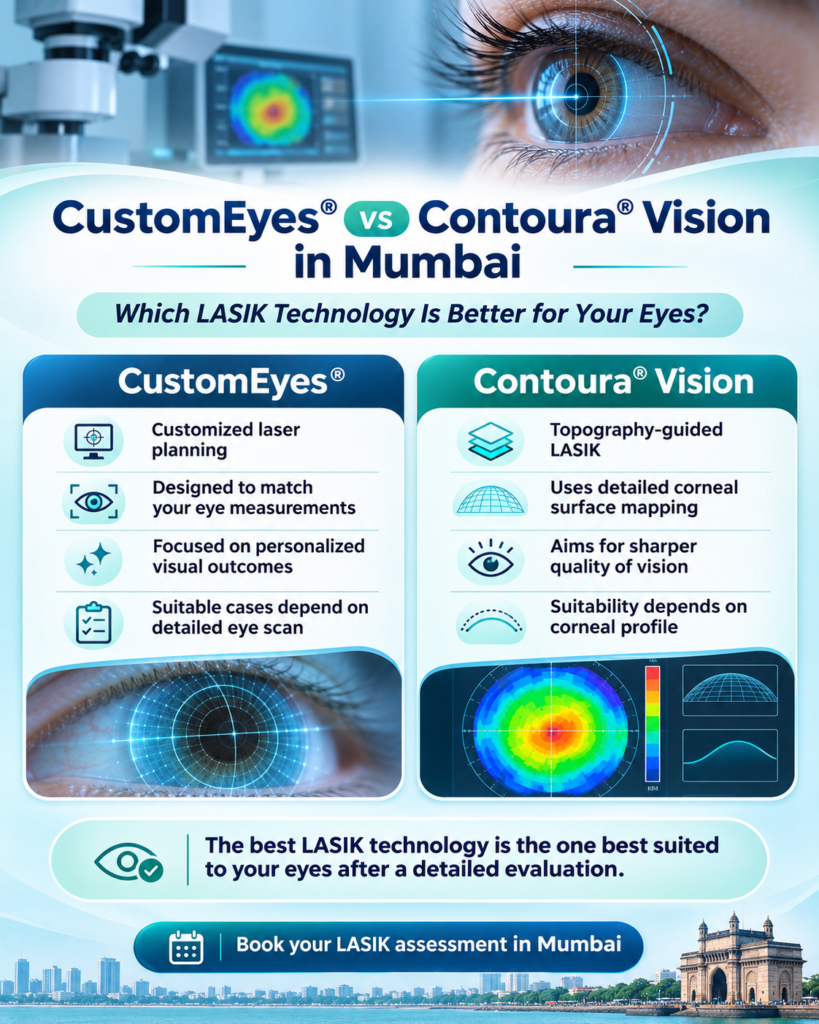
CustomEyes® vs Contoura® Vision in Mumbai — Which LASIK Technology Is Better for Your Eyes?
Written & medically reviewed by Dr. Jignesh Gala, Vitreoretinal & Cataract Surgeon (FRCS Glasgow), Founder & Director — Crystal Clear Eye Clinic (Andheri West) and Topax Eye Hospital (Vile Parle East), Mumbai. Technology claims reviewed: 14 November 2026.
Thank you for reading this post, don't forget to subscribe!⚡ Quick answer: Both are customised LASIK approaches, but they personalise treatment differently. CustomEyes® with SCHWIND AMARIS® uses wavefront-based planning, flexible high-resolution diagnostics, automated aberration selection and tissue-saving optimisation. Contoura® Vision is topography-guided LASIK, planning treatment from the corneal surface map using the WaveLight Topolyzer™ VARIO. Neither is automatically “best” for every patient. The right answer depends on your corneal topography/tomography, thickness, prescription, tear film, lifestyle and surgeon’s assessment. For a personalised eligibility evaluation in Andheri West, call 077188 85245.
- Refraction in real time how the royal college of ophthalmologists tested me in kuching 2017
- Refractive lens exchange rlethe complete guide to clear vision without glasses
- Retina laser treatment in andheri west mumbai prp barrage focal micropulse laser by dr jignesh gala frcs
- Retina surgery in mumbai your complete guide to saving your sight
- Retina treatment in andheri
- Retina treatment in mumbai advanced retinal care by dr jignesh gala
- Rle vs lasik which vision correction surgery is better
- Satisfied patient stories
- Singapore 2021 a year on the founding ophthalmology team of woodlands health
- Smartsurf with customeyes the most advanced glass removal surgery in mumbai and why it outperforms wavelight plus innoveyes
- Surgery packages
- Surgical videos by dr jignesh gala
1. What Are We Actually Comparing?
Many patients searching for LASIK surgery in Mumbai meet two branded names: CustomEyes® and Contoura® Vision. These are not two different surgeries in the everyday sense — both use an excimer laser to reshape the cornea. The difference lies mainly in how the treatment is measured, planned and personalised.
CustomEyes® with SCHWIND AMARIS® is a wavefront-based personalisation platform. Depending on the compatible diagnostic devices used, the measurements may encompass the cornea or the entire eye. Contoura® Vision is a topography-guided treatment: the plan is based on mapping corneal features and surface imperfections. Both are customised. Both require the right patient selection. Neither brand name replaces a careful refractive surgeon.
2. CustomEyes® vs Contoura® Vision — Technology Comparison
This comparison is based on the uploaded patient-education summary and the official manufacturer descriptions cited in the evidence library. It describes platform capabilities — not guaranteed clinical superiority.
| Feature | CustomEyes® with SCHWIND AMARIS® | Contoura® Vision |
|---|---|---|
| Planning approach | Wavefront-based personalisation; measurements may encompass the cornea or the entire eye. | Topography-guided LASIK based on mapping corneal features and surface imperfections. |
| Diagnostic detail | Compatible high-resolution devices can assess the cornea’s front and back surfaces and calculate total optical irregularities of the eye. | Uses the WaveLight Topolyzer™ VARIO to map corneal features for an individualised LASIK plan. |
| Mapping specification | Up to 150,000 unique corneal points with compatible diagnostics. | 22,000 data points from the Topolyzer™ VARIO. |
| Aberration planning | Planning software can automatically identify aberrations to correct and includes refraction optimisation. | Customisation is centred on corneal topography and measured surface imperfections. |
| Tissue optimisation | Tissue-saving automation is designed to reduce tissue removal while supporting visual quality and corneal stability. | The cited description focuses on topography-guided customisation; a direct tissue-saving comparison is not established. |
| Laser platform | SCHWIND AMARIS®, with up to 7D virtually latency-free eye-movement compensation. | Alcon WaveLight® Refractive Suite, including the EX500 excimer laser. |
3. 150,000 vs 22,000 Points — The Marketing Myth, Corrected
A bigger number does not automatically mean a better result. The 150,000-point and 22,000-point figures come from different diagnostic approaches. They are not a like-for-like quality score, and you should not choose LASIK technology on that comparison alone.
Think of it like two different cameras used for two different mapping jobs: counting pixels across separate systems does not tell you which photograph will guide the better operation. The clinically meaningful questions are: Was the map reliable? Was it repeatable? Is the cornea regular enough? Is there adequate thickness? Does the planned ablation respect long-term corneal stability?
That is why Dr. Gala evaluates the measurements rather than the advertising. His SmartSurf and CustomEyes guide explains the surface-ablation option for suitable patients, while the Contoura LASIK overview explains topography-guided treatment in patient-friendly terms.
4. Which Eyes May Suit Which Approach?
| Your Situation | What the Surgeon Considers |
|---|---|
| Standard myopia or astigmatism with healthy corneas | Either customised platform may work; suitability, preference and realistic expectations decide. |
| Measured corneal surface irregularities | Topography-guided planning may be especially relevant, subject to safety and candidacy. |
| Optical aberrations across the eye, where wavefront information is reliable | Wavefront-based customisation may offer useful additional information. |
| Thin or borderline corneas | Tissue preservation becomes crucial; surface ablation or no laser may be safer than forcing LASIK. |
| Dry eye, unstable prescription, abnormal tomography or ectasia risk | First treat the underlying issue or avoid laser — no branded platform makes an unsafe eye safe. |
The honest answer: if your tests show no clear advantage for one platform, the difference in the surgeon’s planning, safety screening and follow-up may matter more than the brand name.
5. The Tests That Decide Your Best Option
A responsible LASIK work-up goes beyond a quick glasses-number check. At Crystal Clear Eye Clinic, the evaluation is built around your individual eye measurements:
- Accurate refraction and prescription stability: the number must be stable, not changing every few months.
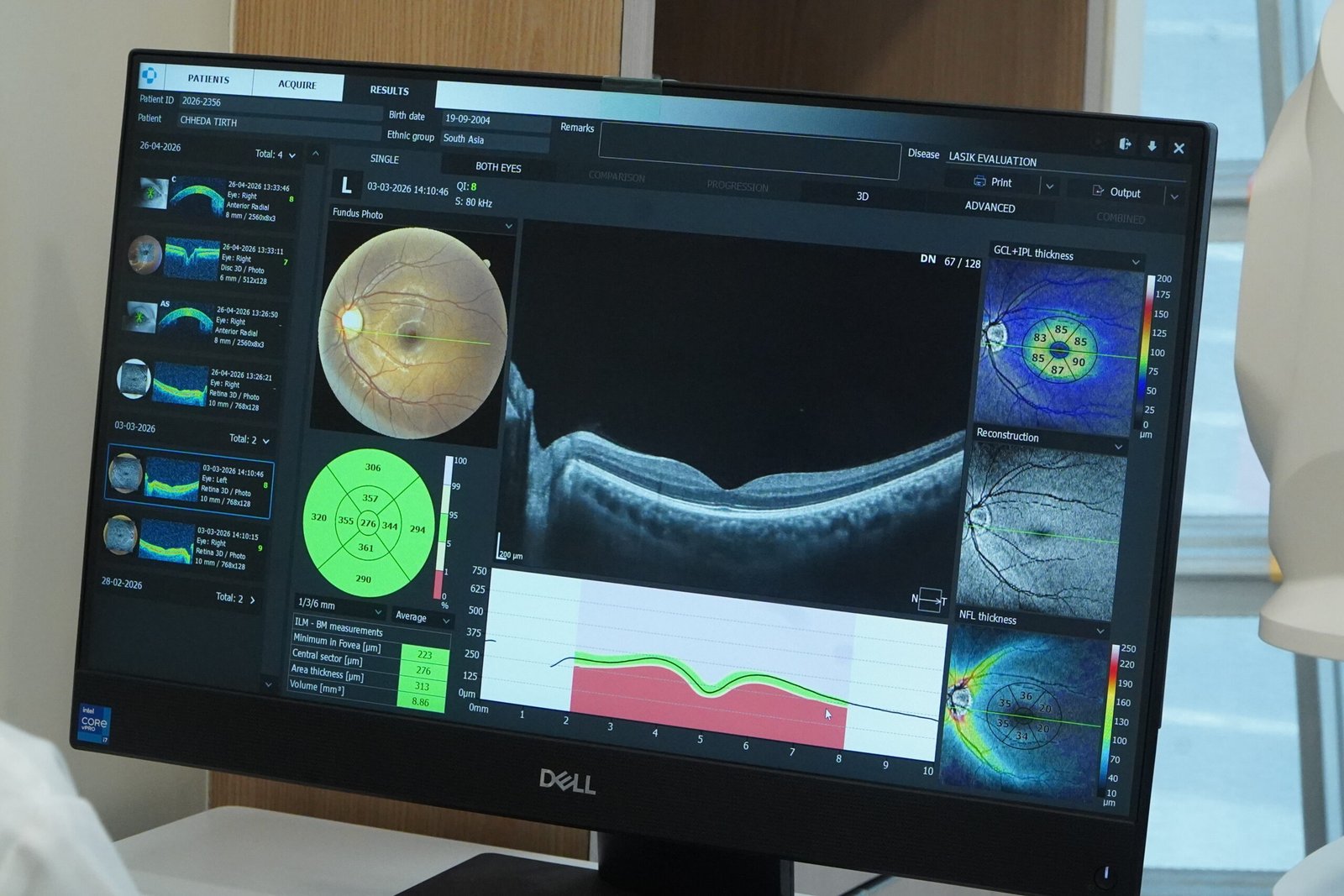
- Corneal topography/tomography: curvature, elevation and shape analysis help identify irregularity and ectasia risk. Our corneal topography and Pentacam guide explains this 3D mapping.
- Pachymetry (corneal thickness): the laser plan must preserve adequate tissue and a safe residual stromal bed.
- Tear-film and ocular-surface evaluation: dry eye can affect measurements and post-operative comfort.
- Dilated retinal examination where indicated: clear vision starts with a healthy whole eye, not only a clear cornea.
6. Honest Outcomes, Risks & Recovery
Customised LASIK has strong published outcomes, but no ethical surgeon can promise 6/6 vision to everyone. Individual results depend on baseline vision, healing, prescription, corneal biology and adherence to aftercare.
- Early recovery: many LASIK patients notice functional improvement within the first days, but vision can fluctuate while healing.
- Possible temporary symptoms: dryness, glare, halos, light sensitivity and foreign-body sensation can occur.
- Not a lifetime guarantee: presbyopia still arrives with age, and glasses may be needed for some tasks later.
- Rare but real risks: under/over-correction, enhancement procedures, infection and corneal ectasia are discussed before consent.
- Aftercare matters: use prescribed drops, avoid rubbing the eyes, attend follow-ups and report severe pain or sudden vision loss urgently.
Research on customised and topography-guided LASIK, wavefront-guided treatment and LASIK-versus-SMILE comparisons is collected in the evidence library below. Dr. Gala is fully aware of the latest research — unlike old practitioners who stopped reading journals years ago — and applies that evidence to patient selection, not just to advertising.
7. Why Dr. Jignesh Gala
Dr. Jignesh Gala owns both Crystal Clear Eye Clinic (Andheri West) and Topax Eye Hospital (Vile Parle East). His training includes FRCS (Glasgow), MRCS (Edinburgh), FICO, a vitreoretinal fellowship at L.V. Prasad Eye Institute, work with the founding ophthalmology team at Woodlands Health Singapore, and a former Assistant Professorship at B.Y.L. Nair Hospital.
✅ Personalised, not platform-driven: your tests decide the approach; no one is pushed into a brand because it sounds newer.
✅ Whole-eye safety: corneal shape, thickness, tear film, prescription and retina are considered together.
✅ Honest alternatives: if LASIK is unsafe, you may be guided toward surface ablation, an alternative refractive option, or simply keeping glasses or lenses.
✅ Direct doctor access: reports and choices explained in English, Hindi, Marathi or Gujarati, with open-daily care till 9 pm.
8. Locations & Timings
1) Crystal Clear Eye Clinic — Andheri West
📍 Address: Laram Centre CHS, A1-202, Swami Vivekanand Road, above Sunil Jewellers, near NADCO Shopping Centre, Railway Colony, Andheri West, Mumbai 400058
📞 077188 85245 • 🕘 Open daily, closes 9 pm
💳 Third-party/TPA cashless is done through Crystal Clear Eye Clinic.
Convenient for Andheri West, Lokhandwala, Versova, Yari Road, Juhu, Oshiwara, DN Nagar, Jogeshwari, Vile Parle, Goregaon, Malad, Kandivali, Bandra, Khar and Santacruz.

2) Topax Eye Hospital — Vile Parle East
📍 Vile Parle East, Mumbai (details on drjigneshgalaeye.com) • 📞 077188 85245
💳 Direct cashless is done through Topax Eye Care.
9. हिंदी • मराठी • ગુજરાતી — Patient Summaries
🇮🇳 हिंदी सारांश
CustomEyes और Contoura दोनों customised LASIK तकनीकें हैं। CustomEyes wavefront-based planning और tissue-saving optimisation पर केंद्रित है; Contoura corneal topography से surface irregularities के अनुसार plan बनाता है। 150,000 बनाम 22,000 points सीधी quality comparison नहीं हैं। सबसे सही विकल्प आपकी cornea की जांच, मोटाई, number और lifestyle पर निर्भर करता है। अंधेरी वेस्ट में जांच के लिए 077188 85245 पर कॉल करें।
🚩 मराठी सारांश
CustomEyes आणि Contoura ह्या दोन्ही customised LASIK पद्धती आहेत. CustomEyes wavefront-based planning व tissue-saving optimisation वापरते; Contoura corneal topography वरून वैयक्तिक plan तयार करते. Points ची संख्या ही थेट गुणवत्तेची स्पर्धा नाही. तुमच्यासाठी योग्य निवड corneal tomography, जाडी, tear film आणि डॉक्टरांच्या तपासणीवर ठरते. अंधेरी वेस्ट येथे मूल्यांकनासाठी 077188 85245 वर कॉल करा.
🟡 ગુજરાતી સારાંશ
CustomEyes અને Contoura બંને customised LASIK તકનીકો છે. CustomEyes wavefront-based planning અને tissue-saving optimisation આપે છે; Contoura corneal topography પ્રમાણે સારવાર આયોજન કરે છે. 150,000 અને 22,000 points એકસમાન ગુણવત્તા સ્કોર નથી. તમારા માટે યોગ્ય વિકલ્પ corneaની તપાસ, જાડાઈ, number અને જીવનશૈલી પર આધારિત છે. અંધેરી વેસ્ટમાં મૂલ્યાંકન માટે 077188 85245 પર કૉલ કરો.
10. ❓ 8 Frequently Asked Questions (English + Hinglish)
1. CustomEyes vs Contoura Vision mein kaunsa better hai?
Neither is universally better. CustomEyes uses wavefront-based personalisation; Contoura is topography-guided. Your corneal maps, thickness, prescription and tear film decide which approach is safer and more suitable. The best plan is individual, not brand-based.
2. Does 150,000 points mean CustomEyes is automatically better?
No. The 150,000 and 22,000 figures come from different diagnostic approaches and are not a like-for-like quality score. More data is useful only when the measurements are accurate and the treatment plan uses them safely.
3. CustomEyes aur Contoura dono customised LASIK hain kya?
Haan — both are customised LASIK approaches. They differ in how measurements and treatment planning are personalised. Neither should be described as ordinary “one-size-fits-all” LASIK.
4. Which LASIK gives better night vision or fewer halos?
Individual healing and the optical problem being treated matter more than the brand alone. Customised planning aims to address relevant aberrations, but halos and glare can still occur temporarily. Your surgeon should assess night-vision symptoms before treatment.
5. What tests do I need before choosing between them?
Accurate refraction, corneal topography/tomography, corneal thickness measurement, tear-film assessment and a full eye examination. If tomography suggests ectasia risk, the safe recommendation may be to avoid LASIK altogether.
6. CustomEyes ya Contoura ke liye cost kaise decide hoti hai?
Cost depends on the planned procedure, technology, consumables, diagnostics and follow-up package. A price should never be quoted responsibly without knowing which procedure suits your eyes. Call 077188 85245 after your eligibility evaluation for the current package.
7. Kya LASIK ke baad glasses hamesha chhut jate hain?
Many suitable patients reduce or eliminate their dependence on distance glasses, but no ethical clinic can promise permanent freedom to everyone. Enhancement may occasionally be needed, and reading glasses can still be required with age-related presbyopia.
8. CustomEyes vs Contoura consultation kahan lein Andheri West mein?
Crystal Clear Eye Clinic, Laram Centre CHS, A1-202, S.V. Road, above Sunil Jewellers, near NADCO Shopping Centre, Andheri West 400058. Open daily, closes 9 pm. Call 077188 85245 to book your diagnostic work-up with Dr. Jignesh Gala.
13. 📖 Related Reading — Complete Eye-Care Library by Dr. Jignesh Gala (78 guides)
Every guide below is written by the same surgeon who would operate on you:
From drjigneshgalaeye.com
- Drjigneshgalaeye.com
- A year at l v prasad eye institute how my vitreoretinal fellowship shaped the surgeon i am today
- About us
- Anti vegf injection cost in mumbai 2026 every drug every price explained honestly by a retina specialist
- B y l nair hospital 2019 2020 my sixteen months as assistant professor of ophthalmology
- Bakuchiol eye cream a gentle revolution in under eye care
- Best eye doctor for retina in mumbai dr jignesh gala retina vitreoretinal surgeon
- Best eye specialist in andheri mumbai
- Best retina specialist mumbai dr jignesh gala
- Best vision correction surgery after 40 what are your options
- Blogs by dr jignesh gala
- Cashless eye surgery in mumbai dr jignesh gala
- Diabetic retinopathy specialist in andheri west mumbai advanced screening injections laser vitrectomy by dr jignesh gala frcs
- Discover crystal clear vision with contoura lasik in mumbai
- Dr jignesh gala top eye specialist in mumbai
- Drjignesh gala premier pediatric ophthalmologistandheri mumbai
- Eylea injection in mumbai cost uses side effects the 2026 price revolution explained by a retina specialist
- Glaucoma treatment in andheri mumbai
- How to prevent dry eyes in winter
- Hvf test in andheri west mumbai visual field test cost procedure how to read your report by a specialist
- I see a curtain or shadow in my vision
- Inside my six years as a bmj case reports peer reviewer
- Inside the fico 2016 the only worldwide medical specialty examination
- Inside the frcs ophth glasgow how a 425 year old royal college tests your surgical knowledge
- Intravitreal injection in andheri west mumbai painless anti vegf eye injections by dr jignesh gala frcs
- Know your eye doctor
- Laser cataract surgery in andheri mumbai dr jignesh gala
- Laser cataract surgery
- Lasik eye surgery in andheri mumbai dr jignesh gala
- Lasik eye surgery in bandra mumbai dr jignesh gala
- Lasik eye surgery in juhu dr jignesh gala
- Lasik eye surgery in lokhandwala dr jignesh gala
- Lasik eye surgery in oshiwara dr jignesh gala
- Lasik in santacruz mumbai
- Lasik in versova mumbai dr jignesh gala
- Lasik surgery in andheri mumbai
- Most common types of refractive eye surgery which one is right for you
- Mrcs edinburgh how i joined a royal college founded in 1505
- Multifocal trifocal iol guide complete patient guide
- Oct eye test in andheri west mumbai cost procedure report why the specialist reading it matters
- People do ask google about this eye issue
- Refraction in real time how the royal college of ophthalmologists tested me in kuching 2017
- Refractive lens exchange rlethe complete guide to clear vision without glasses
- Retina laser treatment in andheri west mumbai prp barrage focal micropulse laser by dr jignesh gala frcs
- Retina surgery in mumbai your complete guide to saving your sight
- Retina treatment in andheri
- Retina treatment in mumbai advanced retinal care by dr jignesh gala
- Rle vs lasik which vision correction surgery is better
- Satisfied patient stories
- Singapore 2021 a year on the founding ophthalmology team of woodlands health
- Smartsurf with customeyes the most advanced glass removal surgery in mumbai and why it outperforms wavelight plus innoveyes
- Surgery packages
- Surgical videos by dr jignesh gala
- Types of intraocular lenses
- Types of refractive surgeries
- Types of retina surgeries
- Understanding and preventing digital eye strain
From crystalcleareye.in
- Crystal Clear Eye Clinic — Home
- About Crystal Clear Eye Clinic, Andheri West
- Eye Health Blog — Crystal Clear Eye Clinic
- Contact & Directions — Andheri West
- Glaucoma Treatment in Andheri, Mumbai
- LASIK Surgery in Andheri, Mumbai
- Premium IOL Selection Guide 2026
- Laser Cataract Surgery in Andheri, Mumbai
- Best Eye Specialist in Andheri, Mumbai
- Best Retina Specialist in Mumbai
- Best Vitrectomy Surgery in Mumbai — Expert Retinal Care
- Diabetic Eye Care in Mumbai
- Diabetic Retinopathy in Andheri
- Diabetic Macular Edema (DME) Treatment in Mumbai
- Macular Edema Treatment in Andheri West
- ARMD Treatment in Andheri West, Mumbai
- Retina Treatment in Andheri
- Vitreoretinal Treatment in Andheri
- Cashless Eye Surgery in Mumbai
- Sudden Floaters? Retina Check-up in Mumbai
- What Is an Intravitreal Eye Injection?
Your retina deserves a specialist. Today, not someday.
The right laser plan is the one your cornea earns after testing — not the one with the loudest marketing.
📍 Andheri West: Laram Centre CHS, A1-202, S.V. Road, above Sunil Jewellers, near NADCO Shopping Centre, Mumbai 400058
📍 Vile Parle East: Topax Eye Hospital • Open daily, closes 9 pm
Dr. Jignesh Gala, FRCS (Glasgow) — Vitreoretinal & Cataract Surgeon • drjigneshgalaeye.com • crystalcleareye.in
Medical disclaimer: This page is educational and does not replace a personal consultation. Prices are indicative, verified on 24 July 2026, and may change. Every eye is different — decisions are made only after examination by Dr. Jignesh Gala.
Research & Evidence Library — 133 Verified References
Includes the official SCHWIND CustomEyes® and Alcon Contoura® Vision source pages cited in the uploaded comparison, plus PubMed research verified live through NCBI E-utilities. Technology claims are not a promise of individual results.
- CustomEyes® – True customisation for clear vision — SCHWIND eye-tech-solutions, 2024
- Alcon introduces enhanced WaveLight® Refractive Suite — Alcon, 2018
LASIK: Topography-Guided Lasik / Contoura
- Topography-Guided LASIK: A Prospective Study Evaluating Patient-Reported Outcomes. — Clinical ophthalmology (Auckland, N.Z.), 2023
- Primary Topography-Guided LASIK: Refractive, Visual, and Subjective Quality of Vision Outcomes for Astigmatism ⩾2.00 Diopters. — Journal of refractive surgery (Thorofare, N.J. : 1995), 2019
- Posterior Corneal Astigmatism Does Not Influence Manifest-Treated Topography-guided LASIK Outcomes. — Journal of refractive surgery (Thorofare, N.J. : 1995), 2022
- Three-Month Comprehensive Outcomes of Topography-Guided LASIK Versus Keratorefractive Lenticule Extraction (KLEx): A Prospective Contralateral Study. — Ophthalmology and therapy, 2024
- Comparison of refractive and visual acuity results after Contoura® Vision topography-guided LASIK planned with the Phorcides Analytic Engine to results after wavefront-optimized LASIK in eyes with oblique astigmatism. — PloS one, 2022
- Retrospective Study Comparing Topography-Guided and Wavefront-Optimized LASIK Procedures in a Single Center. — Clinical ophthalmology (Auckland, N.Z.), 2024
- Patient Reported Visual Outcomes, Dry Eye Symptoms, and Satisfaction Following Topography-Guided LASIK. — Clinical ophthalmology (Auckland, N.Z.), 2025
- Comparison of Wavefront-Optimized Ablation and Topography-Guided Contoura Ablation With LYRA Protocol in LASIK. — Journal of refractive surgery (Thorofare, N.J. : 1995), 2019
- Comparative analysis of outcomes following topography-guided laser in situ keratomileusis using manifest refraction versus a new topographic analysis algorithm. — Indian journal of ophthalmology, 2023
- Clinical outcomes after topography-guided LASIK: comparing results based on a new topography analysis algorithm with those based on manifest refraction. — Journal of cataract and refractive surgery, 2020
- Comparison of clinical outcomes of 2 platforms for topography-guided LASIK in primary eyes. — Journal of cataract and refractive surgery, 2021
- Comparison of clinical and patient-reported outcomes of contralateral topography-guided vs wavefront-guided LASIK. — Journal of cataract and refractive surgery, 2026
LASIK: Wavefront-Guided & Customised Lasik
- Prospective Intraindividual Comparison of Automated Customized Ray-Tracing-Guided versus Wavefront-Optimized LASIK. — Ophthalmology, 2025
- Wavefront-guided customized corneal ablation. — Current opinion in ophthalmology, 2008
- Ray-tracing-guided myopic LASIK: real-world clinical outcomes. — Journal of cataract and refractive surgery, 2023
- Visual Outcomes After LASIK Using Topography-Guided vs Wavefront-Guided Customized Ablation Systems. — Journal of refractive surgery (Thorofare, N.J. : 1995), 2016
- Initial Outcomes with Customized Myopic LASIK, Guided by Automated Ray Tracing Optimization: A Novel Technique. — Clinical ophthalmology (Auckland, N.Z.), 2020
- Topography-Guided Versus Wavefront-Optimized LASIK for Myopia With and Without Astigmatism: A Meta-analysis. — Journal of refractive surgery (Thorofare, N.J. : 1995), 2021
- Recent Advances in Refractive Surgery: An Overview. — Clinical ophthalmology (Auckland, N.Z.), 2024
- Topographic- and wavefront-guided customized ablations with the NIDEK-EC5000CXII in LASIK for myopia. — Journal of refractive surgery (Thorofare, N.J. : 1995), 2006
- Outcomes of topography-guided versus wavefront-optimized laser in situ keratomileusis for myopia in virgin eyes. — Journal of cataract and refractive surgery, 2016
- Wavefront-optimized ablation versus topography-guided customized ablation in myopic LASIK: comparative study of higher order aberrations. — Ophthalmic surgery, lasers & imaging : the official journal of the International Society for Imaging in the Eye, 2011
- A comparison of wavefront-optimized and wavefront-guided ablations. — Current opinion in ophthalmology, 2009
LASIK: Tissue-Saving Customised Ablation
- Optimized Zernike Term Selection in Customized Treatments for Laser Corneal Refractive Surgery: Case Report. — Journal of refractive surgery (Thorofare, N.J. : 1995), 2011
- Six-month clinical outcomes of customized treatments minimized for depth and time in laser corneal refractive surgery. — Cornea, 2011
- Clipped Topography-Guided Treatments: A Different Approach to Custom Corrections. — Journal of refractive surgery (Thorofare, N.J. : 1995), 2024
- Femtosecond laser-assisted hyperopic laser in situ keratomileusis with tissue-saving ablation: analysis of 800 eyes. — Journal of cataract and refractive surgery, 2014
- Targeting Higher Order Aberrations Alone in Keratoconus: A Tissue-Saving Alternative to Established Protocols. — Journal of refractive surgery (Thorofare, N.J. : 1995), 2026
- Numerical nonwavefront-guided algorithm for expansion or recentration of the optical zone. — Journal of biomedical optics, 2014
- [New generation of excimer laser–Asclepion Meditec MEL 70 G-Scan]. — Klinika oczna, 2000
- Spherical aberration from myopic excimer laser ablation for aspheric and non-aspheric profiles. — Optometry and vision science : official publication of the American Academy of Optometry, 2012
- Using LaserSight Astrapro Planner 2.2 Z software in corneal topography-guided laser in situ keratomileusis for myopia with asymmetric corneal shape. — International journal of ophthalmology, 2014
LASIK: Lasik Safety, Dry Eye & Night Vision
- Effective optical zone following small incision lenticule extraction: a review. — Graefe’s archive for clinical and experimental ophthalmology = Albrecht von Graefes Archiv fur klinische und experimentelle Ophthalmologie, 2024
- A comparison of therapeutic regimens containing moxifloxacin 0.5% ophthalmic solution and gatifloxacin 0.3% ophthalmic solution for surgical prophylaxis in patients undergoing LASIK or LASEK. — Journal of ocular pharmacology and therapeutics : the official journal of the Association for Ocular Pharmacology and Therapeutics, 2005
- Patient satisfaction after LASIK for myopia. — The CLAO journal : official publication of the Contact Lens Association of Ophthalmologists, Inc, 2001
- Simultaneous corneal inlay implantation and laser in situ keratomileusis for presbyopia in patients with hyperopia, myopia, or emmetropia: six-month results. — Journal of cataract and refractive surgery, 2012
LASIK: Smile Vs Lasik & Refractive Comparisons
- Visual and refractive outcomes after SMILE versus FS-LASIK: a paired-eye study. — Cirugia y cirujanos, 2024
- Clinical outcomes and higher order aberrations of wavefront-guided LASIK versus SMILE for correction of myopia: A systemic review and meta-analysis. — Acta ophthalmologica, 2023
- Low Contrast Acuity Outcomes After SMILE and LASIK. — Journal of refractive surgery (Thorofare, N.J. : 1995), 2024
- Initial Visual and Refractive Outcomes of Ray-Tracing-Guided LASIK (Wavelight Plus) Versus KLEx (SMILE Pro). — Ophthalmology and therapy, 2026
- Clinical outcomes after small-incision lenticule extraction versus femtosecond laser-assisted LASIK for high myopia: A meta-analysis. — PloS one, 2021
- Small Incision Lenticule Extraction (SMILE) Versus Laser Assisted Stromal In Situ Keratomileusis (LASIK) for Astigmatism Corrections: A Systematic Review and Meta-analysis. — American journal of ophthalmology, 2023
- The efficacy, safety and predictability in transepithelial photorefractive keratectomy versus LASIK/SMILE: A meta-analysis. — European journal of ophthalmology, 2026
- Astigmatic vector outcomes after FS-LASIK versus SMILE for high myopic astigmatism: a single-center retrospective comparative cohort study without cyclotorsion compensation. — International ophthalmology, 2026
- Dry eye disease after refractive surgery: comparative outcomes of small incision lenticule extraction versus LASIK. — Ophthalmology, 2015
- Small Incision Lenticule Extraction (SMILE) versus Femtosecond Laser-Assisted In Situ Keratomileusis (FS-LASIK) for Myopia: A Systematic Review and Meta-Analysis. — PloS one, 2016
- Clinical outcomes of small incision lenticule extraction versus femtosecond laser-assisted LASIK for myopia: a Meta-analysis. — International journal of ophthalmology, 2017
LASIK: Keratoconus Screening Before Lasik
- Understanding Corneal Epithelial Thickness Mapping. — Middle East African journal of ophthalmology, 2022
- Corneal pseudoectasia: a case series. — International ophthalmology, 2024
- Ectasia risk factors in refractive surgery. — Clinical ophthalmology (Auckland, N.Z.), 2016
- Advanced epithelial mapping for refractive surgery. — Indian journal of ophthalmology, 2020
- Utility of regional epithelial thickness measurements in corneal evaluations. — Survey of ophthalmology, 2020
- Topographic, Tomographic, and Aberrometric Characteristics of Post-LASIK Ectasia. — Optometry and vision science : official publication of the American Academy of Optometry, 2016
- Topometric and Tomographic Evaluation of Subclinical Keratoconus. — Ophthalmic epidemiology, 2020
- Incidence and Clinical Characteristics of Post LASIK Ectasia: A Review of over 30,000 LASIK Cases. — Seminars in ophthalmology, 2018
- The Utilization of Brillouin Microscopy in Corneal Diagnostics: A Systematic Review. — Cureus, 2024
- Prevention and Treatment of Iatrogenic Keratectasia. — Klinische Monatsblatter fur Augenheilkunde, 2026
- Second-Generation ELZA-sub400 Protocol: Individualized High-Fluence Cross-Linking for Ultra-Thin Keratoconus Corneas. — American journal of ophthalmology, 2026
- Application of corneal tomography before keratorefractive procedure for laser vision correction. — Journal of biophotonics, 2016
KC: Corneal Tomography / Pentacam Diagnosis & Progression
- Corneoscleral Morphology in Keratoconus and Its Association With Corneal Tomography and Biomechanics. — Translational vision science & technology, 2026
- Simultaneous Topography-guided Custom Ablation With Corneal Cross-linking for Keratoconus: 10-Year Prospective Outcomes. — Journal of refractive surgery (Thorofare, N.J. : 1995), 2023
- Superiority of Baseline Biomechanical Properties over Corneal Tomography in Predicting Keratoconus Progression. — Turkish journal of ophthalmology, 2021
- Machine Learning-Based Identification of Risk Factors of Keratoconus Progression Using Raw Corneal Tomography Data. — Cornea, 2024
- Topical Losartan for Treating Corneal Haze After Ultraviolet-A/Riboflavin Collagen Cross-Linking. — Cornea, 2024
- Repeatability and Comparison of Corneal Tomography in Mild to Severe Keratoconus Between the Anterior Segment OCT MS-39 and Pentacam HR. — Journal of refractive surgery (Thorofare, N.J. : 1995), 2022
- Keratoconus tomographic indices in osteogenesis imperfecta. — Graefe’s archive for clinical and experimental ophthalmology = Albrecht von Graefes Archiv fur klinische und experimentelle Ophthalmologie, 2023
- Belin ABCD Progression Display Identifies Keratoconus Progression Earlier Than Conventional Metrics. — American journal of ophthalmology, 2022
- Scheimpflug-Derived Keratometric, Pachymetric and Pachymetric Progression Indices in the Diagnosis of Keratoconus: A Systematic Review and Meta-Analysis. — Clinical ophthalmology (Auckland, N.Z.), 2023
- Corneal cross-linking in patients with keratoconus: up to 13 years of follow-up. — Graefe’s archive for clinical and experimental ophthalmology = Albrecht von Graefes Archiv fur klinische und experimentelle Ophthalmologie, 2023
- Influence of Keratoconus Severity on Detecting True Progression with Scheimpflug Imaging and Anterior Segment Optical Coherence Tomography. — Life (Basel, Switzerland), 2023
- Artificial intelligence for detecting keratoconus. — The Cochrane database of systematic reviews, 2023
KC: Artificial Intelligence Detection (Tomography/Biomechanics)
- Enhancing Early Keratoconus Detection With Multimodal Machine Learning: Integrating Tomography, Biomechanics, and Clinical Risk Factors. — American journal of ophthalmology, 2025
- Keratoconus: imaging modalities and management. — Medical hypothesis, discovery & innovation ophthalmology journal, 2024
- [Detection of Subclinical Keratoconus]. — Klinische Monatsblatter fur Augenheilkunde, 2022
- Advancing subclinical keratoconus detection using polarization-sensitive optical coherence tomography and artificial intelligence. — Biophotonics discovery, 2026
- Optimized Artificial Intelligence for Enhanced Ectasia Detection Using Scheimpflug-Based Corneal Tomography and Biomechanical Data. — American journal of ophthalmology, 2023
- Artificial Intelligence-Derived Biomechanical Index for Early Corneal Ectasia Detection: Advancing Beyond Tomography. — Ophthalmology science, 2026
- Early Detection of Keratoconus: Diagnostic Advances and Their Impact on Visual Outcomes: A Systematic Review. — Medicina (Kaunas, Lithuania), 2025
- Artificial intelligence in ophthalmology: opportunities, challenges, and ethical considerations. — Medical hypothesis, discovery & innovation ophthalmology journal, 2025
- A Novel Chaos-inspired Artificial Intelligence-based Model for Keratoconus Prediction. — Journal of ophthalmic & vision research, 2026
- Risk factors for postlaser refractive surgery corneal ectasia. — Current opinion in ophthalmology, 2020
- Machine Learning Algorithms to Detect Subclinical Keratoconus: Systematic Review. — JMIR medical informatics, 2021
- Multimodal diagnostics for keratoconus and ectatic corneal diseases: a paradigm shift. — Eye and vision (London, England), 2023
KC: Genetics, Pathophysiology & Biomechanics
- Advances in keratoconus animal models: From genetics to biomechanics. — Experimental eye research, 2025
- A review of keratoconus: Diagnosis, pathophysiology, and genetics. — Survey of ophthalmology, 2017
- [KERATOCONUS: DIAGNOSIS AND INNOVATIONS]. — Harefuah, 2025
- The pathogenesis of keratoconus. — Eye (London, England), 2014
- Nutritional and Metabolic Imbalance in Keratoconus. — Nutrients, 2022
- Update on the Physiopathology of Keratoconus. — Medical sciences (Basel, Switzerland), 2026
- The Proteins of Keratoconus: a Literature Review Exploring Their Contribution to the Pathophysiology of the Disease. — Advances in therapy, 2019
- Experimental models for keratoconus: Insights and challenges. — Experimental eye research, 2024
- Tear Proteomic Analysis From Offspring of Keratoconus Patients: New Insights Into Corneal Biomechanical Weakness and Disease Risk Stages. — Investigative ophthalmology & visual science, 2025
- Biomechanical and inflammatory pathways underlying the genetic architecture of keratoconus: A genomic SEM study. — Experimental eye research, 2026
- The importance of corneal biomechanics in assessing first degree family members of keratoconus patients. — Romanian journal of ophthalmology, 2018
- Keratoconus Prevalence in Families: A French Study. — Cornea, 2020
OCT: Diabetic Macular Edema Biomarkers
- Multimodal imaging in diabetic retinopathy and macular edema: An update about biomarkers — Survey of ophthalmology, 2024
- Persistent diabetic macular edema: Definition, incidence, biomarkers, and treatment methods — Survey of ophthalmology, 2023
- Baseline OCT Biomarkers Associated with Visual Acuity in Diabetic Macular Edema: A Systematic Review and Meta-analysis — Ophthalmology, 2026
- Optical coherence tomography in the management of diabetic macular oedema — Progress in retinal and eye research, 2024
- Imaging and Biomarkers in Diabetic Macular Edema and Diabetic Retinopathy — Current diabetes reports, 2019
OCT: Oct Angiography In Diabetic Retinopathy
- OCT angiography 2023 update: focus on diabetic retinopathy — Acta diabetologica, 2024
- New insights into diabetic retinopathy by OCT angiography — Diabetes research and clinical practice, 2018
- Optical coherence tomography angiography in diabetic retinopathy: an updated review — Eye (London, England), 2021
- Association of OCT Angiography-Detected Intraretinal Microvascular Abnormalities with Diabetic Retinopathy Severity — Ophthalmology. Retina, 2026
- COMPARATIVE ANALYSIS OF OCT AND OCT ANGIOGRAPHY CHARACTERISTICS IN EARLY DIABETIC RETINOPATHY — Retina (Philadelphia, Pa.), 2023
OCT: Telemedicine / Screening For Diabetic Retinopathy
- Review of smartphone funduscopy for diabetic retinopathy screening — Survey of ophthalmology, 2024
- Comparison of Telemedicine Screening of Diabetic Retinopathy by Mydriatic Smartphone-Based vs Nonmydriatic Tabletop Camera-Based Fundus Imaging — Journal of vitreoretinal diseases, 2021
- The role of tele-ophthalmology in diabetic retinopathy screening — Journal of optometry, 2020
- Cost-effectiveness of a National Telemedicine Diabetic Retinopathy Screening Program in Singapore — Ophthalmology, 2016
- Feasibility of telemedicine in detecting diabetic retinopathy and age-related macular degeneration — Seminars in ophthalmology, 2015
OCT: Artificial Intelligence In Oct Interpretation
- [OCT biomarkers in diabetic maculopathy and artificial intelligence] — Die Ophthalmologie, 2024
- Artificial intelligence for retinal diseases — Asia-Pacific journal of ophthalmology (Philadelphia, Pa.), 2024
- Artificial Intelligence and Imaging Processing in Optical Coherence Tomography and Digital Images in Uveitis — Ocular immunology and inflammation, 2022
- Application of Artificial Intelligence in Targeting Retinal Diseases — Current drug targets, 2020
- A comparison of deep learning performance against health-care professionals in detecting diseases from medical imaging: a systematic review and meta-analysis — The Lancet. Digital health, 2019
IVT: Intravitreal Injection Technique & Safety
- Intravitreal aflibercept (VEGF trap-eye) in wet age-related macular degeneration. — Ophthalmology, 2012
- Intravitreal Injection–Technique and Safety. — Asia-Pacific journal of ophthalmology (Philadelphia, Pa.), 2015
- Efficacy and safety of avacincaptad pegol in patients with geographic atrophy (GATHER2): 12-month results from a randomised, double-masked, phase 3 trial. — Lancet (London, England), 2023
- Improving Patient Safety in a High-Volume Intravitreal Injection Clinic. — Ophthalmology. Retina, 2022
- Efficacy and Safety of Intravitreal Aflibercept for Polypoidal Choroidal Vasculopathy in the PLANET Study: A Randomized Clinical Trial. — JAMA ophthalmology, 2018
- C5 Inhibitor Avacincaptad Pegol for Geographic Atrophy Due to Age-Related Macular Degeneration: A Randomized Pivotal Phase 2/3 Trial. — Ophthalmology, 2021
- HAWK and HARRIER: Phase 3, Multicenter, Randomized, Double-Masked Trials of Brolucizumab for Neovascular Age-Related Macular Degeneration. — Ophthalmology, 2020
- Assessment of the safety of intravitreal injection of metoprolol tartrate in rabbits. — Documenta ophthalmologica. Advances in ophthalmology, 2021
IVT: Intravitreal Injection Pain, Anxiety & Anesthesia
- Topical anesthesia for intravitreal injection. — Expert opinion on drug delivery, 2012
- Cooling Anesthesia for Intravitreal Injections – A Review. — Clinical ophthalmology (Auckland, N.Z.), 2023
- Experiences of patients undergoing anti-VEGF treatment for neovascular age-related macular degeneration: a systematic review. — Psychology, health & medicine, 2015
- Effects of music therapy on intravitreal injections: a randomised clinical trial. — Singapore medical journal, 2025
- Anesthesia for Intravitreal Injection: A Systematic Review. — Clinical ophthalmology (Auckland, N.Z.), 2020
- Comparison of topical and subconjunctival anesthesia in intravitreal injection administrations. — European journal of ophthalmology, 2006
- Patient pain during intravitreal injections under topical anesthesia: a systematic review. — International journal of retina and vitreous, 2017
- Pain control and subconjunctival haemorrhage after intravitreal injection using cooled anaesthetic eyedrops and antiseptics: A prospective, double-blind, randomized controlled trial. — Acta ophthalmologica, 2024